




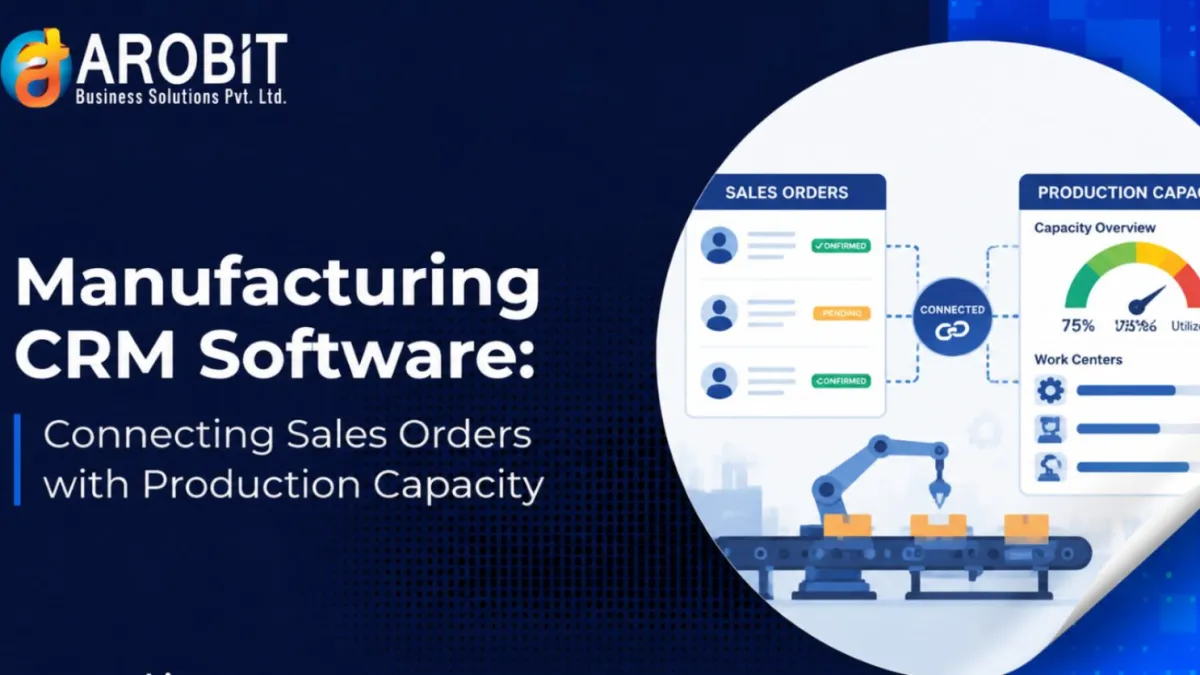
Manufacturers often face a common challenge: the sales team secures new orders without having complete visibility into production capacity, inventory availability, or shop floor constraints. While winning new business is essential, accepting orders that cannot be fulfilled on time can create operational disruptions, customer dissatisfaction, and revenue loss.
This is where Manufacturing CRM software plays a critical role. Unlike traditional CRM systems that focus primarily on customer relationships and sales pipelines, manufacturing-focused CRM solutions help connect sales operations with production planning, inventory management, procurement, and manufacturing workflows.
By linking customer demand directly to production capabilities, manufacturers can make more informed decisions, improve delivery performance, and maintain stronger control over operational resources.
Why Sales and Production Disconnects Create Problems
In many manufacturing organizations, sales and production teams operate using separate systems.
Sales representatives often manage customer inquiries, quotations, and orders through CRM platforms, while production teams rely on ERP systems, spreadsheets, or production planning software.
This separation creates several challenges:
Sales teams may commit to unrealistic delivery timelines.
Production planners may not receive timely order updates.
Inventory shortages can delay manufacturing schedules.
Resource utilization becomes difficult to manage.
Customer expectations may not align with actual production capacity.
As order volumes increase, these communication gaps become more costly and difficult to manage.
What Is Manufacturing CRM Software?
Manufacturing CRM software is designed specifically for manufacturing businesses that require closer coordination between customer management and operational planning.
In addition to managing leads, quotations, and customer communications, the system can integrate with:
Production planning systems
ERP platforms
Inventory management software
Procurement processes
Warehouse operations
Supply chain management systems
This integration creates a unified view of customer demand and production capabilities.
Instead of treating sales and manufacturing as separate functions, manufacturers gain a connected workflow that supports more accurate planning and execution.
How Manufacturing CRM Software Connects Sales Orders to Production Capacity
The primary advantage of Manufacturing CRM software is its ability to bridge the gap between customer demand and production resources.
When a new order is received, the CRM can automatically share information with production planning systems, enabling teams to evaluate capacity before making commitments.
Real-Time Capacity Visibility
Production managers can view:
Available machine capacity
Workforce availability
Existing production schedules
Inventory availability
Supplier lead times
This information helps determine whether an order can be completed within the requested timeline.
Instead of relying on assumptions, sales teams can provide customers with realistic delivery commitments.
Automated Order Validation
Some manufacturers accept orders only to discover later that production constraints prevent timely delivery.
Integrated CRM systems help prevent this issue by validating orders against current operational capacity.
Before confirming an order, the system can evaluate:
Material availability
Production workload
Resource constraints
Delivery schedules
This reduces the risk of overcommitting resources and improves customer satisfaction.
Traditional CRM vs Manufacturing CRM
Feature | Traditional CRM | Manufacturing CRM |
Customer Management | Yes | Yes |
Lead Tracking | Yes | Yes |
Production Capacity Visibility | Limited | Extensive |
Inventory Integration | Limited | Strong |
Production Planning Support | No | Yes |
Order Feasibility Analysis | No | Yes |
Manufacturing Workflow Alignment | Limited | High |
This distinction becomes increasingly important as manufacturers scale operations and manage larger order volumes.
Improving Forecast Accuracy and Production Planning
One challenge many manufacturers face is aligning future sales opportunities with production planning activities.
Without visibility into potential demand, production teams may struggle to allocate resources effectively.
Manufacturing CRM software helps address this issue by providing visibility into:
Sales pipelines
Quotation trends
Customer demand patterns
Expected order volumes
Seasonal buying behavior
Production planners can use this information to prepare capacity requirements before orders are finalized.
This proactive approach improves planning accuracy and reduces last-minute scheduling adjustments.
Reducing Production Bottlenecks
Production bottlenecks can significantly affect delivery performance and operational efficiency.
When sales teams lack visibility into production constraints, orders may accumulate faster than manufacturing resources can handle them.
Integrated CRM systems help identify bottlenecks early by highlighting:
Capacity limitations
Equipment utilization levels
Resource shortages
Inventory constraints
With better visibility, manufacturers can take corrective action before bottlenecks affect customer deliveries.
Enhancing Inventory and Procurement Coordination
Sales orders influence inventory requirements, procurement schedules, and production planning activities.
When these functions operate independently, businesses often experience:
Raw material shortages
Excess inventory
Delayed procurement
Production interruptions
By linking sales forecasts and confirmed orders with inventory systems, manufacturers can improve procurement planning and inventory control.
This enables organizations to maintain optimal stock levels while supporting production requirements.
Supporting Make-to-Order Manufacturing
Manufacturers operating under a make-to-order model often face unique planning challenges.
Each customer order may require:
Custom configurations
Specialized materials
Unique production schedules
Additional quality requirements
Manufacturing CRM software helps manage these complexities by ensuring that customer requirements flow directly into production workflows.
This reduces manual coordination efforts and improves project visibility across departments.
Improving Customer Experience
Delivery performance remains one of the most important factors influencing customer satisfaction in manufacturing.
Customers expect accurate timelines, consistent communication, and reliable order fulfillment.
When sales and production systems are connected, organizations can provide:
More accurate delivery commitments
Faster order updates
Better communication
Improved transparency
Higher service levels
This creates stronger customer relationships and supports long-term business growth.
Key Features to Look For
Organizations evaluating CRM solutions for manufacturing should prioritize features that support operational integration.
ERP Integration
CRM systems should integrate seamlessly with ERP platforms to ensure consistent data across departments.
Production Planning Connectivity
Direct connections between CRM and production planning systems improve decision-making and resource allocation.
Inventory Visibility
Real-time inventory insights help sales teams avoid committing inventory that is already allocated elsewhere.
Workflow Automation
Automated workflows reduce manual data entry and improve information accuracy.
Partnering with an experienced manufacturing software development company can help manufacturers build CRM solutions that align closely with their operational requirements and production workflows.
Business Benefits Beyond Sales Management
The value of CRM extends far beyond customer relationship management.
Organizations that successfully connect sales and manufacturing operations often achieve improvements in:
Production efficiency
Order fulfillment accuracy
Capacity utilization
Inventory management
Procurement planning
Customer satisfaction
These benefits contribute directly to stronger operational performance and improved profitability.
Implementing Manufacturing CRM Successfully
Technology alone does not guarantee success.
Manufacturers should focus on:
Clearly defined business objectives
Process standardization
Data accuracy
Cross-department collaboration
User adoption and training
Successful CRM initiatives require alignment between sales, operations, production, procurement, and leadership teams.
Working with a trusted manufacturing software development company can help ensure that CRM implementation supports both current operational requirements and future growth objectives.
Key Takeaways
Manufacturing CRM connects sales operations with production planning.
Real-time visibility improves delivery commitments and resource utilization.
Integrated systems reduce communication gaps between departments.
CRM-driven forecasting supports better production planning.
Manufacturers can improve customer satisfaction through more reliable order fulfillment.
Connected workflows help organizations scale operations more effectively.
Conclusion
As manufacturing operations become increasingly complex, organizations need greater visibility across sales, production, inventory, and procurement functions. Managing these activities in separate systems often leads to communication gaps, planning inefficiencies, and missed opportunities.
Manufacturing CRM software helps manufacturers bridge the gap between customer demand and production capacity by creating a connected environment where sales decisions are supported by real-time operational data. The result is improved planning accuracy, stronger delivery performance, better resource utilization, and enhanced customer satisfaction.
For manufacturers seeking to improve operational coordination and business visibility, investing in integrated CRM solutions can deliver significant long-term value. Companies like Arobit help manufacturers develop tailored software solutions that connect customer management, production planning, and business operations, enabling more informed decision-making and sustainable growth.
FAQs
1. What is Manufacturing CRM software?
Manufacturing CRM software is a customer relationship management solution designed specifically for manufacturing businesses. It connects sales activities with production planning, inventory management, procurement, and operational workflows.
2. How does Manufacturing CRM software improve production planning?
By providing visibility into sales pipelines, customer demand, inventory availability, and production capacity, Manufacturing CRM software helps manufacturers make more accurate production planning decisions.
3. Can Manufacturing CRM integrate with ERP systems?
Yes. Most modern manufacturing CRM solutions can integrate with ERP, inventory management, warehouse management, and production planning systems to provide a unified operational view.



Comments
No comments yet. Be the first to share your thoughts!