





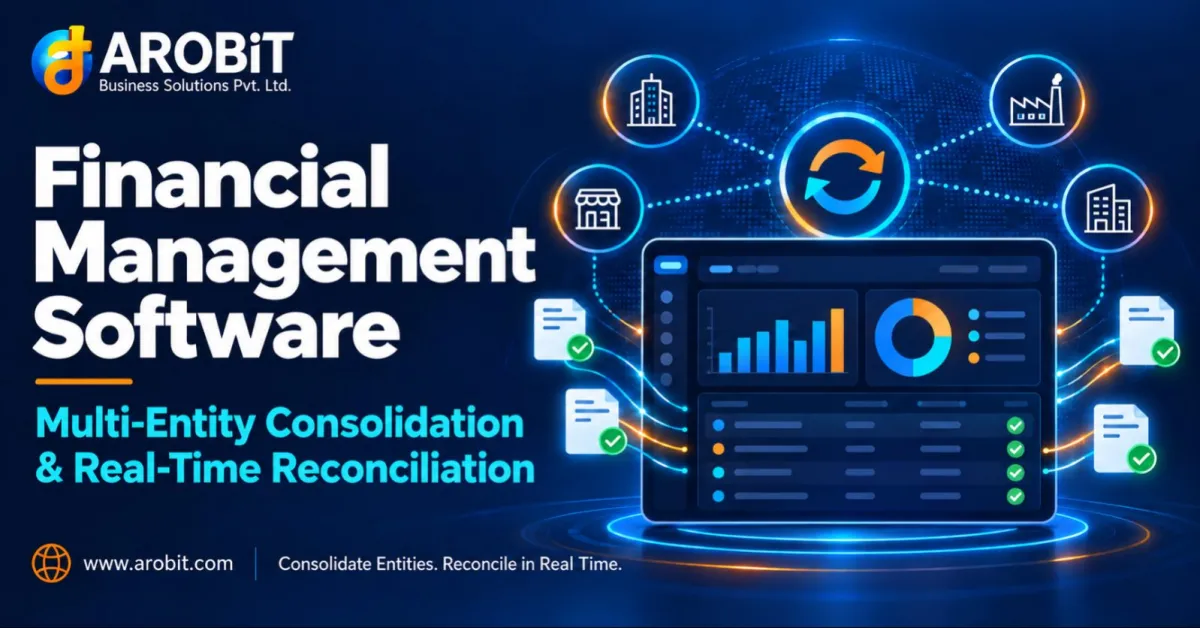
A finance team running five subsidiaries on five separate ledgers can spend two weeks every month just getting the numbers to agree. That delay still shapes how many growing businesses close their books, even though the tools to close in days instead of weeks have existed for years. Financial management software closes that gap by pulling every entity's accounts, eliminations, and currency conversions into one system instead of a dozen spreadsheets.
This guide explains the two mechanics that matter most once a business operates more than one entity. One is how consolidation actually combines separate books into one group result. The other is how real-time reconciliation replaces the end-of-month scramble to match transactions across accounts.
Why Multi-Entity Businesses Outgrow Spreadsheet-Based Finance
A single-entity business can run its books in a spreadsheet for years without much trouble. Add a second subsidiary, a second currency, or a second country, and the same spreadsheet starts breaking down. Someone has to manually pull each entity's trial balance, eliminate intercompany transactions by hand, and convert currencies before anyone sees a group number.
That manual process does not scale, and it does not get faster as the business grows. Each new entity adds another set of books to reconcile and another chance for a copy-paste error to distort the group result. Custom ERP Software Development solves this by building consolidation logic directly into the finance module instead of layering it on top of accounting software after the fact.
If you are still deciding which ERP modules your business needs beyond finance, our guide to types of ERP systems is a useful starting point. From there, you can narrow down to financial management specifically.
What Financial Management Software Actually Does
At its core, this kind of software centralizes the accounting functions a growing business needs: general ledger, accounts payable and receivable, budgeting, and financial reporting. For a multi-entity business, it adds two capabilities a single-entity accounting tool was never built for.
- Consolidated reporting across entities, currencies, and charts of accounts
- Automated intercompany elimination so group numbers are not double-counted
- Continuous transaction matching instead of a once-a-month reconciliation push
- Audit trails that show exactly how a group number was built, entity by entity
None of this works well as an add-on to a basic bookkeeping tool. Consolidation and reconciliation logic has to be built into how the system handles every transaction from the moment it is recorded, not bolted on afterward.
Multi-Entity Consolidation: Eliminations, Currency, and Group Reporting
Intercompany Eliminations
Consolidation combines the financial results of separate legal entities into one set of group statements. The hard part is not addition. It is removing intercompany transactions, such as one subsidiary invoicing another, so the group result does not count the same revenue or expense twice.
Currency Translation and Reporting Standards
Currency adds another layer. A group with subsidiaries in different countries has to translate each entity's results into one reporting currency. That means using consistent exchange rates, not whatever rate someone happened to look up that day.
Global accounting standards, including the IFRS 10 standard on consolidated financial statements, set out exactly when one entity must be included in another's group accounts. That is a judgment call software alone cannot make for you.
Where This Lives in Your ERP
This is where an ERP Financial Management Module earns its place. Intercompany reconciliation has to happen before consolidation, not after, or the elimination entries end up chasing numbers that have already changed. A module built around this kind of consolidation from the start handles this as a scheduled process, not a monthly fire drill.
| Factor | Spreadsheet-Based Process | Software-Driven Process |
|---|---|---|
| Intercompany eliminations | Manual, entity by entity | Automated and rule-based |
| Currency translation | Inconsistent rates, manual lookup | Consistent rates applied automatically |
| Typical close timeline | 1 to 2 weeks | A few days |
| Audit trail | Scattered across files and emails | Centralized, entity-level detail |
| Error risk from copy-paste | High | Low |
Real-Time Reconciliation Software: Replacing the Month-End Scramble
Traditional reconciliation happens once, usually at month-end, when someone compares the general ledger against bank statements, subledgers, and intercompany balances all at once. Real-time reconciliation works differently: it matches transactions continuously instead of waiting for a scheduled batch, flagging a mismatch within hours of it happening rather than weeks later.
Consider a multi-plant manufacturing group that used to spend the first two weeks of every month reconciling intercompany balances between its plants before finance could even start closing the books. After moving to continuous matching, most of that reconciliation work happens automatically through the month. The team now spends the close week reviewing exceptions instead of rebuilding the full picture from scratch.
"Automating processes to free employees to do higher-value work" is the most common finance talent priority CFOs named for the year ahead, cited by 49% of respondents. — Deloitte, Q4 2025 CFO Signals Survey
That priority reflects a real shift in where finance teams want to spend their time. A team that is not manually chasing intercompany reconciliation every month has more capacity for the analysis that actually informs business decisions.
Where AI Fits Into Financial Automation
Gartner's finance research has tracked rising interest in a touchless close, where routine reconciliation and consolidation need no manual step at all. Full touchless close is still rare, but the direction is clear.
Within an AI-Enhanced ERP setup, this usually starts with anomaly detection on reconciliation exceptions and predictive flags for transactions likely to need manual review. Together, these form a layer on top of solid financial consolidation software, not a replacement for getting the underlying consolidation and reconciliation logic right first.
Choosing the Right Financial System for a Multi-Entity Business
Not every accounting platform that claims multi-entity support actually handles consolidation and reconciliation the way a growing group needs. A few questions narrow the decision quickly.
- Does it automate intercompany eliminations, or just flag them for someone to fix manually?
- Does it support real-time reconciliation software workflows, or only a once-a-month batch process?
- Can it handle multiple currencies and charts of accounts without custom workarounds?
- Does it integrate with your existing ERP, CRM, and banking systems?
- Does it give auditors an entity-level trail without a separate manual reconstruction?
Generic accounting software can often track a single entity's books well enough. It rarely handles group-level consolidation or continuous reconciliation the way purpose-built financial consolidation software does. That is why businesses that outgrow spreadsheets usually need to replace the whole approach, not patch it.
Frequently Asked Questions
Q: What does consolidation mean for a business with multiple entities?
It means combining the financial results of separate legal entities, such as subsidiaries, into one set of group financial statements. The process removes intercompany transactions so revenue or expenses are not counted twice, and it applies consistent currency conversion when entities report in different currencies.
Q: How is real-time reconciliation different from traditional bank reconciliation?
Traditional reconciliation happens periodically, usually once a month, comparing records all at once. Real-time reconciliation matches transactions continuously as they occur, so mismatches get flagged within hours instead of surfacing weeks later during a month-end close.
Q: What features should financial management software include for a multi-entity business?
At minimum, automated intercompany eliminations, multi-currency consolidation, continuous transaction matching, and an entity-level audit trail. It should also integrate with the ERP, CRM, and banking systems the business already relies on rather than operating as a disconnected add-on.
Ready to Simplify Consolidation and Reconciliation?
Arobit Business Solutions structures enterprise ERP and financial systems engagements with written delivery plans, phased rollouts, and dedicated support, backed by 13+ years of experience across manufacturing, logistics, and professional services industries.
Request an ERP consultation to review your current consolidation and reconciliation workflows. Discuss your project with Arobit's team.






Comments
No comments yet. Be the first to share your thoughts!