





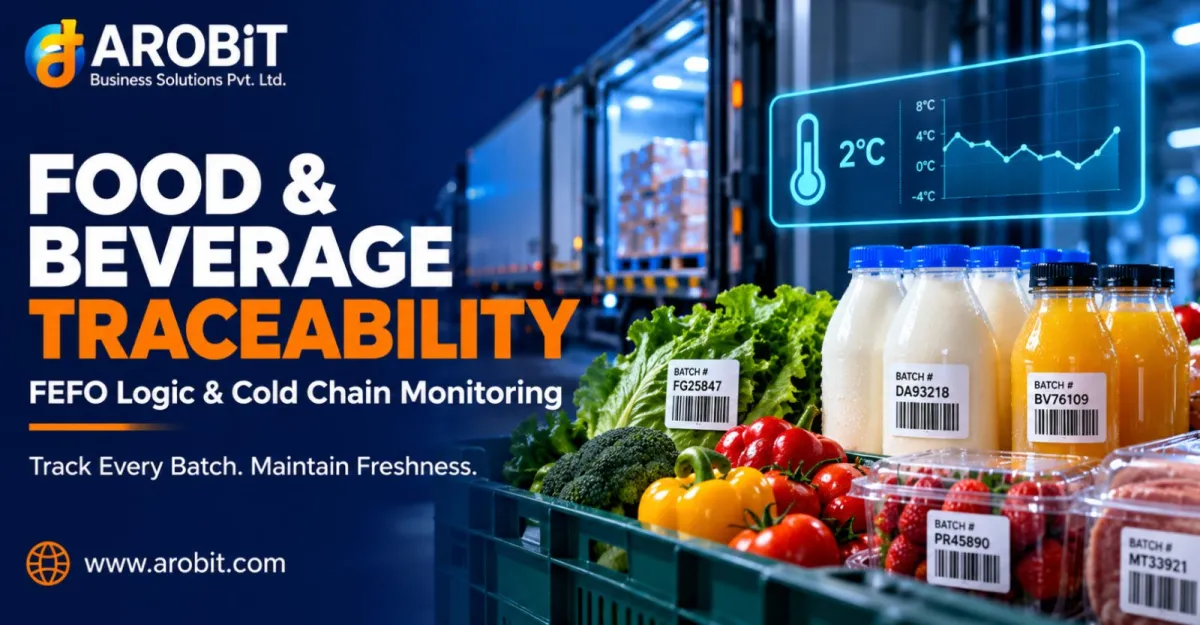
A single mislabeled pallet can force a food distributor to pull stock from every warehouse it touched, not just the one where the error happened. In 2026, that kind of recall still runs on spreadsheets and phone calls at many food and beverage businesses, even though the software to prevent it has existed for years. Food and beverage traceability software closes that gap by tracking every batch, lot, and temperature reading from intake to delivery.
This guide explains how two of the hardest parts of that system work: FEFO picking logic and cold chain monitoring. Both decide whether your stock reaches customers safely, and whether a recall takes minutes or days to contain.
Why Food and Beverage Companies Need Traceability Software in 2026
Shelf life changes everything about how food and beverage businesses run inventory. A pallet of dairy products cannot sit in a queue the way a pallet of hardware can. Food traceability software exists because manual tracking cannot keep pace with expiry dates, temperature limits, and lot-level audits happening across multiple warehouses at once.
Regulators have raised the bar further. The United States' FDA Food Traceability Rule requires faster, more granular recordkeeping for high-risk foods, and comparable rules are tightening across the European Union and other major markets. Businesses that still rely on paper logs or disconnected spreadsheets are the ones most exposed when a regulator or a customer asks for proof.
Good Food and Beverage Software brings planning, inventory, and compliance into one system, so a recall or audit draws on real records instead of a frantic search through email threads.
What Food and Beverage Traceability Software Actually Does
At its core, this kind of system records four things: what a batch contains, where it has been, what condition it was kept in, and who handled it. Done well, this turns a multi-day recall investigation into a query that returns results in minutes.
- Batch and lot capture at receiving, with supplier and raw-material linkage
- Expiry and shelf-life tracking tied to each lot, not just each SKU
- Temperature and humidity logs for cold-chain-sensitive products
- A full movement history from intake through dispatch, searchable by batch, order, or customer
None of this works as a bolt-on report. It has to be built into how stock physically moves through receiving, storage, picking, and dispatch. That is why traceability is usually a module inside a warehouse or ERP system rather than a standalone tool.
FEFO Logic: How Expiry-Driven Picking Works
FEFO, or first-expired-first-out, picks stock by expiry date rather than by arrival date. A later-arriving batch with a shorter remaining shelf life gets picked before an earlier batch that still has months left. This is different from FIFO, which simply picks whatever arrived first, regardless of how long it has left before expiry.
For most food categories, FEFO matters more than FIFO. Dairy, fresh meat, and prepared foods carry real spoilage risk if picking follows arrival order instead of expiry order. Software enforces this rule automatically at the pick face, so a warehouse worker scanning a bin is guided to the correct lot without needing to check dates by hand.
This kind of execution logic belongs inside Warehouse Management Software Development. Expiry-based picking only works when it is built into the actual picking and putaway workflow, not layered on top of it afterward. A warehouse that tries to enforce it through manual checklists alone will lose the rule under pressure, the first time a shift gets busy.
| Factor | FIFO | FEFO |
|---|---|---|
| Pick order driven by | Arrival date | Expiry date |
| Best suited to | Non-perishable goods | Dairy, fresh meat, prepared foods |
| Spoilage risk if misapplied | Low | High |
| Requires per-lot expiry data | No | Yes |
| Manual enforcement reliability | Moderate | Low under peak-shift pressure |
Cold Chain Monitoring Software: Temperature, Humidity, and Compliance
Cold chain monitoring tracks temperature and humidity continuously across storage, transport, and delivery, and flags any point where a product leaves its safe range. For temperature-sensitive goods, a few hours outside that range can spoil an entire shipment even if the product looks fine on arrival.
Consider a mid-sized dairy and beverage distributor running cold storage across three regional warehouses. Before adopting this kind of monitoring, a single refrigeration fault overnight could go unnoticed until a morning inspection, by which point an entire day's stock was already compromised. With continuous sensor logging and automated alerts, the same fault now triggers a notification within minutes, while there is still time to move stock or adjust routing.
"Fully refrigerated supply chains could prevent nearly half of the 1.3 billion tons of food wasted globally each year." — University of Michigan, National Science Foundation, and Carrier Global Corporation, published in Environmental Research Letters, 2024
That scale of loss is why cold chain visibility has become a documented research priority, not just a compliance checkbox. Businesses that can show a continuous temperature record, rather than a spot check twice a day, are the ones best placed to catch a failure before it becomes a write-off.
Batch and Lot Traceability Across the Supply Chain
Traceability inside one warehouse is not enough on its own. A recall usually needs to trace a batch backward to its raw material supplier and forward to every customer who received it, across every warehouse the batch passed through. That kind of tracking has to work at the supply chain level, not just the warehouse level.
This is where Custom Supply Chain Software Development Company work matters: a platform that links supplier records, multi-warehouse movement, and outbound shipments under one batch identifier. Without that link, a recall investigation has to manually cross-reference separate systems for procurement, warehousing, and distribution, which is exactly the kind of delay that turns a contained issue into a wider one.
Regulatory frameworks increasingly expect this level of batch and lot traceability as standard. Beyond the United States' FDA rule, the European Union enforces its own traceability requirements for food businesses, and most export markets now ask for comparable documentation before accepting a shipment. A system built around batch-level data from the start handles these requests as a report, not a project.
Choosing the Right Traceability System for Your Operations
Not every food traceability software platform covers the same ground, and the right fit depends on what your operation actually handles day to day. A few questions narrow the decision quickly.
- Does it enforce FEFO at the pick face, or only report on expiry dates after the fact?
- Does it log temperature continuously, or rely on manual spot checks entered later?
- Can it trace a batch backward to its supplier and forward to every customer in one query?
- Does it integrate with your existing ERP, warehouse, and transportation systems, or require re-entering the same data twice?
- Does it support the specific compliance documentation your markets require, such as batch-level export records?
Generic inventory software can track stock quantities well enough, but it rarely enforces expiry-based picking or captures full temperature history the way a purpose-built system does. Businesses that try to retrofit these rules onto a generic system usually end up maintaining a parallel manual process anyway, which defeats the purpose of having software at all.
Frequently Asked Questions
Q: What is the difference between FEFO and FIFO in food inventory?
FIFO picks stock in the order it arrived, while FEFO picks stock in the order it expires. For most perishable food categories, this expiry-first approach is the safer default, since a later-arriving batch can still have a shorter remaining shelf life than one already in storage.
Q: How does cold chain monitoring software work?
It connects temperature and humidity sensors in storage and transport to a central system that logs readings continuously and alerts staff when conditions move outside a safe range. This replaces manual spot checks with a complete, auditable record for every shipment.
Q: What features should food and beverage traceability software include?
At minimum, batch and lot capture, FEFO-driven picking, continuous temperature logging, and end-to-end movement history from supplier to customer. It should also integrate with your existing ERP, warehouse, and supply chain systems rather than operating as a disconnected add-on.
Ready to Strengthen Your Traceability Program?
Arobit Business Solutions structures enterprise ERP and traceability engagements with written delivery plans, phased rollouts, and dedicated support, backed by 13+ years of experience across manufacturing, healthcare, and food and beverage industries.
Request an ERP consultation to review your current batch tracking and cold chain requirements. Discuss your project with Arobit's team.






Comments
No comments yet. Be the first to share your thoughts!