





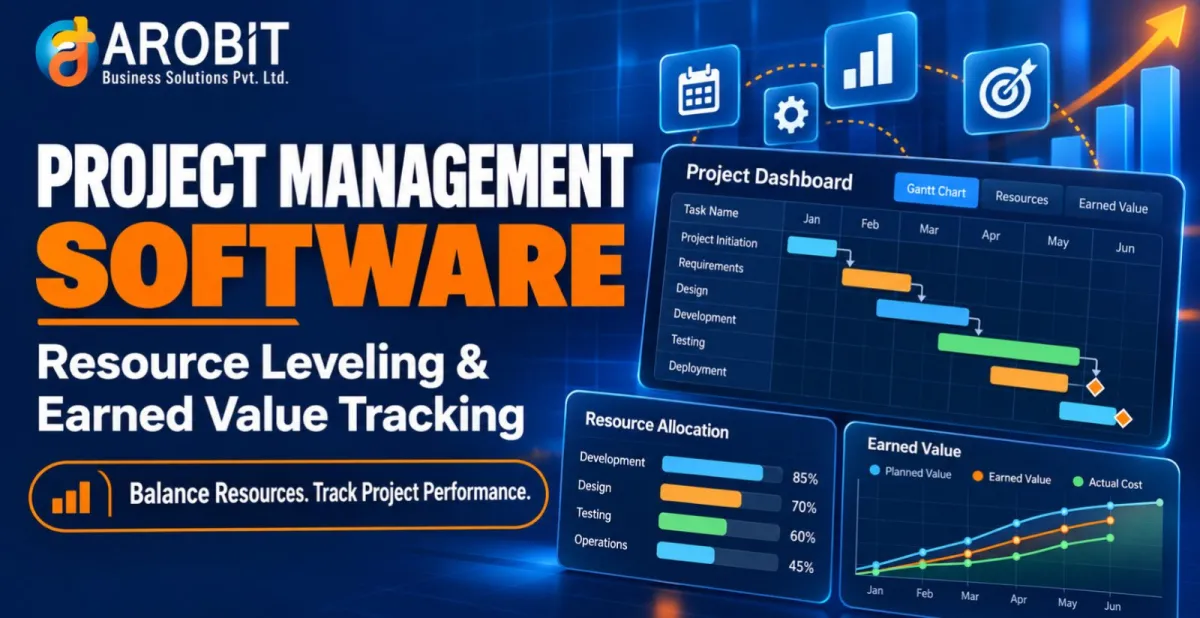
Throwing more people at a late project is supposed to bring it back on track. More often it does the opposite, because the real constraint is rarely raw headcount. It is how work is sequenced against the people and the time actually available. Project Management Software addresses that constraint directly, and it does far more than host a shared task list.
This guide explains two of the mechanisms that separate an enterprise-grade tool from a glorified checklist. The first decides who works on what and when without overloading anyone. The other is earned value tracking, which tells you whether a project is genuinely on budget for the progress made, not just on schedule.
Why Spreadsheets and Task Boards Stop Working at Scale
A single project with one team can run on a task board and a weekly check-in. Run ten projects that share the same pool of people, and that approach starts hiding the problems that matter. Nobody can see that one specialist is booked at 150% across three projects until a deadline is already missed.
The gap is visibility across projects, not within one. Custom ERP Software Development solves this when project data needs to sit alongside finance, resourcing, and delivery in one system, so a staffing conflict or a cost overrun surfaces while there is still time to act on it.
If you are deciding how project delivery should fit with the rest of your operations, our guide to types of ERP systems is a useful starting point. From there, you can judge whether a standalone tool or an integrated module fits your structure.
Only 36% of organisations say they mostly or always complete projects on time. — Wellingtone, State of Project Management 2026
That number has barely moved in a decade, and the cause is rarely a lack of effort. It is a lack of reliable signal: teams find out a project is off track too late to change the outcome.
What Project Management Software Actually Does
At its core, the system is the single record for how work gets planned, staffed, tracked, and paid for. For an organization running many projects at once, it brings together four things that spreadsheets keep apart.
- A live view of who is allocated where, across every active project
- Scheduling that reflects real capacity, not just ideal timelines
- Cost and progress measured together, so budget status is never a guess
- One source of truth that delivery, finance, and clients can all draw from
Good project scheduling software does not just draw a Gantt chart. It connects the schedule to the people and the budget behind it, so a change in one place updates the others instead of quietly going stale.
Resource Leveling: Matching Work to Real Capacity
The Problem It Solves
The technique adjusts a schedule so that no person or team is assigned more work than they can actually do in a given period. Without it, a plan can look perfect on paper while quietly assuming three people will each work sixty-hour weeks for a month straight.
How It Works in Practice
Consider a 40-person engineering services firm running a dozen client projects at once. Before adopting capacity-aware scheduling, two project managers would each book the same senior engineer for the same week, and nobody noticed until the engineer flagged it. Resource management software prevents that by showing every commitment against each person's real availability before the assignment is confirmed.
Done well, this turns resourcing from a monthly firefight into a continuous view. The schedule shifts automatically when capacity changes, rather than waiting for someone to rebuild the plan by hand.
Earned Value Management: Measuring Progress in Money, Not Just Time
Most teams can tell you whether a project is on schedule. Far fewer can tell you whether it is on budget for the work actually completed, which is a different and more useful question. It answers this by comparing three numbers: what was planned, what has been delivered, and what it has cost.
The approach is formalized in the PMI standard for earned value management, and the core of it fits in a short table.
| Metric | The question it answers |
|---|---|
| Planned Value (PV) | What should be finished by now? |
| Earned Value (EV) | What has actually been completed, in budget terms? |
| Actual Cost (AC) | What has it cost so far? |
| Schedule Performance Index | Are we ahead of or behind schedule? |
| Cost Performance Index | Are we over or under budget for the work done? |
The value of this approach is that it catches trouble early. A project can look on time while quietly burning budget faster than it delivers. These metrics expose that gap months before a simple schedule view would.
Project Management Inside a Wider ERP
Businesses that already run finance and operations on one platform often want project delivery in the same place. An ERP Project Management Module fits that case, because project costs, timesheets, and billing then share a system with the general ledger rather than syncing across tools.
The payoff is that earned value and resourcing draw on live financial data, not a monthly export. The deciding factor is usually whether project accounting needs to tie directly into company finance, or can stand on its own.
Where AI Fits in Project Delivery
Within an AI-Enhanced ERP setup, the first useful applications are predictive rather than flashy. The system flags projects whose cost and schedule indices are trending toward overrun, and suggests where a resource conflict is likely before it lands. These are a layer on top of solid scheduling and cost tracking, not a replacement for getting those fundamentals right first.
Choosing the Right Project Management System
Not every tool that markets itself to project teams handles capacity and cost at the depth a multi-project business needs. A few questions narrow the decision quickly.
- Does it level resources against real availability, or just let you assign work freely?
- Does it track cost against progress, or only mark tasks complete?
- Does the project scheduling software reflect capacity changes automatically, or need a manual rebuild?
- Can the resource management software show allocation across every project at once, not one at a time?
- Does it integrate with your finance and delivery systems, or stand alone?
Generic task tools handle a single team well enough. They rarely level resources across a portfolio or measure earned progress in budget terms. That is why organizations that outgrow them usually need a purpose-built system rather than another workaround.
Frequently Asked Questions
Q: What does Project Management Software do that a task board does not?
A task board shows what needs doing and who owns it. The software adds capacity-aware scheduling and cost-versus-progress tracking across many projects at once. That lets you see staffing conflicts and budget overruns early, rather than after they have already happened.
Q: How is earned value different from simply tracking percent complete?
Percent complete tells you how much work is done. Earned value expresses that progress in budget terms and compares it against both the plan and the actual cost. A project that is behind on value for the money spent shows up clearly, instead of hiding behind an optimistic completion figure.
Q: Can project delivery live inside an ERP, or does it need a separate tool?
Both work. An ERP module fits when project costs and billing need to tie directly into company finance. A standalone tool fits when project delivery can operate on its own. The right answer depends on how closely project accounting and company finance need to connect.
Ready to Bring Your Projects Under Control?
Arobit Business Solutions structures enterprise ERP and project delivery engagements with written delivery plans, phased rollouts, and dedicated support. That track record spans 13+ years across manufacturing, logistics, retail, and professional services industries.
Schedule a consultation to review your resourcing and project-cost workflows. Discuss Your Project Requirements with Arobit's team.




Comments
No comments yet. Be the first to share your thoughts!