





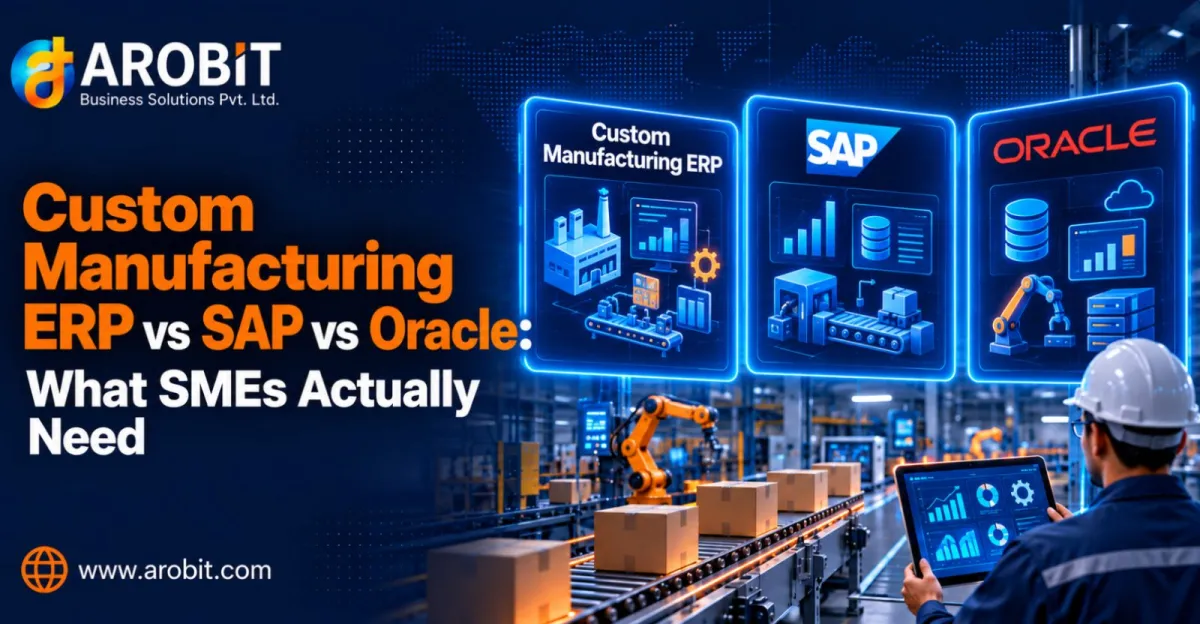
An SME manufacturer evaluating ERP options in 2026 usually starts by requesting demos from SAP and Oracle. Both names carry weight, and both can genuinely run a factory. The Custom Manufacturing ERP vs SAP vs Oracle decision, though, is rarely about which brand is more capable.
It is about which system matches how your specific shop floor actually operates. The wrong fit forces your team to work around software built for a different scale of business. This guide breaks down what each path offers, where packaged platforms strain for SMEs, and how to decide which one fits your manufacturing operation.
What SAP and Oracle actually offer manufacturers
SAP and Oracle NetSuite both bring mature financial modules, established compliance frameworks, and a large ecosystem of certified partners and integrations. For manufacturers with standard production processes, this maturity reduces risk. The core workflows have already been built, tested, and refined across thousands of implementations.
The custom ERP vs SAP question usually comes down to fit rather than capability. SAP was not designed around any single manufacturer's process. Most SME buyers configure a subset of its features and work within its assumptions about how production, inventory, and finance connect.
"The global cloud ERP market is projected to grow from $87.73 billion in 2024 to $172.74 billion by 2029, at a CAGR of 14.5%."
MarketsAndMarkets, Cloud ERP Market Report, 2025
That growth reflects real demand for cloud ERP in general. It does not mean any single packaged platform fits every manufacturer's process on day one.
Where packaged platforms strain for SME manufacturers
Packaged ERP systems are built for the widest possible customer base. That design choice creates friction for manufacturers with specific production methods, batch structures, or shop floor reporting needs.
- Rigid workflow assumptions: production steps that do not match the platform's default sequence often require expensive customization or manual workarounds.
- Per-user and per-module licensing: costs climb quickly once a manufacturer needs modules beyond core finance and inventory.
- Consultant dependency: even small configuration changes often require certified implementation partners, adding cost and delay.
- Slow change cycles: platform updates and change requests move on the vendor's release schedule, not the manufacturer's.
"More than a quarter of organizations exceeded their ERP project budgets, often after discovering fatal misfits between the software and their processes late in the project."
Panorama Consulting, 2026 ERP Report
Those misfits are exactly what push some SME manufacturers toward scope expansion, added tools, or a custom build once the packaged system is already live.
What a custom manufacturing ERP is built to do differently
A custom manufacturing ERP starts from your actual production process, not a generic template you adapt to. It reflects your bill of materials structure, your machine-specific reporting needs, and your existing quality and compliance checkpoints.
- Process-first design: workflows match your production line instead of forcing your line to match the software.
- No per-module licensing lock-in: you own the system outright, with no recurring per-user fees tied to feature access.
- Direct control over changes: new requirements go into a development backlog you control, not a vendor's product roadmap.
- Built-in integrations: connections to existing machines, sensors, or legacy systems are designed in from the start.
The custom ERP vs Oracle comparison plays out similarly. NetSuite offers strong cloud infrastructure and financial reporting. A manufacturer with unusual batch tracking or multi-unit conversion needs still has to configure around NetSuite's data model. That data model is not built around the manufacturer's own process.
Custom Manufacturing ERP vs SAP vs Oracle: the core trade-offs
Each path optimizes for a different priority. The table below summarizes where they typically land.
| Factor | SAP | Oracle NetSuite | Custom manufacturing ERP |
|---|---|---|---|
| Fit to unique processes | Configured, not built-in | Configured, not built-in | Built around your process |
| Licensing model | Per-user, per-module | Per-user, tiered | One-time build, no per-user fees |
| Time to first value | 3 to 9 months | 4 to 9 months | 3 to 6 months, scoped to your needs |
| Change control | Vendor release cycle | Vendor release cycle | Owned by your business |
| Best fit | Complex global compliance needs | Cloud-first, finance-heavy operations | Distinct production processes at SME scale |
How to decide which path fits your business
The right choice depends on how closely your operations already resemble a standard manufacturing template. It also depends on how much that template is likely to change as you grow.
Signs that a packaged platform like SAP or Oracle fits well:
- Your production process is close to standard discrete or process manufacturing, with no unusual batch or conversion logic.
- You operate across multiple countries and need built-in support for varied tax and compliance regimes.
- Your team has budget for ongoing consultant support and periodic platform upgrades.
Signs that a custom manufacturing ERP fits better:
- Your production process includes steps, unit conversions, or quality checks that packaged systems handle only through workarounds.
- Licensing costs are growing faster than your headcount, because each new function needs another paid module.
- You have already customized a packaged system heavily and are paying consultants for changes that feel like they should be simple.
A mid-sized precision components manufacturer illustrates this well. It ran SAP Business One for three years, but its multi-stage machining process required three separate workarounds that consultants rebuilt after every major update. Each fix cost more than the original implementation had budgeted for that module.
The company eventually moved core production tracking to a custom-built system while keeping SAP for finance. Its consultant costs dropped by more than half within the first year. Production reporting error rates fell too, once the new system finally matched how the shop floor actually worked.
Cost and timeline reality check
Packaged platforms typically cost less upfront but accumulate costs over time through per-user licensing and consultant hours. A mid-sized manufacturer can expect SAP Business One implementations in the range of $50,000 to $250,000. Oracle NetSuite implementations typically run $100,000 to $500,000, depending on scope and the number of integrations involved.
The custom ERP vs SAP cost comparison shifts further from there. Add five years of per-user licensing fees on top of that initial SAP figure, and the gap narrows quickly.
Custom builds cost more upfront but avoid recurring per-user licensing entirely. Working with an experienced ERP software development company also means the build is scoped to your actual process from day one. It is not adjusted later, after a packaged system reveals its gaps.
- Packaged platform: lower upfront cost, ongoing per-user and consultant fees, 3 to 9 months to go live.
- Custom build: higher upfront cost, no recurring licensing, 3 to 6 months to go live once scope is fixed.
Choosing the right implementation approach
A capable manufacturing software development company should be able to walk through your actual shop floor process before proposing a system. That conversation should happen before a contract is signed, not after. Ask any shortlisted partner how they would handle your specific production steps, not just their standard feature list.
For a closer look at vendor options on each side of this decision, see Top 10 Best Custom ERP Solutions Providers in India. A related guide covers Top 10 Custom Manufacturing ERP Software Development Companies in India.
If you are still early in scoping the project, Arobit's guide to the ERP implementation lifecycle lays out the stages worth planning for. This applies regardless of which path you choose. For the custom ERP vs Oracle question specifically, a detailed cost comparison of SAP Business One and Oracle NetSuite is worth reading. It is useful if a packaged platform is still on your shortlist.
Frequently asked questions
Q: Custom Manufacturing ERP vs SAP vs Oracle: which one is cheapest?
Packaged platforms like SAP and Oracle NetSuite usually cost less upfront, starting around $50,000 for smaller SAP Business One deployments. Custom builds cost more initially but avoid recurring per-user licensing. The total cost often evens out, or favors custom, over a three to five year period.
Q: Can an SME manufacturer switch from SAP or Oracle to a custom ERP later?
Yes. Many manufacturers keep SAP or NetSuite for finance while moving production-specific tracking to a custom system, then migrate further modules over time. Data migration and integration planning are the main technical considerations.
Q: How long does it take to implement a custom manufacturing ERP?
A scoped custom build typically takes 3 to 6 months, similar to or faster than a packaged SAP or Oracle NetSuite implementation. Timelines depend on the number of production processes, integrations, and legacy systems involved.
Arobit Business Solutions builds custom manufacturing ERP systems around a company's actual production process, rather than adjusting that process to fit a packaged platform. Its work spans production planning, inventory, quality management, and integration with existing machines and systems.
Request an ERP consultation to evaluate whether a packaged platform or a custom build fits your manufacturing process.

Comments
No comments yet. Be the first to share your thoughts!