




Manufacturing MSMEs are under increasing pressure to improve efficiency, control costs, manage inventory accurately, and make faster business decisions. While many businesses still rely on Tally for accounting and financial management, operational complexity often grows beyond what standalone accounting software can handle.
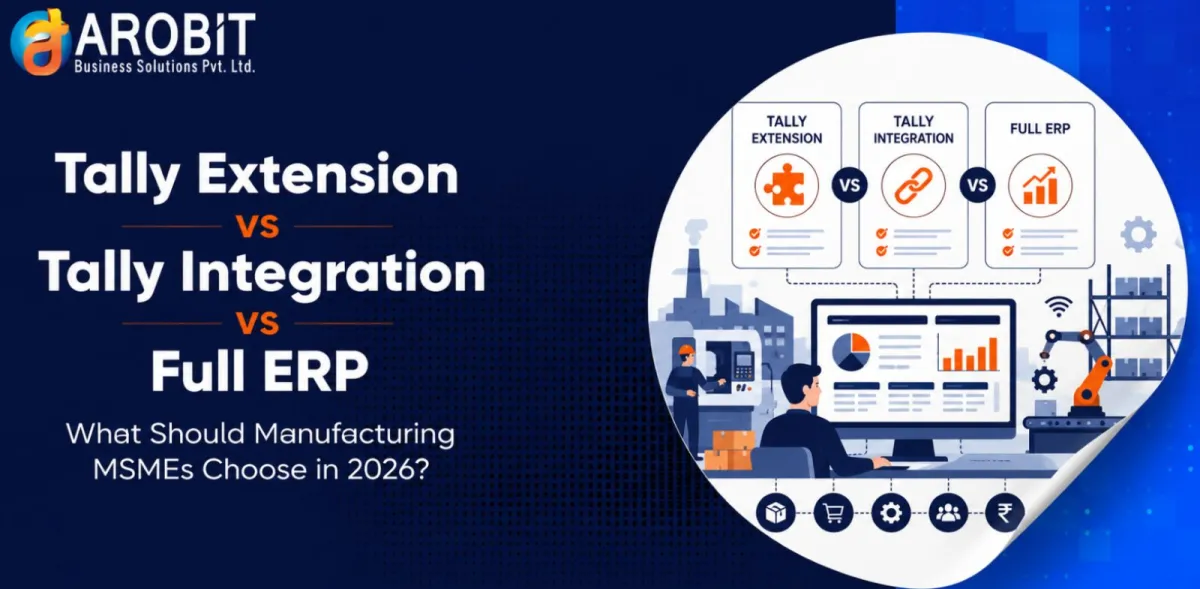
As manufacturers evaluate their technology investments in 2026, a common question arises: Tally Extension vs Tally Integration vs Full ERP—which option delivers the right balance of functionality, scalability, and cost?
The answer depends on your current business processes, growth plans, and operational challenges. Understanding the differences between these approaches can help manufacturing businesses make a more informed decision.
Why Manufacturing MSMEs Are Looking Beyond Basic Accounting
Tally remains a popular solution for bookkeeping, taxation, and financial reporting. However, manufacturing businesses often require additional capabilities such as:
Production planning
Inventory tracking
Purchase management
Quality control
Batch tracking
Warehouse management
Vendor coordination
Real-time operational reporting
When these functions are managed through spreadsheets, manual processes, or disconnected systems, businesses often experience:
Inventory discrepancies
Delayed decision-making
Data duplication
Production bottlenecks
Limited operational visibility
This is where manufacturers begin evaluating Tally extensions, integrations, and ERP solutions.
Understanding Tally Extensions
A Tally extension is a customization developed within the Tally environment to add specific functionality beyond the software's standard features.
Examples include:
Customized reports
Industry-specific forms
Additional approval workflows
Production-related data entry screens
Specialized inventory tracking modules
Advantages of Tally Extensions
Lower implementation cost
Faster deployment
Familiar user interface
Minimal training requirements
Limitations of Tally Extensions
While extensions can address specific gaps, they are typically designed to solve individual problems rather than provide end-to-end operational management.
Common limitations include:
Restricted scalability
Limited process automation
Challenges with complex manufacturing workflows
Difficulty managing multiple departments through a unified system
For small manufacturers with simple requirements, extensions may provide a practical short-term solution.
What Is Tally Integration?
Tally integration involves connecting Tally with other software applications used across the business.
For example, manufacturers may integrate Tally with:
Inventory management systems
Warehouse management solutions
Procurement systems
Business intelligence dashboards
The goal is to enable data sharing between systems while allowing Tally to continue handling accounting functions.
Benefits of Tally Integration
Reduced manual data entry
Better information flow
Improved reporting accuracy
Greater flexibility in selecting specialized software
Challenges of Tally Integration
Integration can improve efficiency, but it may also introduce complexity.
Potential challenges include:
Multiple software subscriptions
Data synchronization issues
Integration maintenance costs
Dependency on third-party connectors
Fragmented user experience
Businesses often discover that as operations grow, managing several connected applications becomes increasingly difficult.
What Is a Full ERP System?
A full ERP (Enterprise Resource Planning) system brings multiple business functions together within a single platform.
Instead of maintaining separate systems for inventory, procurement, production, finance, and reporting, all departments work within a unified environment.
A manufacturing ERP commonly includes:
Production management
Inventory control
Procurement management
Warehouse operations
Sales and distribution
Quality assurance
Finance and accounting
Business analytics
Data flows automatically across departments, creating a single source of truth for decision-makers.
Comparing Tally Extension vs Tally Integration vs Full ERP
When evaluating Tally Extension vs Tally Integration vs Full ERP, manufacturing MSMEs should consider both current requirements and future growth.
Factor | Tally Extension | Tally Integration | Full ERP |
Initial Cost | Low | Medium | Higher |
Deployment Time | Fast | Moderate | Moderate to Long |
Scalability | Limited | Moderate | High |
Process Automation | Limited | Moderate | Extensive |
Department Integration | Low | Moderate | High |
Real-Time Visibility | Limited | Moderate | Comprehensive |
Manufacturing Management | Basic | Moderate | Advanced |
Long-Term Growth Support | Limited | Moderate | Strong |
The right choice depends on the maturity of business operations and strategic objectives.
When Should MSMEs Choose a Tally Extension?
A Tally extension may be appropriate when:
The business has fewer operational complexities.
Accounting remains the primary requirement.
Existing workflows are relatively simple.
Budget constraints are significant.
Only a few additional features are required.
For example, a small manufacturing unit with straightforward inventory and production processes may benefit from targeted customizations without investing in larger systems.
When Does Tally Integration Make Sense?
Tally integration becomes valuable when businesses need specialized applications while retaining Tally as their financial backbone.
Suitable scenarios include:
Separate inventory systems are already in place.
Production software is being used successfully.
Business units require specialized tools.
The organization wants gradual digital adoption.
This approach can work effectively during transitional growth phases.
However, leadership should carefully evaluate long-term maintenance requirements and integration dependencies.
When Is a Full ERP the Better Choice?
Many growing manufacturers eventually reach a point where multiple disconnected systems create more problems than they solve.
A full ERP solution often becomes the preferred option when businesses need:
End-to-end operational visibility
Multi-location inventory management
Production planning and scheduling
Batch and lot traceability
Quality management processes
Procurement automation
Real-time reporting
Manufacturers operating in regulated industries such as pharmaceuticals, chemicals, food processing, and textiles often benefit significantly from ERP adoption.
A well-designed ERP can eliminate redundant data entry, improve process consistency, and support better decision-making across departments.
Key Questions Manufacturing MSMEs Should Ask in 2026
Before choosing between Tally Extension vs Tally Integration vs Full ERP, decision-makers should evaluate several important questions:
How Complex Are Current Operations?
If multiple departments rely on spreadsheets and manual coordination, a more integrated solution may be necessary.
What Is the Expected Growth Over the Next Five Years?
Technology investments should support future expansion rather than only current requirements.
How Much Process Automation Is Needed?
Businesses aiming to reduce manual intervention should assess automation capabilities carefully.
Is Real-Time Visibility Important?
Access to accurate operational data can significantly improve production planning and inventory management.
Are Existing Systems Creating Data Silos?
Disconnected information often results in delays, errors, and inefficient decision-making.
The Growing Role of Custom Manufacturing Software
Not every manufacturer fits into a standard software model.
Many MSMEs have unique workflows, approval processes, production methods, and reporting requirements. As a result, businesses increasingly explore custom manufacturing software development to align technology with operational realities.
A tailored solution can address specific manufacturing challenges while supporting future growth initiatives.
Organizations that require specialized production workflows, advanced inventory management, or industry-specific compliance features often find that custom manufacturing software development provides greater flexibility than generic software packages.
Conclusion
The debate around Tally Extension vs Tally Integration vs Full ERP does not have a one-size-fits-all answer.
Tally extensions may work well for businesses with limited operational complexity. Tally integrations can support organizations seeking gradual digital transformation while preserving existing investments. Full ERP systems offer the most comprehensive approach for manufacturers looking to streamline operations, improve visibility, and support long-term growth.
The most effective choice depends on your business goals, operational challenges, and future plans. Manufacturing MSMEs should evaluate not only their current requirements but also how their technology investments will support future growth. Whether the need is a Tally extension, system integration, or a full ERP platform, choosing the right solution can improve operational visibility, streamline workflows, and reduce manual effort. With more than 13 years of experience in enterprise software, manufacturing ERP, workflow automation, and digital transformation, Arobit helps manufacturers build technology solutions that align with their operational goals and long-term business strategy.
Frequently Asked Questions
1. What is the main difference between Tally Extension and Tally Integration?
A Tally Extension adds functionality within the Tally environment, while Tally Integration connects Tally with external software applications to share data and automate workflows.
2. Is a Full ERP expensive for manufacturing MSMEs?
The investment is generally higher than extensions or integrations, but ERP systems often deliver broader operational benefits through automation, visibility, and process optimization.
3. Can manufacturers continue using Tally after implementing an ERP?
Yes. Some businesses integrate Tally with operational systems, while others migrate financial processes into ERP platforms depending on their requirements and technology strategy.






Comments
No comments yet. Be the first to share your thoughts!