





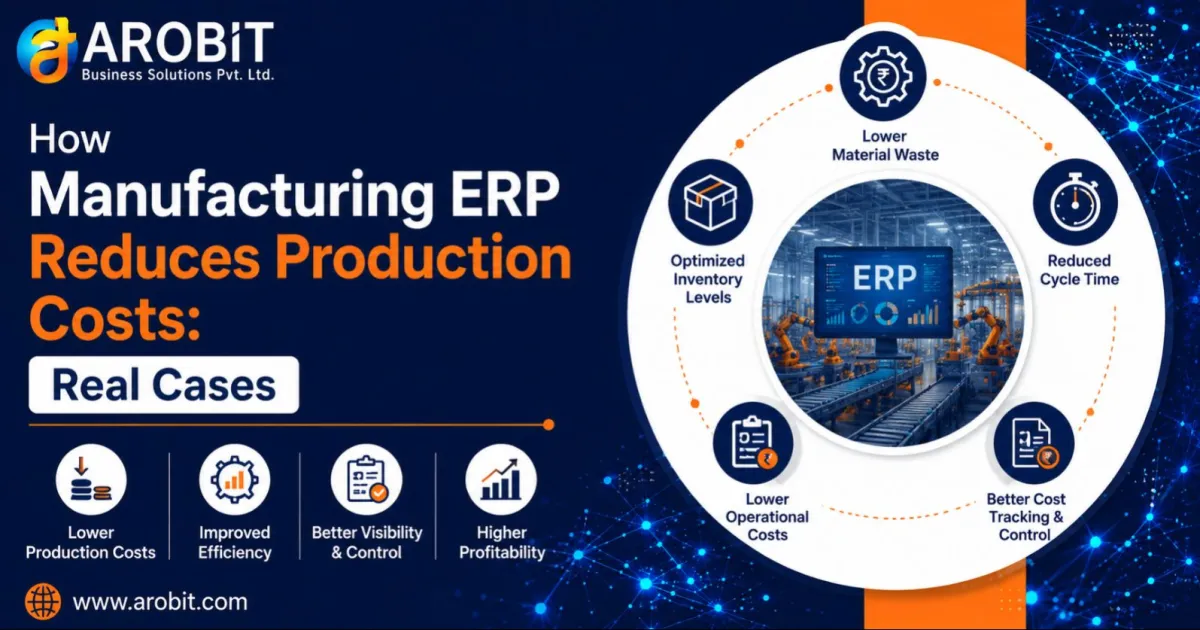
Ask a manufacturer where their production costs go and you will get a confident answer. Ask them to prove it with numbers from last month, and the confidence usually fades.
That gap is the problem. Costs leak in places nobody measures. Scrap gets written off as normal. Inventory sits idle in a corner. A machine runs below its rated output. Hours of manual data entry never count as production cost. None of it appears on a single line in the accounts. All of it comes out of the margin.
A Manufacturing ERP closes that gap by measuring what was previously estimated. This guide shows exactly where the savings come from, with real numbers from real implementations, and what determines whether you actually see them.
Where Production Costs Actually Leak
Production cost is not one number. It is four separate leaks, and a Manufacturing ERP addresses each differently.
- Material waste and rework: Defective output consumes raw material, machine time, and labour, then produces nothing saleable.
- Inventory holding: Stock bought too early or in excess ties up cash, occupies space, and risks obsolescence.
- Downtime and cycle time: Every hour a line sits idle, or runs slower than it should, spreads fixed costs across fewer units.
- Manual administration: Hours spent typing numbers into spreadsheets, reconciling registers, and chasing information are hours nobody is producing.
The reason these persist is simple. What is not measured cannot be managed, and in most plants none of these are measured accurately in real time.
Saving 1: Cutting Defects and Rework
This is usually the largest saving a Manufacturing ERP delivers, because every defect wastes material, machine time, and labour at once.
A Manufacturing ERP catches quality problems earlier. Instead of finding defects at final inspection, when all the value has already been added, the system records quality data at each stage. Batch-level traceability shows which material lot, machine, or shift produced the problem, so the cause gets fixed rather than absorbed.
Real result: apparel manufacturing
Arobit's own work shows what this delivers. In an apparel manufacturing operation handling 25,000 garments per day, an Arobit-built system reduced defects by 22%, alongside improved raw material accountability and production dashboards.
At that volume, a 22% reduction in defects is a substantial recovery of material and labour that was previously being thrown away.
Saving 2: Reducing Inventory Holding Costs
The second Manufacturing ERP saving is quieter but steady. Inventory is cash sitting still. Most manufacturers hold more than they need, because without accurate visibility, buffer stock is the only defence against a stockout.
A Manufacturing ERP replaces that guesswork with live data. Demand alignment improves, reorder points reflect actual consumption, and overstocking falls. Well-built custom ERP software ties reorder logic to real usage rather than habit. The buffer shrinks because the uncertainty it was protecting against shrinks.
Real result: leather export manufacturing
Arobit's leather manufacturing ERP demonstrates the effect. It was deployed for an export operation managing over 12,000 SKUs monthly with end-to-end traceability. The system delivered an 18% reduction in inventory holding costs, through better demand alignment and reduced overstocking.
Independent benchmarks point the same way. Aberdeen's research on manufacturers found the best performers achieved a 20% reduction in inventory levels while maintaining 97% inventory accuracy.
Saving 3: Shortening Cycle Times and Downtime
Time is a production cost, even though it rarely appears as one in the ledger.
Without live production tracking, downtime and slow-running machines go unnoticed until output targets are missed. A Manufacturing ERP surfaces machine-level and shift-level performance as it happens. A supervisor sees a problem during the shift, not in next week's report.
Better scheduling compounds the gain. When orders, machine capacity, and material availability sit in one system, planners stop building schedules that were never feasible. The published benchmark is meaningful here:
Companies implementing ERP systems experienced a 23% reduction in manufacturing cycle times and a 16% improvement in on-time deliveries. — Aberdeen Group, ERP in Manufacturing research
Shorter cycles mean more output from the same plant and the same fixed costs.
Saving 4: Removing Manual Administration
The least glamorous saving is often the steadiest. Every hour spent transcribing production figures, reconciling stock registers, or assembling a report by hand is overhead that produces nothing.
A Manufacturing ERP eliminates most of that work by capturing data once, at source, and using it everywhere. Aberdeen's benchmark quantifies the operational effect:
Top-performing manufacturers achieved a 14–15% reduction in manufacturing operation and administrative costs, with 95% scheduling compliance. — Aberdeen Group, ERP in Manufacturing benchmark report
Panorama Consulting's research is more conservative, reporting around a 7% decrease in operating costs across implementations. The range between those figures is the honest picture, and it depends entirely on execution.
How the Savings Stack, Honestly
Here is where most vendor material overpromises, so it is worth being precise.
No single lever cuts production costs by a third. What happens instead is that several savings compound:
- Fewer defects — less material and labour thrown away
- Lower inventory holding — less cash tied up in idle stock
- Shorter cycle times — more output from the same fixed costs
- Less manual administration — hours returned to productive work
Picture a plant that reduces defects by roughly a fifth and cuts inventory holding by nearly as much. Add shorter cycle times and less manual administration. The total reduction in production cost becomes meaningful.
For a plant starting from paper registers and spreadsheets, the combined effect can be substantial, because the baseline is so inefficient. For a plant already running disciplined processes, the gains are real but smaller. Both outcomes are normal.
The honest framing is this. The published numbers are what well-executed implementations achieved, not what every project delivers automatically. Aberdeen's own research is explicit that these results came from top-performing manufacturers, not the average.
What Determines Whether You See These Results
Three factors separate the Manufacturing ERP projects that deliver from those that disappoint.
- Data discipline: Automation built on inaccurate master data produces confident wrong answers. Clean your item codes, bills of material, and stock records first.
- Measurement before and after: If you do not know your current scrap rate, inventory days, and downtime hours, you cannot prove a saving later. Baseline them before you start. Any competent ERP software development company will insist on this before quoting.
- Ownership: Someone must own the numbers the system produces and act on them. A dashboard nobody looks at changes nothing.
Fit matters too. A generic system forces workarounds that erode the savings, which is why manufacturers often choose custom ERP software built around their actual production flow.
A Note on Arobit's Manufacturing Work
The examples above are Arobit's own. Arobit has documented manufacturing implementations. They include the apparel unit that cut defects by 22%, and the leather export operation that reduced inventory holding costs by 18%. It works with clients across 15 or more countries, with a 96% client retention rate.
That track record matters for a practical reason. Results like these come from systems designed around a specific plant's processes. That is what an experienced Manufacturing Software Development Company delivers, and what a generic package cannot.
How to Get Started
Start by measuring, not buying. Pick your three biggest suspected leaks, usually scrap, inventory days, and downtime hours, and record them accurately for a month. That baseline becomes your business case and your proof.
Then automate the single largest leak first. Prove the saving on one process before extending across the plant. A Manufacturing ERP rolled out in stages, with each stage measured, builds internal confidence and avoids the over-budget pattern that affects most large implementations.
If you are weighing a packaged tool against a tailored build, that is worth a conversation before committing budget. A capable ERP software development company will baseline your costs and model both options honestly, rather than promising a percentage before seeing your plant.
What to Do Next
Measure one number this month: your true scrap rate, or your true inventory days. Most manufacturers discover the real figure is worse than the assumed one, and that gap is your opportunity.
Then fix the leak that costs the most. In manufacturing, where margin lives in fractions of a percent per unit, accurate measurement is not overhead. It is the first step to every saving that follows.
Speak with our team to baseline your production costs and scope an ERP around your plant. Get in touch with Arobit



Comments
No comments yet. Be the first to share your thoughts!