





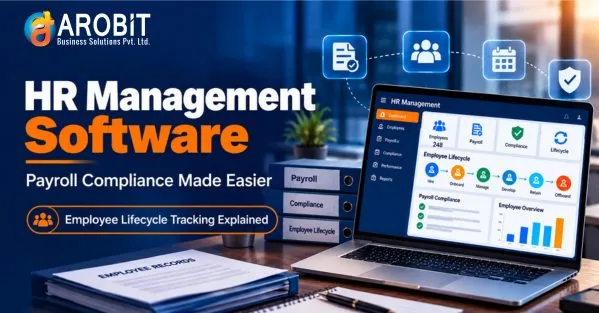
Most businesses assume their payroll runs clean. The data disagrees. The average employer operates at roughly 80% payroll accuracy. That means close to one in five pay runs carries an error someone has to find and fix after the fact.
HR Management Software exists to close that gap, and payroll is only one of the functions it holds together.
This guide explains the two mechanics that decide whether an HR operation scales cleanly or buckles as headcount grows. One is how statutory payroll rules get handled when staff sit under different tax and labour regimes. The other is how employee lifecycle tracking follows a person from the offer letter to the exit interview without the record falling apart in between.
Why Growing Teams Outgrow Manual HR and Spreadsheets
A team of ten can run HR on a shared drive and good intentions. At fifty, a hundred, or spread across regions, that approach starts dropping things: a missed statutory filing, a leave balance nobody trusts, an onboarding checklist that lives in one manager's inbox. The failure stays quiet until an audit or a resignation forces everyone to reconstruct a record that was never kept properly.
This is the point where businesses formalize their systems, either adopting a dedicated HR platform or folding HR into a wider ERP rollout alongside finance and operations. Custom ERP Software Development makes sense when HR data needs to sit in the same system as payroll cost centres, project staffing, and financial reporting. The alternative is syncing across tools that were never built to talk to each other.
If you are weighing whether HR belongs inside a broader platform, our guide to types of ERP systems is a useful starting point. From there, you can decide whether a standalone system or an integrated module fits your structure.
What HR Management Software Actually Does
At its core, this kind of software is the system of record for each employee: identity, pay, entitlements, and where they sit in the organization. For a growing business, it brings together four things that spreadsheets keep apart.
- Payroll processing and statutory deductions tied to each employee's jurisdiction
- A single record per employee, from recruitment through to exit
- Attendance and leave management linked directly to payroll
- Reporting that HR, finance, and auditors can all draw from one source
None of this works as a stack of disconnected tools. The value comes from one record feeding every process. A change to an employee's status updates payroll, leave, and reporting at the same time, not in three separate places.
Payroll Compliance Across Multiple Jurisdictions
Payroll is where an HR system earns its keep, because the rules are unforgiving and they differ almost everywhere.
Why One Ruleset Never Fits
A business employing people in more than one country does not face a single payroll rulebook. It faces several. India operates statutory deductions such as provident fund and professional tax. The United States layers federal, state, and FICA withholding.
The United Kingdom, in turn, runs PAYE with real-time reporting to its tax authority. International wage-protection principles, set out in instruments like the ILO's wage conventions, add a baseline that national law builds on.
What Automated Compliance Handling Looks Like
Software handles this by attaching the correct ruleset to each employee based on where they work, then applying deductions, filing formats, and payment timing automatically. Done well, this stops being a recurring monthly risk and becomes a configured rule the system enforces on every run.
The average company runs at about 80% payroll accuracy and makes roughly 15 corrections every pay period, at an estimated $291 per error. — EY, Cost and Risks Due to Payroll Errors (survey of US employers), 2022
That figure comes from a survey of US employers, but the mechanism travels. Every manual correction is time spent fixing something a configured system would have caught before the run went out.
Employee Lifecycle Management: Onboarding to Exit
A single employee generates records at every stage of their time with a company. Tracking those stages in one place is what separates an HR system from a payroll tool with extra fields.
- Recruitment and offer: candidate data carried into the employee record without re-entry
- Onboarding: documents, equipment, and system access provisioned against a repeatable checklist
- Active employment: attendance and leave management, appraisals, and role changes
- Offboarding: final settlement, access revocation, and a clean audit trail
Handled in one system, employee lifecycle management means a role change or a resignation flows through payroll, access, and reporting automatically. Handled across disconnected tools, the same event becomes a set of manual updates that someone inevitably forgets.
Standalone HR Platform or ERP HR Module
Businesses usually reach this decision at a predictable moment: HR has outgrown spreadsheets, and the question is whether to buy a dedicated platform or extend an existing system. An ERP HR Management Module fits businesses that already run finance and operations on an ERP and want HR in the same place. A standalone HRMS software platform fits businesses that want deep HR-specific features without committing to a full ERP.
Neither is automatically right. The module wins on integration. The standalone wins on HR depth. The deciding factor is usually where the rest of your operational data already lives.
| Factor | Standalone HRMS | ERP HR Module |
|---|---|---|
| Best fit | HR-led orgs without a full ERP | Businesses already on an ERP |
| Integration with finance | Via connectors | Native, same system |
| HR feature depth | High | Moderate to high |
| Implementation scope | Focused on HR | Part of a wider rollout |
| Data location | Separate HR system | Unified operational system |
Choosing the Right HR System for a Growing Business
Not every platform that markets itself to HR handles payroll and lifecycle tracking at the depth a scaling business needs. A few questions narrow the decision quickly.
- Does it handle statutory payroll rules for every country you employ in, or just one?
- Does it track the full employee lifecycle, or only the active-employment slice?
- Does leave and attendance data feed payroll directly, or require re-entry?
- Will the system scale with headcount without per-seat costs spiralling?
- Does it give auditors a clean trail without a separate manual reconstruction?
A business that expects to grow into new regions or headcount bands should build for that from the start. That is where custom HRMS Software Development earns its place over an off-the-shelf tool. The system is shaped around your structure, your jurisdictions, and your lifecycle, not the vendor's assumptions.
Frequently Asked Questions
Q: What is the difference between HR Management Software and an HRMS?
The terms overlap heavily. In practice, an HRMS is a type of HR platform that bundles payroll and operational HR, as distinct from a records-only HRIS or a broader talent-focused HCM suite. For most growing businesses, the distinction matters less than whether the system covers payroll and lifecycle tracking end to end.
Q: How does the software keep payroll correct when staff work under different tax rules?
It assigns each employee the statutory ruleset for their work location, then applies the right deductions, filing formats, and pay timing automatically. When a rule changes, the configuration updates centrally rather than requiring a manual fix on every affected record.
Q: What features matter most for tracking employees from hire to exit?
Look for a single employee record that carries through every stage, leave and attendance linked to payroll, configurable onboarding and offboarding workflows, and reporting that finance and auditors can share. Those four cover the operational core most businesses actually need.
Ready to Modernize HR and Payroll Operations?
Arobit Business Solutions structures enterprise ERP and HRMS engagements with written delivery plans, phased rollouts, and dedicated support. That track record spans 13+ years across manufacturing, logistics, retail, and professional services industries.
Schedule a consultation to review your payroll and lifecycle workflows. Discuss Your Project Requirements with Arobit's team.


Comments
No comments yet. Be the first to share your thoughts!