





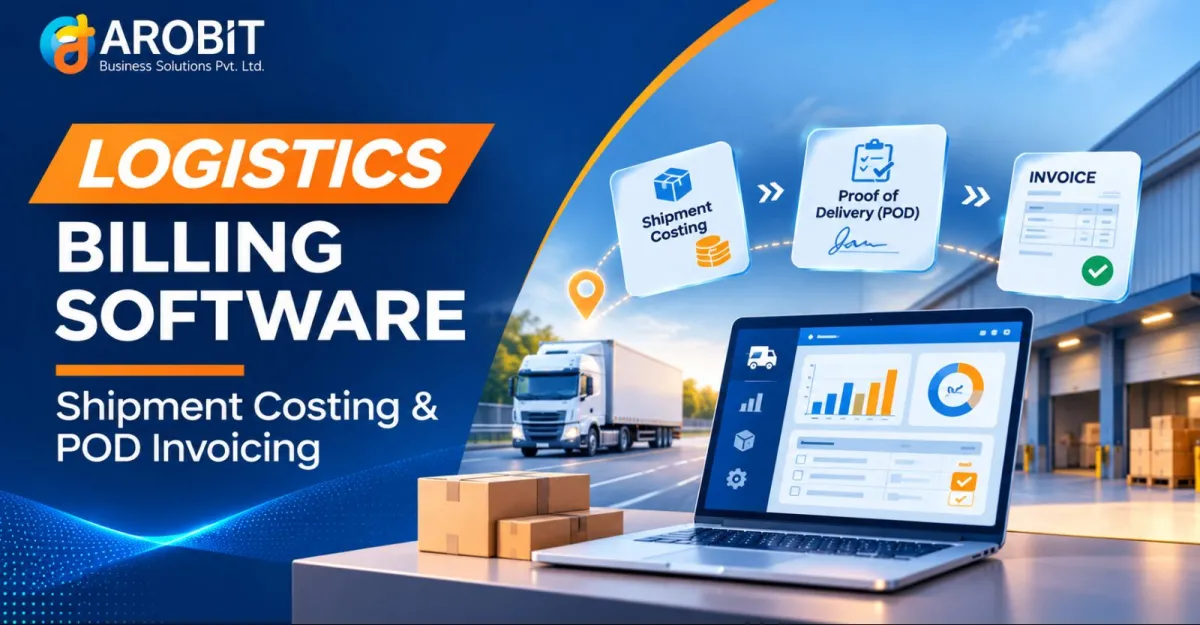
US businesses spent $2.4 trillion on logistics in a single year, yet many carriers still cannot say what one delivery cost them. They also struggle to say when that delivery became billable. Logistics billing software closes both gaps by tying every cost and every delivery event to the same shipment record. This guide explains the two mechanisms behind it, where they break, and what to check before you build or buy.
"U.S. business logistics costs fell to $2.4 trillion in 2025, or 7.8% of GDP, down from 8.7% the previous year."
— CSCMP 2026 State of Logistics Report, authored by Kearney (reported by Inside Logistics)
Why Billing Breaks Between Operations and Finance
Operations data and finance data usually live in different systems. Trip sheets, fuel cards and driver apps record what happened on the road. The accounting system only sees a lump of fuel spend and an invoice raised days later.
That split creates three recurring problems:
- Cost lag: Fuel, tolls and driver hours reach the ledger weeks after the trip, long after the customer price was fixed.
- Billing lag: Invoices wait for paper delivery notes to come back from drivers, which stretches the cash cycle.
- Disputed extras: Waiting time, extra drops and reattempts go unbilled because nobody can prove when they happened.
An ERP fixes this only when operational events flow into it as they occur. Our guide to fleet, dispatch and consignment tracking covers the operations side of that flow. This article stays on the money side.
How Shipment Costing Works in an ERP
Costing starts with one rule. Every cost must land on a shipment, either directly or through a defined allocation. Costs that sit in a general pool tell you the business lost money, but not which customer or lane caused it.
Direct Costs Captured at Source
Some costs belong to one trip and can be posted automatically. Fuel card transactions, toll feeds, subcontractor freight and driver trip allowances fall into this group. The ERP matches each transaction to a trip using the vehicle number, driver ID and timestamp.
- Fuel card and toll data arrive through integrations, not manual entry.
- Subcontracted legs post from the carrier's invoice, matched to the booked rate.
- Driver hours come from the trip log or telematics, not from a monthly payroll total.
Freight Cost Allocation for Shared Costs
Other costs are shared across many shipments on the same trip or depot. Vehicle depreciation, depot rent, insurance and dispatcher salaries are typical examples. The ERP spreads them using a driver that reflects how each shipment consumed capacity.
- Pallet positions or volume suit mixed loads where space is the constraint.
- Weight-kilometres suit heavy freight where fuel burn follows load and distance.
- Stops or handling time suit multi-drop urban routes where time, not distance, drives cost.
Each cost pool can use a different driver. Posting these pools through the finance and accounting module keeps the general ledger and shipment margins in agreement. Finance then reconciles to one set of numbers instead of two.
Margin by Consignment and Lane
The output is a cost per shipment that can be compared with its revenue. The illustrative trip below carries three consignments on one truck. Shared trip costs of $340 are allocated by pallet share, and depot overhead is absorbed at $2.50 per pallet.
| Consignment | Pallets | Allocated trip cost | Shipment-specific cost | Overhead | Cost per shipment | Revenue | Margin |
|---|---|---|---|---|---|---|---|
| A | 6 | $170.00 | $0.00 | $15.00 | $185.00 | $260.00 | $75.00 (28.8%) |
| B | 3 | $85.00 | $50.00 (2-hour wait) | $7.50 | $142.50 | $150.00 | $7.50 (5.0%) |
| C | 3 | $85.00 | $0.00 | $7.50 | $92.50 | $120.00 | $27.50 (22.9%) |
At trip level, the truck earned $530 against $420 of cost and looked healthy. At shipment level, consignment B barely broke even because two hours of unbilled waiting time absorbed its margin. That waiting time is billable only if the delivery record proves it happened.
How Proof-of-Delivery Invoicing Works
A proof of delivery record is more than a signature. A digital POD captures the receiver's name, arrival and departure timestamps, GPS location, photos and any exceptions such as short or damaged goods. That data is what turns a completed trip into a defensible invoice.
In an ERP, the delivery event drives billing through a fixed sequence:
- Capture: The driver app records the POD and sends it to the ERP within minutes of delivery.
- Validate: The system checks delivered quantities against the booking and flags any exception.
- Rate: The contract rate, fuel surcharge and evidenced extras, such as detention from timestamps, are applied.
- Invoice: Clean deliveries are invoiced automatically. Exceptions go to a review queue instead of holding up the whole batch.
- Post: The invoice posts to receivables and links back to the shipment's cost record.
The booking, the delivery and the invoice must share one record for this to work. That is the job of the order management module, which carries the customer's order from booking to billing.
Regulators are moving the same way. The European Commission's eFTI Regulation moves freight documents from paper to electronic data across transport modes and requires authorities to accept that data. The Commission estimates the shift could save the EU transport and logistics sector up to €1 billion per year. Rules such as India's e-way bill point in the same direction for domestic freight.
How Logistics Billing Software Connects Costing and Delivery
Costing and invoicing deliver most value when they meet on the same shipment. The cost side tells you what a delivery consumed. The billing side tells you what you recovered and when.
- Margin you can trust: Revenue and cost post to the same shipment, so lane and customer profitability need no spreadsheet stitching.
- Faster cash: Invoices leave on delivery day rather than after paperwork returns.
- Fewer disputes: Timestamps and photos settle detention and damage claims with evidence.
- Cleaner month-end: Accruals for delivered but uninvoiced freight are visible by shipment.
A transport management system often handles planning and carrier tendering, while the ERP owns cost and revenue. Our comparison of how ERP and a TMS divide the work explains that split. For the matching logic behind clean month-end figures, see our explainer on real-time reconciliation.
What to Check Before You Build or Buy
Most billing tools handle simple per-trip invoicing well. The differences appear in the rules your contracts actually use.
- Rate engine: Can it handle lane, weight-break, pallet and minimum-charge rates in one contract?
- Allocation drivers: Can each cost pool use its own driver, and can finance change it without a developer?
- Exception workflow: Do short deliveries and damage claims route to a queue with the POD attached?
- Tax and e-invoicing: Does it meet the e-invoicing and transport document rules in each country you serve?
- Audit trail: Can you trace any invoice line back to the delivery event and the rate that priced it?
Ready-made products suit operators whose contracts follow common patterns. Operators with unusual rate structures or allocation rules often find custom ERP development cheaper over time than configuring around a product's limits. If you are comparing build partners, our list of custom logistics ERP development companies in India is a useful starting point.
Frequently Asked Questions
What does logistics billing software do?
It converts completed deliveries into accurate invoices by applying contract rates, surcharges and evidenced extras to each shipment. When it runs inside an ERP, it also links each invoice to the costs of that shipment. That link lets you see margin by customer, lane and consignment.
How do you work out the true cost of a single delivery?
Start with direct costs such as fuel, tolls and driver time posted to the trip. Then apply freight cost allocation to shared costs such as depreciation and depot rent, using a driver like pallets or weight-kilometres. Add any delivery-specific extras, and compare the total with the revenue for that consignment.
Why does proof of delivery matter for invoicing?
It confirms the goods arrived, in what condition and at what time. Without it, invoices wait for paperwork and extras such as waiting time are hard to defend. A digital record lets billing start the moment delivery is confirmed.
Turning Delivered Freight into Accurate Invoices
Margin leaks in logistics rarely come from one large mistake. They come from small, unrecorded costs and unbilled extras repeated across thousands of deliveries. Costing each shipment and invoicing from the delivery event closes both leaks.
Arobit Business Solutions builds logistics software solutions that connect trip costs, delivery events and receivables in one system. Since 2011, the team has delivered custom ERP and CRM platforms for clients across 15+ countries. Each build is shaped around the client's own rate contracts and allocation rules.
Discuss Your Project Requirements
If your margins look fine by trip but uncertain by shipment, the gap is usually in costing or delivery data. Schedule a Consultation to map your billing rules and see what a connected system would change.




Comments
No comments yet. Be the first to share your thoughts!