





Somewhere right now, a truck is driving empty. It delivered its load an hour ago and is heading back with nothing in the trailer, burning fuel and paying a driver to move air. Across the industry, this is not a rare event.
Between 15% and 30% of all truck miles are driven empty, one of the largest sources of inefficiency in transportation. — Industry estimates, transportation management research
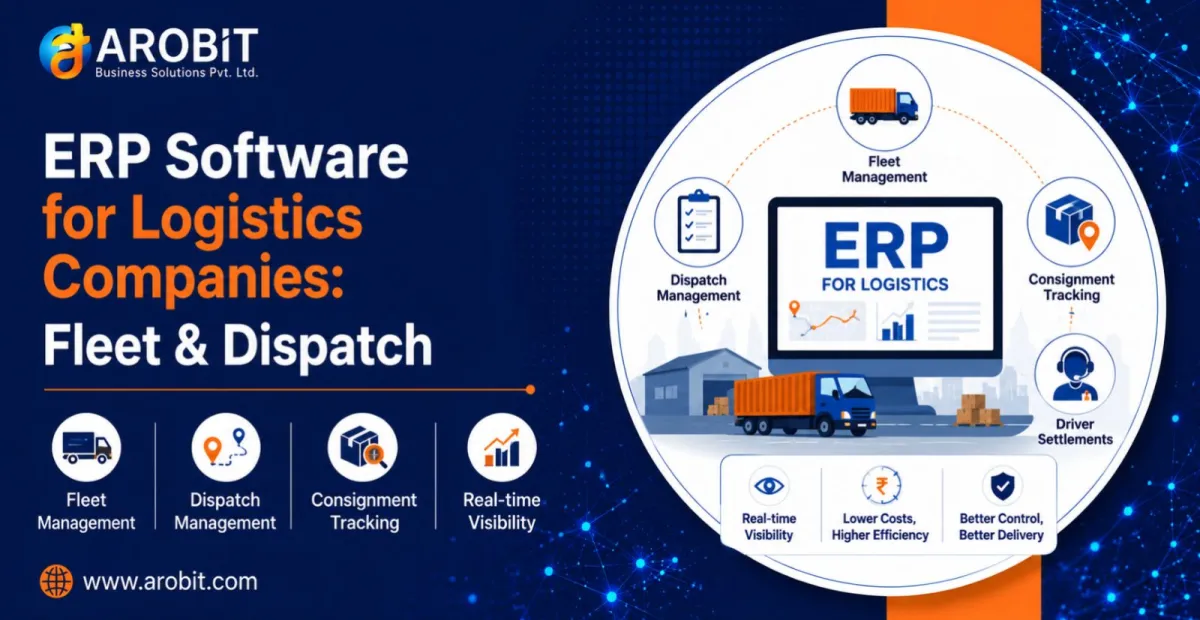
Empty miles are one symptom of a deeper problem that ERP software for logistics companies is built to solve: operations that run on disconnected tools. When vehicle tracking lives in one app, consignments in a spreadsheet, and driver payments in a notebook, nobody sees the whole picture. Money leaks from every gap. ERP software for logistics companies exists to close those gaps by putting fleet, dispatch, consignments, and settlements into one connected system.
This guide walks the four areas where that connection matters most: vehicle tracking, load planning, consignment tracking, and driver payroll.
Why Disconnected Tools Cost So Much
Logistics is a business of thin margins and constant motion, and transportation is its single largest cost.
Transportation costs can make up as much as 58% of total logistics expenses, often outpacing all other functions combined. — Jabil logistics research
When the largest cost in your business is managed across separate, disconnected tools, inefficiency is guaranteed. A vehicle sits idle because dispatch did not know it was free. A consignment is delayed because no one linked it to the right trip. A driver is overpaid because a manual settlement missed a deduction. None of these is a disaster on its own. Together, across hundreds of trips a month, they are the difference between profit and loss.
Logistics ERP software addresses this by making the connections the business actually runs on. Every vehicle, trip, consignment, driver, and invoice sits in one record, visible in real time.
The value of ERP software for logistics companies shows up across four connected areas.
Vehicle Tracking, Connected to Everything Else
Most logistics operations already have GPS on their vehicles. The problem is that the tracking usually stops at a dot on a map, disconnected from the rest of the business.
A capable ERP software for logistics companies connects vehicle tracking to the operation around it:
- Trips and consignments are linked to each vehicle, so a location tells you what is on board and where it is due.
- Drivers and customers are tied to the trip, so the right people can be updated automatically.
- Delivery milestones update as the vehicle moves, turning raw location data into real status.
The difference is meaning. A raw GPS dot says where a truck is. A connected system says which consignment is on it, which customer is waiting, whether it is running late, and what happens next. That is the visibility a dispatcher actually needs.
Load Planning That Matches Reality
ERP software for logistics companies also fixes planning. The costliest mistakes happen before a wheel turns. Send a half-empty truck, or assign the wrong vehicle to a route, and the loss is locked in the moment it leaves the yard.
Modern IT solutions for logistics match consignments to capacity intelligently at the planning stage:
- Capacity matching fits consignments to the right vehicle size, so trucks run full rather than half-empty.
- Route and priority grouping combines deliveries heading the same way and flags urgent ones.
- Driver availability is checked against the plan, so a trip is never assigned to a driver who cannot take it.
Done well, load planning is where the empty-mile problem starts to shrink. Fuller trucks, smarter routes, and fewer wasted trips all trace back to a plan built on live data rather than a dispatcher's memory. This is one of the clearest returns an operation sees after adopting a proper system.
Consignment Tracking, End to End
Consignment tracking is the backbone of ERP software for logistics companies. A consignment passes through many hands between booking and payment, and each handoff is a place where information gets lost. The value of a system is holding that entire journey in one record.
Good custom ERP software keeps one operational record that follows the consignment through every stage:
- Booking captures the order, customer, and delivery terms.
- Dispatch and transit link the consignment to its trip and vehicle, with live status.
- Proof of delivery records confirmation and any exceptions at the point of handover.
- Billing generates the invoice directly from the completed delivery, no re-entry required.
The payoff is twofold. Customers get accurate answers about their shipment without a phone call. The business also bills faster and more accurately, because the invoice flows from the same record that tracked the delivery. Nothing falls into the gap between operations and accounts.
Driver Payroll and Settlements
The final piece of ERP software for logistics companies is settlement. Driver pay in logistics is rarely a simple salary. It is a moving calculation of completed trips, allowances, advances, expenses, and deductions, and doing it by hand is slow and error-prone.
An ERP software for logistics companies calculates settlements from the operational data it already holds:
- Trip-based earnings are computed automatically from completed, verified trips.
- Allowances and expenses such as fuel, tolls, and daily allowances are captured against each trip.
- Advances and deductions are tracked and netted off cleanly at settlement.
Because the payroll draws on the same trips and expenses the system already recorded, settlements are faster, more accurate, and far easier to dispute-proof. Drivers are paid correctly and on time, which matters in an industry where driver retention is a constant challenge.
Off-the-Shelf or Custom?
ERP software for logistics companies is not always a custom build. Not every logistics business needs a tailored system. The honest test is how specific the operation is.
- A company running standard trucking or delivery workflows may be well served by a packaged logistics platform at lower cost.
- A company with specific contract structures, multi-modal operations, or unusual settlement rules often finds a packaged tool forces awkward workarounds.
Where the differences are structural, custom ERP software earns its place, because the data model can be built around how the operation actually runs. This is the kind of assessment an experienced ERP software development company should carry out before recommending anything.
A Note on Arobit's Logistics Work
This is not theoretical for Arobit. Arobit builds custom ERP for transportation and logistics operations, including trucking companies, freight forwarders, and third-party logistics providers. Its modules cover dispatch, fleet maintenance, GPS tracking, automated load planning, and route optimisation.
That domain fit matters. A logistics business does not need a generic ERP with a fleet label attached. It needs software that understands trips, consignments, proof of delivery, and driver settlements as one connected flow. Arobit's IT solutions for logistics are built around that reality, delivering better delivery reliability, reduced downtime, and real-time visibility across the network.
What to Check Before You Start
A few specifics separate a system that fits a logistics operation from one that fights it:
- Connected tracking. Vehicle location must link to trips, consignments, and delivery status, not sit in a separate app.
- Real load planning. Confirm the system matches consignments to capacity, route, and driver availability.
- End-to-end consignment records. One record should run from booking through proof of delivery to billing.
- Automated settlements. Driver pay should compute from trip data, allowances, advances, and deductions without manual spreadsheets.
How to Get Started
Roll out ERP software for logistics companies in stages rather than all at once:
- Start with connected vehicle tracking and consignment records, because they deliver visibility fast.
- Add load planning next, to attack empty miles and under-filled trucks.
- Then bring driver settlements into the same system to close the loop.
A logistics business that gets trips, consignments, and settlements into one record has already removed its biggest sources of leakage and dispute. That is the core promise of ERP software for logistics companies.
What to Do Next
Measure one thing first: how much of your fleet's mileage runs empty or under-loaded, and how long it takes to settle a driver's pay accurately. Those two numbers reveal the cost of running on disconnected tools.
Then fix the area that leaks the most, usually load planning or settlements, and build from there. ERP software for logistics companies pays back fastest when aimed at the biggest leak first. In logistics, where transportation is the largest cost and margins are thin, connected real-time data is not overhead. It is the margin itself.
Speak with our team to scope ERP built around your fleet, consignments, and settlements. Get in touch with Arobit

Comments
No comments yet. Be the first to share your thoughts!