





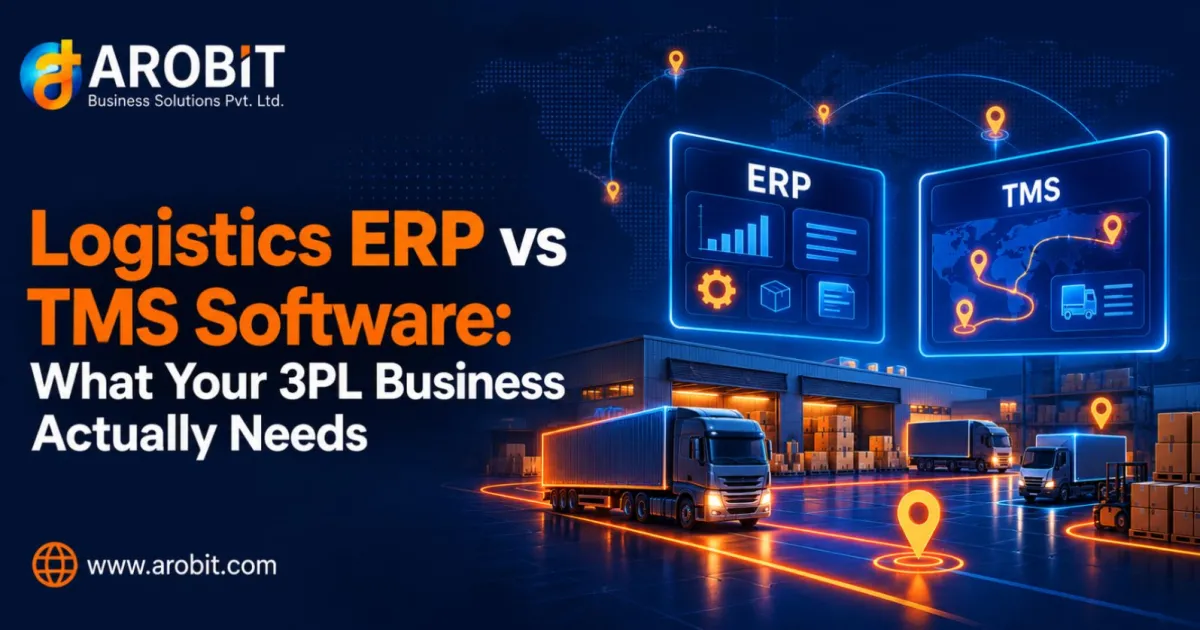
U.S. business logistics costs reached $2.4 trillion, or 7.8% of GDP, according to the 2026 State of Logistics Report from the Council of Supply Chain Management Professionals. Behind that figure sits a recurring software decision: logistics ERP vs TMS software.
In 2026, a third-party logistics (3PL) provider that chooses the wrong system pays for it in manual rework, slow billing and weak carrier control. This guide explains what each system does, where they differ and which one your 3PL should start with.
What each system is built to do
ERP and TMS both touch freight data, but they own different decisions. One protects the books. The other protects the margin on every load.
The role of logistics ERP
Enterprise Resource Planning (ERP) is the system of record for the whole business. In a 3PL, logistics ERP software connects finance, customer contracts, inventory records and reporting. It tells leadership what was billed, what was paid and which customer is profitable.
- Customer invoicing, receivables and payables
- Contract, rate and pricing records
- Inventory and asset tracking
- Financial and operational reporting
The role of a TMS
A transportation management system (TMS) is built to move freight. TMS software plans loads, selects carriers, tenders shipments, tracks them in transit and audits freight invoices. It works in hours and days, while ERP works in accounting periods.
- Load planning and route optimization
- Carrier selection and tendering
- Shipment tracking and exception alerts
- Freight audit and settlement
Gartner evaluates TMS vendors as a separate software category. That separation reflects a practical truth: freight execution needs tools that a finance-led system rarely provides.
Logistics ERP vs TMS software: side-by-side comparison
The table below shows where each system leads. Most 3PLs need both, because their strengths rarely overlap.
| Area | Logistics ERP | TMS |
|---|---|---|
| Primary job | Run the business: finance, inventory, contracts | Run the freight: planning, tendering, tracking |
| Planning horizon | Accounting periods and budgets | Hours and days |
| Carrier handling | Vendor records and payments | Rate shopping, tendering, performance scores |
| Route planning | Not designed for it | Core capability |
| Freight audit | Basic invoice matching | Checks charges against contracted rates |
| Shipment visibility | Order status only | In-transit tracking and exception alerts |
| Customer billing | General invoicing | Freight charges per shipment, passed to ERP |
In short, a TMS is strongest before and during the move. ERP is strongest once the shipment is complete and needs billing.
Where 3PLs need more than a general comparison covers
Most comparisons assume one shipper moving its own freight. A 3PL resells capacity to many customers, so the gaps look different.
- Multi-customer billing: each customer has its own rates, accessorial charges and invoice format.
- Margin per load: the gap between what you charge and what the carrier charges must be visible per shipment.
- Carrier management: insurance, credentials and performance need tracking across many carriers.
- Customer visibility: clients expect tracking links and status updates without calling your desk.
- Accessorial charges: detention, liftgate and fuel surcharges must reach the customer invoice accurately.
Generic logistics management software often covers one or two of these well. The rest end up in spreadsheets, which is where errors and delays start.
How ERP and TMS work together in a 3PL
A working setup passes data in a clear sequence. Each system owns its own step, and neither re-enters what the other already holds.
- The customer order and contract rates are stored in the ERP.
- The ERP sends the shipment request to the TMS.
- The TMS selects a carrier, tenders the load and tracks it in transit.
- The TMS audits the carrier invoice and returns the final freight cost.
- The ERP bills the customer and records the margin.
This sequence removes the copy-and-paste step that often slows billing. It also gives finance a margin figure per shipment instead of a monthly estimate.
What the industry data shows
Recent industry studies show why this choice matters commercially. The table summarizes four findings that shape system decisions for 3PLs.
| Finding | Result | Source |
|---|---|---|
| U.S. business logistics costs | $2.4 trillion (7.8% of GDP) | CSCMP, State of Logistics Report, 2026 |
| 3PLs citing demand for end-to-end visibility | 61% | Penske Logistics and NTT DATA, Third-Party Logistics Study, 2026 |
| Business growth as the leading driver of TMS adoption | 53% of shippers, 48% of logistics service providers | Descartes, Transportation Technology Study, 2026 |
| Shippers and 3PLs deploying advanced analytics | 80% of shippers, 81% of 3PLs | Penske Logistics and NTT DATA, Third-Party Logistics Study, 2026 |
"The great majority of shippers (90%) regard technological capabilities among the most critical elements of selecting a 3PL."
Penske Logistics and NTT DATA, The Annual Third-Party Logistics Study, 2026
Descartes, a logistics software provider, surveyed 600 senior transportation decision-makers worldwide. Its findings point the same way.
"...the percentage of surveyed North American organizations planning to increase transportation management (TM) technology investment has risen from 53% in 2017 to 78% in 2026."
Descartes Systems Group, 10th Annual Transportation Technology Study, 2026
Two points stand out. Technology now shapes how shippers pick a 3PL, so your systems are part of your sales case. Growth also pushes teams toward TMS adoption, and a setup that worked for a few customers can strain as volume rises.
How a 3PL should decide
An illustrative scenario
Consider a mid-sized 3PL in the U.S. Midwest that manages freight for about 40 customers. Dispatchers copy load details from the ERP into carrier portals. Billing waits until a clerk matches carrier invoices to customer quotes.
The fix is rarely a bigger ERP. It is a TMS that tenders loads and audits invoices, connected back to the ERP so finance stays current. Dispatchers then tender loads inside the TMS, and finance sees the carrier cost before the invoice goes out. This scenario is illustrative, not a specific client result.
Four questions to ask before you buy
- Where is freight data re-keyed today? Every manual copy between systems is a candidate for automation.
- How long does billing take? Count the days between delivery and customer invoice.
- Can you see margin per load before invoicing? If not, ask for 3PL references and per-customer billing when you compare TMS software.
- Can the systems exchange data? If your ERP cannot, custom ERP software development can build the connection.
What to measure after go-live
Track a few operational measures for the first 90 days. They show whether the systems are removing rework or only moving it.
- Days from delivery to customer invoice
- Share of loads with margin visible before invoicing
- Manual re-entries per shipment
- Carrier invoice errors caught before payment
Frequently asked questions
Q: What should a 3PL compare when weighing logistics ERP vs TMS software?
Compare scope, speed and margin control. ERP records financial and inventory data over accounting periods. A TMS plans and audits freight in near real time. A 3PL usually needs both, with the TMS passing freight costs and shipment events to the ERP.
Q: Can an ERP replace a TMS for a 3PL?
Rarely. Most ERP modules handle orders, inventory and invoicing, but not carrier tendering, route planning or freight audit. Some vendors bundle transport features into logistics management software, yet these are often lighter than a dedicated TMS. Test any bundled feature against your real load volume.
Q: How do I start if I have neither system?
Start with the process that costs you most. If billing delays and unclear margins hurt, begin with ERP finance and contract records. If freight cost and carrier control hurt, begin with a TMS. Then connect the two through a defined data exchange before adding more modules.
Choosing the right system for your 3PL
ERP and TMS are partners, not rivals. A transportation management system keeps freight cost and carrier performance visible, while ERP keeps finance, contracts and inventory reliable. Whether logistics ERP software or a TMS comes first depends on where margin leaks today. The strongest setups connect both, so freight events flow into billing without manual entry.
Arobit Business Solutions works as a technology partner, with 15+ years of experience in custom software development and ERP, and clients across 15+ countries. Its logistics software solutions include consignment management and vehicle tracking systems, built around each client's operations.
Request an ERP consultation to evaluate which systems your 3PL should implement first.





Comments
No comments yet. Be the first to share your thoughts!