





A pharma distributor carries a risk that most businesses never face: the stock on the shelf can become worthless overnight. A batch crosses its expiry date, and a saleable product turns into a write-off and a disposal problem. Multiply that across thousands of SKUs, hundreds of batches, and tight regulatory rules, and the margin for error is razor thin.
This is why generic billing software fails a distributor. It does not think in batches and expiry dates. It does not enforce drug-licence rules or generate the compliance paperwork the trade demands. It cannot bill a chain of stockists and sub-distributors the way the pharma supply chain actually works.
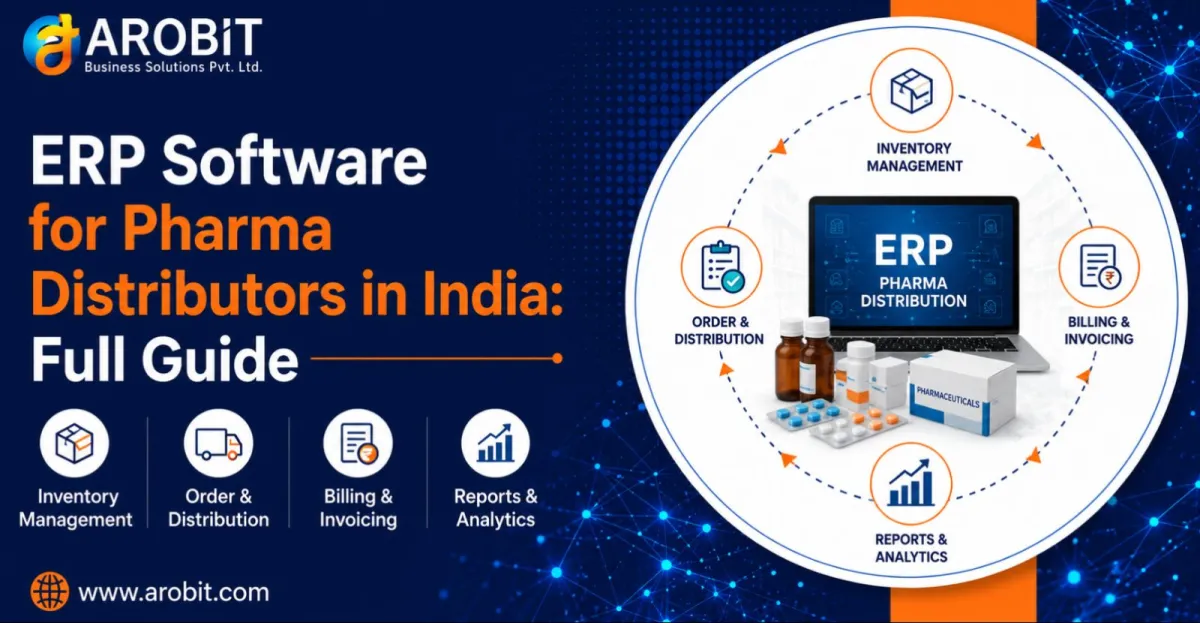
ERP software for pharma distributors is built for exactly these realities. This guide covers the features that matter, the compliance it must handle, and what it costs in India.
The Scale, and the Leak
Indian pharma distribution is a large business operating on thin margins, and it is growing quickly.
The Indian pharmaceutical market stood at US$ 55 billion in 2025 and is expected to grow to US$ 120–130 billion by 2030. — Bain & Co, cited by India Brand Equity Foundation, Ministry of Commerce
India is now the third-largest drug producer by volume and supplies roughly one in five generic medicines worldwide. Distribution volumes are rising accordingly, and so is the cost of losing track of stock.
That loss is measurable:
Close to 1.5% of medicines manufactured in India expire or are destroyed each year, due to unfavourable conditions during manufacturing, transit, or storage. — Industry estimates, Confederation of Indian Industry conference on pharma cold chain logistics
Trade estimates suggest much of that wastage sits at the wholesaler and distributor end of the chain.
The cause is not mysterious:
Poor store management was strongly associated with higher rates of expired medicine, with inadequate inventory management a leading contributing factor. — BMC Health Services Research, pharmaceutical supply chain study
In other words, expiry loss is largely an inventory-control problem. That is precisely what a system fixes.
Why Pharma Distribution Needs Specialised ERP
ERP software for pharma distributors exists because pharma distribution is not ordinary distribution. It sits under drug-control regulation, deals in dated and temperature-sensitive stock, and runs through a multi-tier chain of stockists, sub-stockists, and retailers.
A general accounting tool was never designed for this. It cannot tie every sale to a specific batch and expiry. It cannot block the sale of an expired lot, or produce the licence-linked records a drug inspector may ask for. Forcing pharma workflows into generic software creates manual workarounds, and in a regulated trade, those workarounds become compliance risks.
ERP software for pharma distributors removes that risk by modelling how the trade actually operates. This is why many distributors choose custom ERP software rather than a generic package. The regulatory and batch-level demands are specific enough that the system has to fit the business.
Feature 1: Batch Tracking
Batch tracking is the foundation of ERP software for pharma distributors, and the first thing good custom ERP software gets right. Every unit of stock belongs to a batch, and the batch determines everything: its expiry, its supplier, and its traceability if a recall ever happens.
ERP software for pharma distributors records every transaction against its batch. When stock arrives, it enters against a batch number, manufacturing date, and expiry. When it sells, the system knows exactly which batch left the warehouse and to whom. If a manufacturer issues a recall, the distributor can trace every affected unit in minutes rather than days. This traceability is not a convenience. In pharma, it is a safety and legal requirement.
Feature 2: Expiry Management
Expiry is where a distributor's money quietly dies, and where ERP software for pharma distributors saves the most. Stock that ages past its date is a total loss, and without a system, that loss is discovered too late.
ERP software for pharma distributors applies first-expiry-first-out logic automatically, so the oldest stock moves first. It flags batches approaching expiry well in advance, giving the distributor time to push, return, or redistribute them before they become dead stock. Expiry-linked returns to the manufacturer are tracked cleanly.
Given that inadequate inventory control is a leading driver of expiry loss, this single feature can save more than the system costs. It turns silent write-offs into managed, visible decisions.
Feature 3: Multi-Stockist Billing
ERP software for pharma distributors also fixes billing across the chain. The pharma supply chain runs through tiers. A distributor sells to sub-stockists, who sell to retailers, and each tier has its own pricing, credit terms, and scheme structure.
A proper system handles this tiered billing natively. It manages different price lists and margins for different customer types. It applies the correct scheme to each, and tracks credit and outstanding balances tier by tier. Orders from multiple stockists are processed against live batch-wise stock, so nobody is billed for a batch that is not there. This is the kind of multi-tier complexity that generic billing tools simply cannot model.
Compliance: GST, E-Invoicing, and Drug Rules
Compliance is the sharpest test of ERP software for pharma distributors. It is not just a feature. It is the licence to operate, and the paperwork is unforgiving.
ERP software for pharma distributors has to produce GST-compliant, batch-wise invoicing as a matter of course. It calculates the correct tax, generates GST invoices, and prepares filing-ready reports. For distributors above the turnover threshold, e-invoicing and e-way bill generation flow from the same data, without a separate manual step.
Beyond tax, the system supports the drug trade's own rules. Batch and expiry data underpin the traceability that regulation demands. Sales records tie back to the distributor's drug licence. India's drug regulator has also formalised the reverse supply chain for expired medicines. Distributors and stockists must accept, segregate, and return expired stock from those they supplied. A system that tracks batches cleanly makes that obligation manageable rather than chaotic.
The consistent theme is that compliant documentation is produced as a by-product of daily operation, rather than assembled by hand under audit pressure.
The Cost: What to Expect in India
Cost is where distributors want a straight answer. Here is an honest framing of what ERP software for pharma distributors involves, rather than a single number.
Systems come in two broad shapes. Packaged pharma-distribution software is subscription-based, sized by users and features, and suits distributors whose processes are standard. A tailored build carries a higher one-time cost but fits a distributor's specific tier structure, schemes, and integrations. It is often the better long-run choice for a larger or more complex operation.
The real cost is never the licence alone. Budget for implementation, data migration, and training, which are where most projects are under-quoted. Treat any figure as a range that depends on your SKU count, number of tiers, and integration needs. Prices also change, so confirm current rates before committing.
The honest test is whether your processes are standard enough for a packaged tool, or specific enough to justify a custom build. Against a 1.5% industry expiry-loss benchmark, even a modest reduction in write-offs changes that calculation quickly.
A Note on Arobit's Pharma Experience
This is not theoretical for Arobit. As a healthcare and pharma ERP developer, Arobit builds customised systems for pharma distributors. Wholesalers gain expiry tracking, batch management, and compliant invoicing built around how the trade operates.
That domain fit matters. A pharma distributor does not need a generic ERP with a pharma label attached. It needs software that understands batches, expiry, tiered billing, and the compliance the trade lives under. Building that requires a partner who knows the regulatory floor, not just the code.
What to Check Before You Start
Batch and expiry at the core. These cannot be add-ons. Confirm every transaction ties to a batch and expiry, with automatic first-expiry-first-out logic.
Multi-tier billing. The system must handle stockist, sub-stockist, and retailer pricing, schemes, and credit separately.
Compliance built in. GST, batch-wise e-invoicing, and e-way bills should be automatic, not manual add-ons.
A partner who knows pharma. Distribution has regulatory quirks a generic developer will miss. An experienced ERP software development company that has built for pharma will handle licence, batch, and compliance needs from the start.
How to Get Started
Roll out ERP software for pharma distributors in stages. Start with your biggest leak, which for most distributors is expiry write-offs or reconciliation across tiers. Get batch and expiry accurate first, prove the saving, then extend across billing and compliance.
Do not try to digitise everything at once. A distributor who gets clean, batch-level stock visibility has already removed the largest source of loss and risk.
Baseline your numbers before you begin. If you do not know what you currently write off to expiry, you cannot prove the saving later.
What to Do Next
Measure one number first: what you wrote off last year to expired stock. Compare it against the roughly 1.5% industry benchmark. That gap is the recurring cost of running pharma distribution without proper batch and expiry control.
Then fix the leak that costs the most, and build from there. ERP software for pharma distributors pays back fastest when aimed at a specific loss first. In pharma distribution, where stock expires, tiers multiply, and regulation is strict, accurate batch-level data is not overhead. It is the difference between a compliant, profitable business and a risky one.
Speak with our team to scope ERP built around your batches, tiers, and compliance needs. Get in touch with Arobit





Comments
No comments yet. Be the first to share your thoughts!