





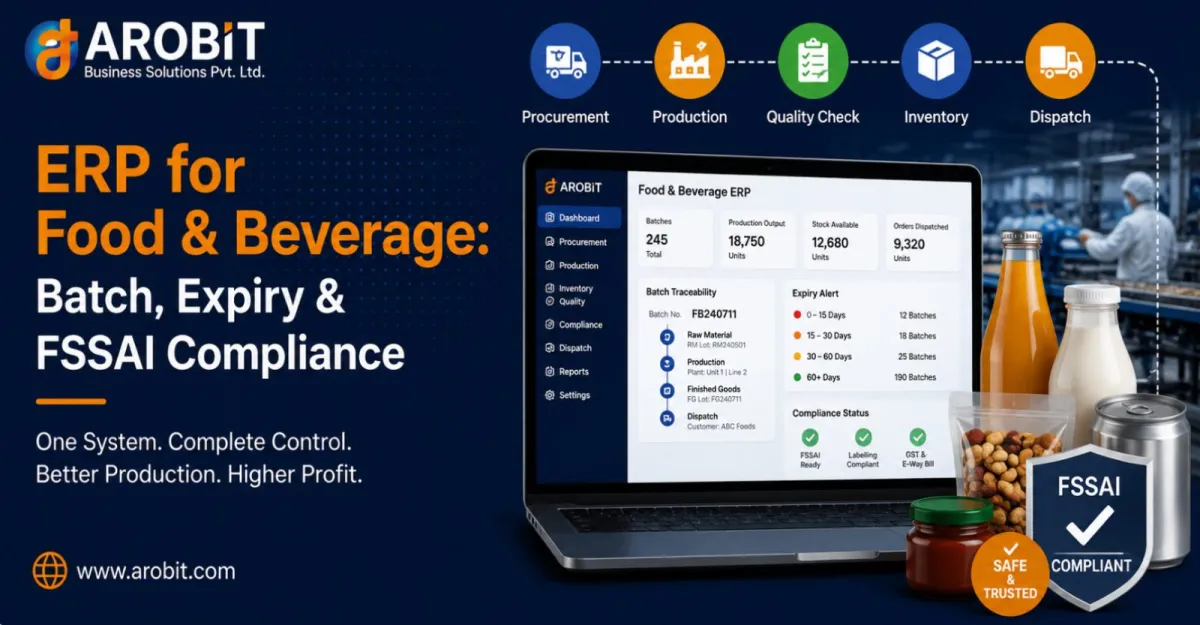
A food and beverage business runs against the clock in a way few other industries do. Every product on the shelf has a date on it, and every day that passes moves it closer to being unsaleable. Add strict safety regulation, recipe-based production, and multiple plants, and the room for error narrows sharply.
This is why generic accounting software struggles here. It does not think in batches and shelf-life. It cannot trace a contaminated lot back to its source in minutes. It cannot enforce the food-safety records a regulator expects. When a recall happens, that gap becomes a genuine risk to the business and to public health.
ERP for Food and Beverage is built for exactly these realities. This guide covers the three areas that decide whether a food business stays in control: batch tracking, expiry and shelf-life, and FSSAI compliance. It also covers how a system handles production across multiple plants.
Why This Industry Is Different
India's food processing sector is large, fast-growing, and increasingly scrutinised. Scale and regulation are rising together.
India's food processing market reached US$ 354.5 billion in 2024 and is projected to grow substantially by 2027. — India Brand Equity Foundation, Ministry of Commerce
That growth comes with tighter oversight, not looser. Enforcement has stepped up sharply in recent years:
FSSAI and state authorities conducted 397,009 food-safety inspections in FY2025-26, imposing penalties of ₹154.87 crore. — India Brand Equity Foundation, citing FSSAI
For a food business, that combination is the whole point. Demand is growing, but so is the cost of a compliance failure. A system that keeps batch, expiry, and safety records accurate is no longer optional at any real scale.
Feature 1: Batch Tracking and Traceability
Batch tracking is the foundation of any ERP for Food and Beverage. Every unit of production belongs to a batch. That batch links back to the raw materials, the recipe, the plant, and the shift that made it.
A good ERP for Food and Beverage records every step against its batch:
- Raw material intake is logged with supplier, lot number, and quality parameters.
- Production ties finished goods to the exact raw material lots and recipe used.
- Dispatch records which batch went to which customer.
The payoff of an ERP for Food and Beverage is traceability in both directions. If a raw material is found to be contaminated, the system shows every finished batch that used it. If a customer reports a problem, the system traces that product back to its source lot. When a recall is unavoidable, this is the difference between pulling a single affected batch and dumping weeks of production as a precaution.
Feature 2: Expiry and Shelf-Life Management
Shelf-life is where ERP for Food and Beverage saves the most. It is where a food business quietly loses money. Stock that ages past its date is a total loss, and without a system, that loss is found too late.
A proper system manages the clock automatically:
- First-expiry-first-out logic ensures the oldest stock ships first.
- Advance alerts flag batches nearing their date, so they can be pushed or discounted before they expire.
- Automatic blocking prevents expired or near-expired stock from being dispatched by mistake.
For perishable and dated goods, this is often the single most valuable function. It turns silent write-offs into managed, visible decisions, and it protects the business from the far worse outcome of shipping out-of-date product to a customer.
Feature 3: FSSAI Compliance and Food Safety
Compliance is the sharpest test of an ERP for Food and Beverage. It is not just a feature. It is the licence to operate, and the paperwork is unforgiving.
A capable ERP for Food and Beverage builds compliance into daily operation rather than treating it as a separate scramble before an audit. The system supports:
- FSSAI-ready records tying every batch to its production and quality data.
- Quality checks recorded at each production stage, not just at the end.
- Labelling accuracy, so manufacturing and expiry dates, batch codes, and ingredient information are consistent and correct.
- GST-compliant, batch-wise invoicing and e-way bills produced from the same data.
The consistent theme is that compliant documentation is produced as a by-product of daily operation. When an inspector arrives, the records already exist. In an environment of nearly 400,000 inspections a year, that reliability is worth as much as any efficiency gain.
Handling Multi-Plant Production
Many food businesses run more than one plant, and that multiplies every challenge above. ERP for Food and Beverage has to hold it together. Recipes must stay consistent across sites. Stock and production need to be visible centrally. A recall must be traceable across every location at once.
A multi-plant ERP for Food and Beverage brings this together:
- Standardised recipes apply the same formulation and quality standard at every plant.
- Centralised visibility shows stock, production, and batches across all sites in one view.
- Inter-plant transfers move stock between locations with full batch traceability intact.
- Consolidated compliance means records from every plant roll up into one auditable system.
Without this, each plant becomes its own island, and head office is left reconciling spreadsheets that never quite agree. Good Food and Beverage ERP Software replaces that with a single operating picture.
Off-the-Shelf or Custom?
Not every food business needs a tailored system. The honest test is how specific your processes are.
- A business running standard processes on common products may be well served by a packaged tool at lower cost.
- A business with specific recipes, unusual units of measure, or multi-plant complexity often finds a packaged system forces awkward workarounds.
Where the differences are structural, custom ERP software earns its place, because the data model can be built around how the business actually operates. This is the kind of assessment a food and beverage software development services partner should carry out first. A good one assesses the business before recommending anything, rather than pushing one option by default.
A Note on Arobit's Food and Beverage Work
This is not theoretical for Arobit. Arobit builds connected ERP systems for food and beverage and FMCG businesses, covering production, inventory, procurement, warehouse, and quality processes.
Its documented work includes a customised ERP for Caterpure Essential Pvt. Ltd. that unified FMCG and e-commerce operations, eliminated manual workflows, enabled real-time inventory visibility, and reduced order cancellations and downtime. That kind of result comes from a system designed around a specific business. That is what an experienced ERP software development company delivers, and what a generic package cannot.
What to Check Before You Start
A few specifics separate a system that fits a food business from one that fights it:
- Batch and expiry at the core. Every transaction must tie to a batch and shelf-life, with automatic first-expiry-first-out logic.
- Recipe and quality management. The system must handle recipe-based production and stage-wise quality checks, not just simple stock counts.
- Compliance built in. FSSAI records, labelling, and batch-wise GST invoicing should be automatic, not manual add-ons.
- Multi-plant capability. If you run more than one site, confirm the system standardises recipes and consolidates records across all of them.
How to Get Started
Roll out an ERP for Food and Beverage in stages rather than all at once:
- Start with your biggest leak, usually shelf-life write-offs or traceability gaps, because the return is easiest to measure.
- Get batch tracking and expiry accurate first, and prove the saving on that.
- Then extend across compliance, quality, and multi-plant consolidation.
A food business that gets clean, batch-level visibility has already removed its largest source of loss and its sharpest compliance risk. This is where good custom ERP software earns its return.
What to Do Next
Before you weigh up an ERP for Food and Beverage, measure one number. What did you write off last year to expired or wasted stock? That figure is the recurring cost of running a food business without proper batch and shelf-life control.
Then fix the leak that costs the most, and build from there. An ERP for Food and Beverage pays back fastest when aimed at a specific loss first. In food and beverage, where every product has a clock and a regulator, accurate batch and expiry data is not overhead. It is the difference between a safe, profitable business and a risky one.
Speak with our team to scope ERP built around your batches, shelf-life, and FSSAI compliance needs. Get in touch with Arobit


Comments
No comments yet. Be the first to share your thoughts!