





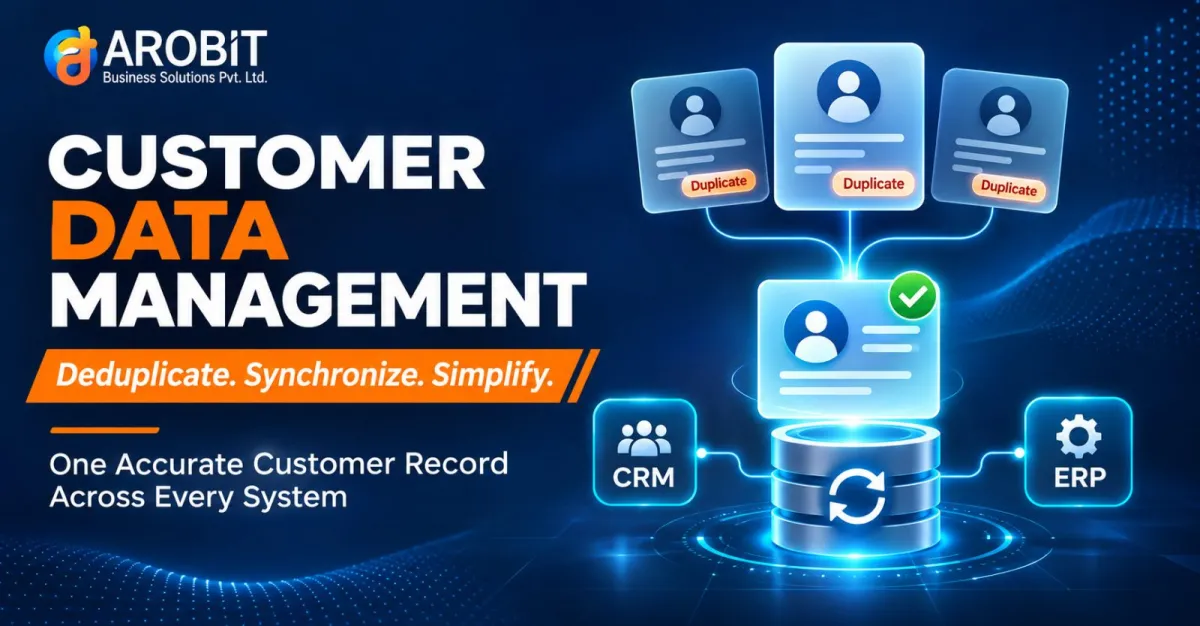
The same customer often exists several times across a company's systems, and every copy says something slightly different. Sales has one spelling of the name, finance has another, and support has a third with an old address. Each team trusts its own version, and none of them agree. Customer Master Data Management is the discipline that collapses those copies into one trusted record and keeps it consistent everywhere it is used.
This guide explains the two mechanics that make it work. One is record deduplication, which merges duplicate entries into a single reliable record. The other is cross-system syncing, which keeps that record the same whether it is read in the ERP, the CRM, or a billing tool.
Why Customer Data Breaks as a Business Grows
One system with one team rarely has a data problem. Add a CRM for sales, an ERP for finance, a support desk, and a marketing tool, and the same customer gets entered separately in each. Nobody is at fault, but the copies drift apart with every manual edit, and reports built on them quietly disagree.
The cost of that drift is real, not cosmetic. Custom ERP Software Development helps when the fix has to live in the systems themselves rather than in a monthly clean-up spreadsheet. If you are still mapping which systems hold what, our guide to types of ERP systems is a useful starting point.
Poor data quality costs organizations an average of $12.9 million per year. — Gartner
Most of that cost is invisible day to day. It shows up as wasted marketing spend, misrouted invoices, and decisions made on numbers that were never quite right.
What Customer Master Data Management Actually Does
At its core, the discipline creates one authoritative version of each customer and governs how it changes. For a business running several systems, it brings together four things that disconnected databases keep apart.
- One golden record per customer, not a copy in every system
- Rules that decide which data wins when two sources disagree
- A single customer view that sales, finance, and support all read from
- An audit trail showing how each record was built and changed
None of this works as a one-time cleanup. The value comes from governing the record continuously, so a change entered anywhere updates the single source rather than creating yet another version.
Record Deduplication: Turning Many Copies Into One
Matching and Merge Rules
Deduplication starts by deciding when two records are the same customer. Exact matching catches identical entries, but real data is messier, so fuzzy matching compares names, addresses, and identifiers that are close but not identical. Good data deduplication tunes those rules so it merges true duplicates without collapsing two genuinely different customers into one.
Choosing the Golden Record
Once duplicates are grouped, the system decides which values survive into the merged record. This is where an AI-Enhanced ERP setup helps, scoring and matching records at a scale manual review cannot reach. The result is one record built from the best available data, not whichever copy happened to be edited last.
Cross-System Syncing: Keeping Every System in Agreement
A clean record is only useful if it stays clean everywhere. Cross-system syncing pushes the trusted record out to every connected tool and keeps them aligned as data changes. Reliable data synchronization is what stops the ERP and the CRM from drifting apart again a week after a cleanup.
This is where Custom CRM Software Development matters, because the CRM is usually where customer records are created and changed most often. Strong customer data integration means a new contact in the CRM becomes the same trusted record in finance and support, without anyone re-keying it.
| Factor | Without MDM | With MDM |
|---|---|---|
| Customer records | Duplicated across systems | One golden record |
| Conflicting data | Resolved by guesswork | Resolved by survivorship rules |
| Updates | Entered separately in each tool | Synced from one source |
| Reporting | Numbers rarely agree | One consistent set of figures |
| Audit trail | Scattered or absent | Centralized and traceable |
The Payoff: A Single, Trusted Customer View
When deduplication and syncing work together, every team sees the same customer the same way. A single customer view means support knows what finance sees, and marketing stops mailing three versions of the same person. Standards like the ISO 8000 data quality standard exist precisely because consistent, trusted data has become a measurable business asset.
Choosing the Right Approach for Your Business
Not every tool that claims to clean data actually governs it. A few questions separate a real solution from a temporary patch.
- Does it run data deduplication continuously, or only as a one-off import cleanup?
- Does it keep systems aligned with ongoing data synchronization, or sync once and drift?
- Does it handle customer data integration across every tool you run, not just two?
- Can it explain why a record was merged, for audit and trust?
- Does it fit the systems you already have, rather than forcing a rebuild?
Generic cleanup tools can tidy a single list well enough. They rarely keep records trustworthy across systems over time, which is why businesses that outgrow spreadsheets usually need a governed approach. Our guide to CRM strategies covers the customer-facing side of the same problem.
Frequently Asked Questions
Q: What is Customer Master Data Management, and why does it matter?
It is the practice of maintaining one authoritative record for each customer and governing how that record changes across every system. It matters because duplicate and conflicting records quietly distort reporting, waste spend, and erode trust in the numbers teams rely on.
Q: How is deduplication different from a one-time data cleanup?
A cleanup fixes the data you have today. Deduplication within a governed system keeps merging and preventing duplicates continuously, so the records stay clean instead of drifting apart again within weeks.
Q: Does this require replacing our existing ERP and CRM?
Usually not. The approach sits across the systems you already run, creating and syncing a trusted record between them. The goal is to govern the data, not to force a rebuild of tools that otherwise work.
Ready to Trust Your Customer Data Again?
Arobit Business Solutions structures enterprise ERP and CRM engagements with written delivery plans, phased rollouts, and dedicated support. That track record spans 15+ years and clients across more than 15 countries.
Schedule a consultation to review your customer data and system-sync workflows. Discuss Your Project Requirements with Arobit's team.





Comments
No comments yet. Be the first to share your thoughts!