





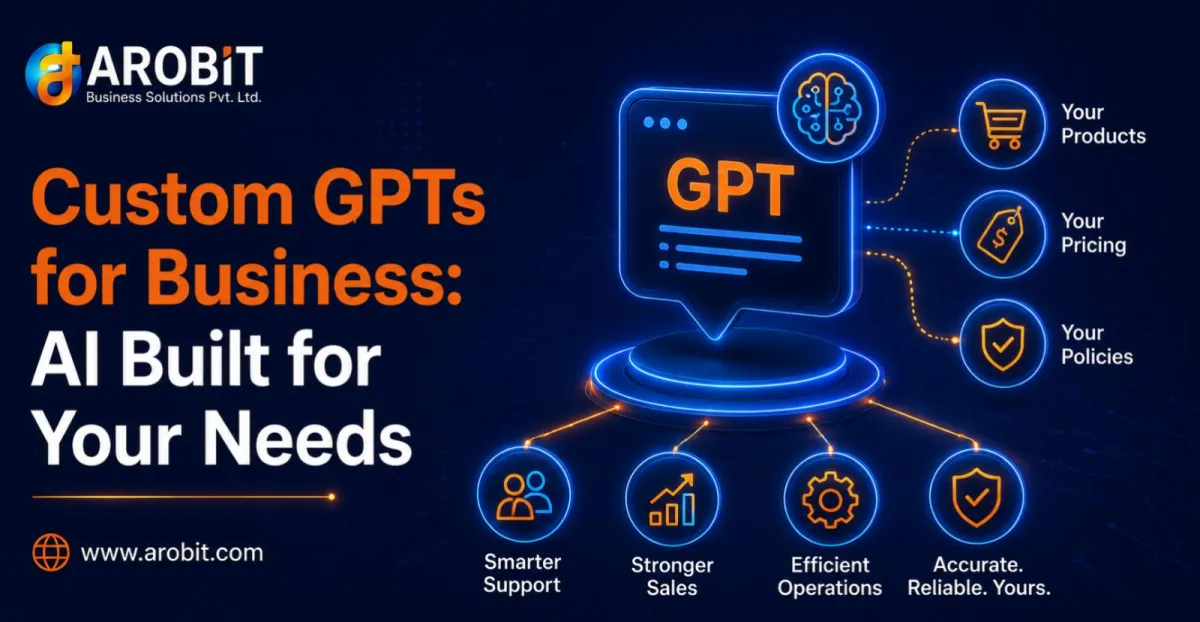
Ask a generic AI assistant what your product costs, and it cannot tell you. It has never seen your price list, your product catalogue, or your return policy. It will either admit it does not know, or worse, invent a plausible-sounding answer. For a business, a confident wrong answer about pricing or policy is not a small problem.
This is the gap Custom GPTs for Business close. It is the difference between a general chatbot and a custom GPT. A general model knows the public internet. A custom GPT knows your business, because it has been given your actual products, pricing, and policies to work from. Ask it the same question and it answers from your real information, the way a well-trained employee would.
Custom GPTs for Business are how companies turn a general AI into one that knows their specific operation. This guide explains what they are, how they are built on your data, and where they deliver value across sales, support, and internal operations.
Custom GPTs for Business are already reshaping how teams find answers, so it helps to start with what one actually is.
What a Custom GPT Actually Is
Stripped of the jargon, a custom GPT is a general AI model given a specific job and specific knowledge.
A standard AI assistant answers from broad, public training data. A custom GPT starts from that same capable foundation, then adds three things that make it yours:
- Your knowledge. Product details, price lists, policies, and documents the AI can draw on to answer accurately.
- Your instructions. Rules for how it should respond, in your tone, within your boundaries, escalating when it should.
- Your guardrails. Limits on what it will and will not do, so it stays on-topic and on-brand.
The result is an assistant that responds from your business reality rather than general knowledge. This is not a speculative technology. It is already widely used:
Weekly usage of custom GPTs grew roughly 19-fold over the year, and they now account for around 20% of all enterprise AI messages. — OpenAI, State of Enterprise AI 2025
The Importance of Grounded Business Knowledge
The phrase that matters most for Custom GPTs for Business is grounded knowledge. It is the difference between an assistant that helps and one that is a liability.
A general model, asked about your business, has two options: admit it does not know, or guess. Neither is useful, and the guess is dangerous. A custom GPT built on your data has a third option: answer from your real information. When it does not know, it says so or points the person onward, rather than inventing an answer.
That grounding is what makes the technology safe to put in front of a customer or an employee. A GPT that quotes your actual current price is an asset. One that invents a price is a problem waiting to happen. That is exactly why custom GPT development centres on connecting the model to real, maintained business data, rather than letting it improvise.
Use Case 1: Sales Teams
The first place Custom GPTs for Business prove their worth is sales. Sales moves fastest when answers are instant, and a custom GPT gives a team a knowledgeable assistant that never has to check with someone else.
A custom GPT for sales can:
- Answer product questions instantly. Specifications, compatibility, and comparisons drawn from your real catalogue.
- Quote accurate pricing. Current prices and package details, so a rep never guesses or over-promises.
- Explain policies. Warranty, returns, and terms answered consistently, the same way every time.
- Support proposals. Draft responses and summaries built from approved, accurate information.
The effect is a sales team that responds faster and more consistently, without waiting on a product expert for every question. New reps in particular get up to speed quickly, because the knowledge they lack sits in an assistant they can simply ask.
Use Case 2: Customer Support
Support is where Custom GPTs for Business earn their keep most visibly, because so many customer questions are repetitive and answerable from existing information.
A custom GPT for support can:
- Resolve common questions. Order status logic, policies, and how-to answers handled instantly, at any hour.
- Stay accurate and on-brand. Every answer drawn from approved information, phrased in your voice.
- Escalate cleanly. Complex or sensitive cases handed to a human, rather than forced into an automated answer.
- Free up your team. Routine load handled by the assistant, so staff focus on the cases that need judgement.
The goal is not to replace support staff. It is to remove the repetitive volume that consumes their day, so the people are free for the conversations that genuinely need a person.
Use Case 3: Internal Operations
The least visible use of Custom GPTs for Business is often the most valuable. Inside a business, huge amounts of time are lost to employees hunting for information buried in documents, wikis, and shared drives.
A custom GPT for internal operations can:
- Answer policy questions. HR rules, IT procedures, and internal guidelines, retrieved in seconds.
- Surface documents. The right SOP, template, or reference found by asking, not by searching folders.
- Onboard new staff. New hires ask the assistant instead of interrupting colleagues for every question.
- Standardise answers. Everyone gets the same correct information, rather than differing versions from memory.
This is where much of the quiet return on custom AI for business lives. When institutional knowledge becomes something anyone can simply ask, the daily friction of finding information disappears.
How Arobit Builds a Custom GPT
Building Custom GPTs for Business well is a deliberate process, not a switch to flip. It is worth understanding what proper custom GPT development actually involves.
- Understand the need. Which team, which questions, which sources of truth. A GPT built for a clear job outperforms a vague general one.
- Prepare the knowledge. Products, pricing, and policies are gathered, cleaned, and structured so the AI draws on accurate, current information.
- Configure and guardrail. Instructions, tone, boundaries, and escalation rules are set so the assistant behaves the way the business needs.
- Test against reality. The GPT is checked against real questions to confirm it answers accurately and admits when it should not.
- Maintain it. Prices and policies change, so the knowledge is kept current, because a GPT is only as good as the data behind it.
That last point is the one most people miss. A custom GPT is not a one-time build. Its value depends on the data behind it staying accurate, which is why the maintenance matters as much as the build.
Understanding the Limitations
Being clear about the limits of Custom GPTs for Business is what separates a useful deployment from a disappointing one.
A custom GPT is not a replacement for human judgement, and it is not infallible. Built poorly, on messy or outdated data, it produces confident wrong answers. Built well, on clean and maintained information with proper guardrails, it is a reliable assistant for the many questions that have a clear, correct answer.
The market reflects both the opportunity and the gap:
Around one in four enterprises has not yet built internal AI assistants or connected AI to their business data, using it generically rather than grounded in their operation. — OpenAI, State of Enterprise AI 2025
The lesson is not that the technology is unproven. It is that the value comes from doing it properly, with real data and real guardrails. Pointing a generic tool at a serious job is what fails.
Where a Custom GPT Fits Best
Custom GPTs for Business earn their place on a specific kind of work, and being honest about that builds trust.
Custom GPTs for Business fit some work far better than others:
- High-volume, repetitive questions. The same product, pricing, or policy questions asked constantly.
- Information that already exists. Answers that live in your documents but are slow to find.
- Consistency matters. Situations where everyone should get the same correct answer.
- Speed matters. Questions where waiting for a human is the bottleneck.
Judgement-heavy decisions, sensitive negotiations, and anything needing genuine human accountability stay with people. The goal of custom AI for business is to handle the routine, not to replace the human.
What to Check Before You Start
A few things separate a custom GPT that helps from one that misleads:
- Grounded in real data. It must answer from your actual products, pricing, and policies, not general knowledge.
- Honest about limits. A good GPT says when it does not know, rather than inventing an answer.
- Maintained. There must be a plan to keep pricing and policies current as they change.
- Properly scoped. Start with a clear job, not a vague ambition to answer everything.
How to Get Started
Roll out Custom GPTs for Business in stages rather than all at once:
- Start with one team and one clear need, usually the questions your people answer most often.
- Prepare and clean the knowledge it will rely on, because accuracy depends entirely on the data.
- Test it against real questions before it goes live, then expand to other teams as it proves out.
A business that begins with one well-scoped assistant, built on clean data, sees the value of Custom GPTs for Business quickly. It then builds the confidence to do more.
What to Do Next
Getting value from Custom GPTs for Business starts with finding the repetition. Identify the questions your sales, support, or operations teams answer over and over, the ones that already have a correct answer sitting in your documents. That is exactly the work a custom GPT is built to take on.
Then build one properly, on real data with real guardrails, for that specific job. Done well, a custom GPT stops being a novelty and becomes something genuinely useful. It is an assistant that knows your business and answers from it, so your people can focus on the work that needs them.
Speak with our team about building a custom GPT trained on your products, pricing, and policies. Get in touch with Arobit

Comments
No comments yet. Be the first to share your thoughts!