





A flour mill runs on fine margins and heavy volumes. A few paise per kilogram, multiplied across hundreds of tonnes, is the difference between a good month and a loss. Yet most mills still track that money on paper registers and spreadsheets that never quite agree.
The gap shows up everywhere. Wheat arrives by the truckload but the weighbridge slip reaches the office a day late. Production output is estimated, not measured. Stock on the books rarely matches stock in the godown. By the time the numbers are reconciled, the month is over and the leak is already booked.
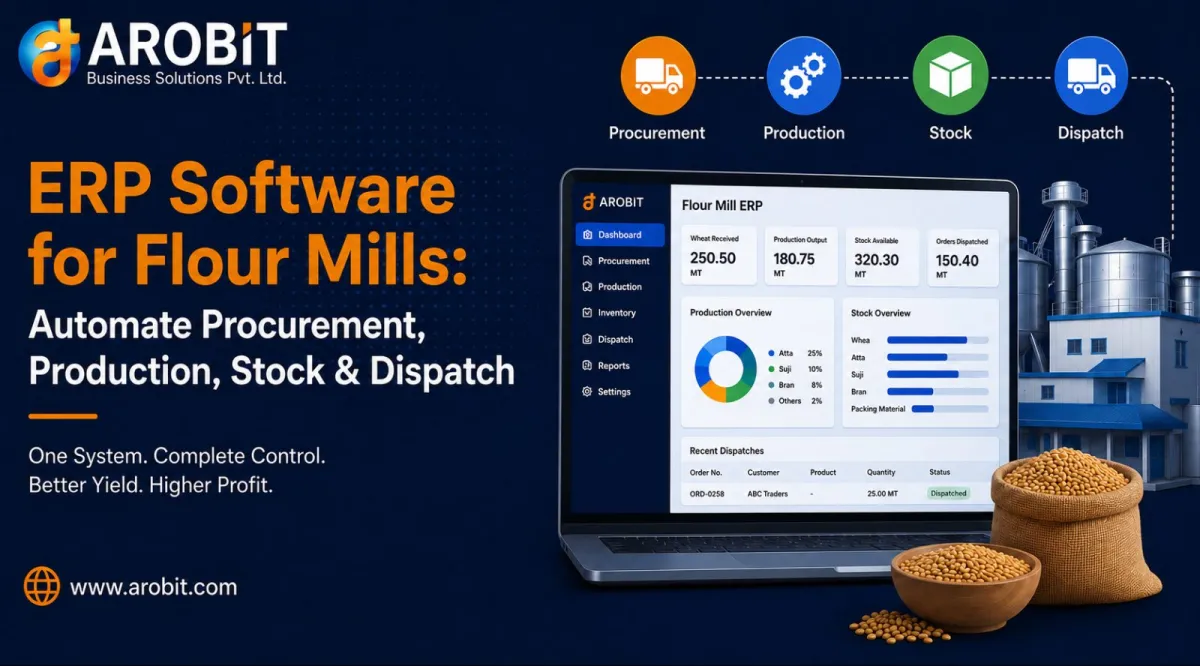
ERP software for flour mill businesses closes that gap. ERP software for flour mill operations ties grain procurement, production, stock, and dispatch into one system. The mill owner sees the real picture as it happens, not weeks later. This guide covers how it works across each of those four areas, and what to look for before you commit.
Why a Flour Mill Needs Industry-Specific ERP
A generic accounting package was not built for a mill. It does not understand a weighbridge or a moisture-based rate cut. Nor does it grasp the yield split between maida, atta, suji, and bran from a single lot of wheat.
ERP software for flour mill operations is different because it models the mill's actual physics. One tonne of wheat does not produce one tonne of flour. It produces several products in fixed proportions, plus waste, and the system has to account for every kilogram. A packaged tool that cannot do this forces staff into manual workarounds, which is where errors and leakage creep in.
This is why many mills move to custom ERP software rather than an off-the-shelf product. The processes are specific enough that the software has to fit the mill, not the other way around. This is also why a Manufacturing Software Development Company, familiar with how production plants run, is usually a better fit than a general web-software vendor.
The value of ERP software for flour mill businesses shows up clearly across four areas.
Grain Procurement: Getting the Intake Right
Procurement is where a mill's money enters, and where the first leaks appear.
ERP software for flour mill procurement connects the weighbridge directly to the system. When a wheat truck arrives, its gross and tare weights flow straight into a goods receipt, against the purchase order and the supplier. No slip travels to the office. No clerk retypes a number a day later.
The system handles the details a mill actually deals with. Moisture and quality readings adjust the rate automatically. Deductions for foreign matter are recorded against the lot. The supplier's account updates in real time, so payments and disputes rest on timestamped data rather than memory. For a mill buying from hundreds of farmers and traders, this alone removes a recurring source of argument and loss.
Production: Measuring What Actually Comes Out
Milling is where wheat becomes product, and where most mills lose visibility.
ERP software for flour mill production ends that guesswork. Without a system, output is estimated at the end of a shift. Nobody knows the true yield of each product from each lot. So nobody can tell whether a machine is underperforming or a batch of wheat was poor.
ERP software for flour mill production records the real conversion. It logs the wheat consumed, the maida, atta, suji, and bran produced, and the resulting yield percentage for every batch. When yield drops below the expected range, the number is visible immediately, and someone can ask why. Over time, the mill builds a true picture of which wheat sources and which machines deliver the best return. This is the data that turns milling from guesswork into a managed process.
Stock and Inventory: Making the Books Match the Godown
Stock is where ERP software for flour mill operations proves its worth daily. In most mills, book stock and physical stock quietly drift apart. A packaging entry gets missed. A dispatch goes unrecorded. By month end, someone spends days reconciling the difference.
Automation keeps the two aligned. Every movement, wheat into the mill, finished bags into the godown, stock out for dispatch, is captured as it happens. Business process automation matters here, because a flour mill holds several distinct inventories at once. These are raw wheat, work in progress, multiple finished products, packing material, and by-products. A good system tracks each separately and in real time.
Good custom ERP software gives the owner a stock figure to trust without a physical count every week. Shortages surface early. Slow-moving stock becomes visible. The godown and the books finally tell the same story.
Dispatch: Closing the Loop Cleanly
Dispatch is the last mile, and a messy one in many mills. Orders, loading, weighing, and invoicing often happen across disconnected registers, and errors here reach the customer directly.
ERP software for flour mill dispatch ties the last mile into the same system. An order is picked, the loaded vehicle is weighed, and the dispatch note and invoice generate from the same record. Stock reduces automatically as goods leave. The customer's account and the outstanding balance update instantly. Vehicle turnaround shortens because the paperwork no longer holds up the gate.
Closed properly, the whole loop runs from wheat intake to customer dispatch inside one system. Every step is accounted for.
A Real Example: A Flour Mill Automated End to End
This is not theoretical for Arobit. Since 2022, Arobit has built and run a custom ERP system for a flour mill client. The owner's goal was direct: automate everything, with the least manpower possible.
The brief was exactly the challenge above. The owner wanted the mill's operations, from intake to output to dispatch, handled by software rather than registers and staff time. Arobit's team studied the mill's specific workflow, built the system around it, and implemented it. In the client's own words, they wanted everything automated with the least manpower, and the solution was developed to fit that need.
The lesson from that engagement is simple. A flour mill does not need a generic ERP with a mill label stuck on it. It needs software shaped around how a mill actually runs, from the weighbridge to the yield sheet to the dispatch gate.
What to Check Before You Start
Choosing ERP software for flour mill operations comes down to a few specifics.
Weighbridge integration. The single biggest source of manual effort and error is the weighbridge. Make sure any system can connect to yours directly.
Yield and by-product handling. Confirm the software can model the multi-product output of milling, not just a single finished good. This is the test most generic tools fail.
Real-time stock across categories. The system must track wheat, work in progress, finished products, and by-products separately and live.
A partner who understands mills. Software is only as good as the fit. Choosing an experienced Manufacturing Software Development Company that has built for milling and production plants saves months of costly rework.
How to Get Started
Roll out ERP software for flour mill operations in stages. Start with your biggest leak. For most mills that is procurement reconciliation or the gap between book stock and godown stock. Automate that first, prove the accuracy, then extend across production and dispatch.
Do not try to digitise everything at once. A capable ERP software development company will recommend phasing: pick one process, get it right, and build from there. A mill that connects its weighbridge and gets stock accurate has already removed most of its recurring pain.
If the choice between a packaged tool and a custom build feels hard to judge, that is worth a conversation before you spend. Arobit builds exactly these systems.
What to Do Next
Before you weigh up ERP software for flour mill options, measure one thing. How many days does it take your mill to close its books and know its true stock each month? That number is the cost of running on registers instead of a system.
Then decide which process leaks the most money, and fix that one first. In a flour mill, where margins are thin and volumes are large, accurate real-time data is not a luxury. It is the margin itself.
Speak with our team to scope ERP software built around how your mill actually runs. Get in touch with Arobit





Comments
No comments yet. Be the first to share your thoughts!