





Ninety-three percent of businesses cannot see their own supply chain from end to end.
In a 2024 McKinsey survey, only about 7% of companies reported having end-to-end, real-time visibility across their supply chains. — McKinsey & Company
That single gap explains a surprising share of everyday business pain. A shortage discovered only when production stops. A shipment that goes quiet between the warehouse and the customer. An order status that takes three phone calls to piece together. In most companies the information exists somewhere. But it is scattered across procurement, inventory, warehousing, and delivery systems that do not talk to each other. Nobody can see the whole chain at once. The gaps between those systems are where delays, stockouts, and blind spots live.
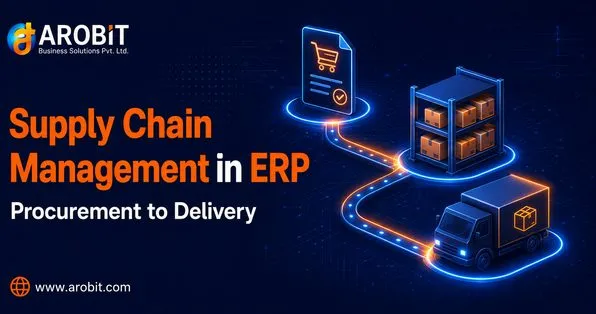
Supply Chain Management in ERP exists to remove that blindness. It connects every stage, from raising a purchase order to confirming a delivery, into one system with one view. This guide walks that journey and shows where the visibility actually comes from.
Why Visibility Is the Real Problem
Most supply chain failures are not really about logistics. They are about information arriving too late to act on, which is the gap Supply Chain Management in ERP is built to close.
When systems are disconnected, a shortage is discovered when production stops, not when the supplier first slipped. A delayed shipment surfaces when the customer complains, not when it could still be fixed. The chain is only as strong as the visibility across it, and for most businesses that visibility is poor.
- Blind spots. Without one connected view, problems hide in the gaps between separate systems until they become emergencies.
- Slow reactions. By the time a scattered team assembles the full picture, the window to act has often closed.
- Reactive management. Teams spend their days firefighting disruptions instead of preventing them.
Supply Chain Management in ERP addresses this at the root by holding the whole chain in one place. A problem anywhere becomes visible everywhere it matters.
Vendor Management: A Single Source of Truth for Suppliers
Supply Chain Management in ERP begins upstream, with vendors. Managing them across spreadsheets and inboxes is where the first cracks appear.
A capable Supply Chain Management in ERP centralises the supplier relationship:
- One vendor record. Every supplier's contact details, terms, pricing, and history live in one place, not in scattered emails.
- Performance tracking. On-time delivery, quality, and pricing are tracked over time, so vendor decisions rest on data rather than habit.
- Consolidated communication. Purchase orders, confirmations, and queries run through one system, leaving a clear record.
The payoff is better sourcing decisions and fewer surprises. When you can see which vendors deliver reliably and which cause delays, you buy from strength rather than guesswork. A late supplier is spotted early, rather than after it stops your line.
PO Automation: Removing the Manual Bottleneck
Purchase orders are the engine of procurement, and Supply Chain Management in ERP automates them. Processing them by hand is slow, error-prone, and hard to track. Automating them is one of the clearest wins in the whole chain.
Custom ERP software automates the purchase-order cycle end to end:
- Automatic PO generation. When stock hits a reorder point, the system raises a purchase order to the right vendor automatically.
- Approval workflows. POs route through the correct approvals by value or category, so control is built in rather than chased by email.
- Status tracking. Every PO's status, raised, approved, sent, acknowledged, received, is visible live.
- Three-way matching. The system matches the PO, the goods received, and the invoice, so you never pay for what did not arrive.
The result is a procurement process that runs faster with fewer errors, and a finance team that stops chasing paperwork. Automatic reordering also means materials are less likely to run out unnoticed, which is one of the most common causes of a stalled operation.
Inventory and Warehouse Visibility
Between procurement and delivery sits inventory, where Supply Chain Management in ERP protects both cash and accuracy. It is where cash and chaos both accumulate. A connected system keeps stock accurate without constant manual counts.
Supply Chain Management in ERP keeps inventory honest across the operation:
- Real-time stock levels. Every receipt, transfer, and dispatch updates stock as it happens, across all locations.
- Multi-warehouse view. Stock across several sites is visible in one place, so you can fulfil from the best location.
- Automated reorder points. The system flags what to reorder before it runs short, not after.
Because stock is accurate and visible, the business holds less safety buffer without risking stockouts, which frees up the cash that excess inventory quietly traps.
Last-Mile Tracking and Delivery Visibility
The final stretch is where Supply Chain Management in ERP proves itself: getting the product to the customer. Visibility has traditionally been weakest here, and customer patience thinnest. Closing this gap is what completes the chain.
A capable system extends visibility all the way to the door:
- Dispatch to delivery. Each shipment is tracked from the warehouse gate through to confirmed delivery.
- Real-time status. The current location and delivery estimate are visible, so a customer query is answered in seconds, not fifteen minutes.
- Proof of delivery. Confirmation and any exceptions are captured at handover and flow straight back into the system.
- Delivery performance. On-time rates and delays are measured, so problems in the delivery network are visible and fixable.
This is where the customer actually experiences your supply chain. When your team can see exactly where an order is, the answer changes. "Where is my delivery" becomes an instant, confident reply rather than a scramble.
How the Pieces Create End-to-End Visibility
Individually, each function solves a local problem. Connected, they create something bigger: one continuous view from purchase order to doorstep.
- Vendor management shows the health of your supply base.
- PO automation shows every order's status in real time.
- Inventory visibility shows exactly what you hold and where.
- Last-mile tracking shows where every delivery stands.
Joined together, these turn a set of disconnected snapshots into a single live picture. That is the whole point of Supply Chain Management in ERP, and the payoff is measurable:
McKinsey research found that manufacturers who improved supply chain visibility achieved a 15–20% improvement in inventory turns and reduced expedited-service costs by 30–50%. — McKinsey & Company
Off-the-Shelf or Custom?
Supply Chain Management in ERP is not always a custom build. Not every business needs a tailored system, and the honest test is how specific your chain is.
- A business with standard procurement and distribution may be well served by a packaged supply chain module at lower cost.
- A business with complex sourcing, multi-warehouse operations, or specific delivery models often finds a packaged tool forces awkward workarounds.
Where the differences are structural, custom ERP software earns its place, because the system can be built around how your chain actually runs. This is the kind of assessment an experienced ERP software development company should carry out before recommending anything.
A Note on Arobit's Approach
This is not theoretical for Arobit. Arobit builds custom ERP with integrated supply chain management, connecting procurement, inventory, warehousing, and delivery into one system with visibility across the whole chain.
That connection is the point. A supply chain module delivers its value only when procurement, stock, and delivery genuinely feed one another. Then the picture is whole, rather than stitched together after the fact. Building that integration well is what a capable development partner delivers, shaped around how a specific business sources, stores, and ships.
What to Check Before You Start
A few specifics separate a supply chain system that delivers visibility from one that just records transactions:
- End-to-end connection. Procurement, inventory, and delivery must update one another automatically, with no re-entry.
- Vendor performance tracking. The system should measure supplier reliability, not just store contacts.
- PO automation. Reordering, approvals, and three-way matching should be built in.
- Delivery visibility. Tracking should extend to confirmed delivery, not stop at the warehouse gate.
How to Get Started
Roll out Supply Chain Management in ERP in stages rather than all at once:
- Start with procurement and inventory, because accurate stock and automated reordering deliver value fast.
- Add vendor performance tracking next, to improve sourcing decisions.
- Then extend visibility through to last-mile delivery, closing the loop to the customer.
A business that connects procurement to inventory to delivery has already removed the blind spots that cause most supply chain surprises.
What to Do Next
Measure one thing first: how long it takes your team to answer where a specific order is, right now, from purchase to delivery. If that answer requires checking several systems and making a few calls, the gap between them is costing you speed, cash, and customer trust.
Then connect the stages that are most disconnected today, usually procurement and delivery, and build from there. Supply Chain Management in ERP pays back fastest when aimed at the widest blind spot first. In a business where a single blind spot can stop production or lose a customer, end-to-end visibility is not overhead. It is control over the chain your business runs on.
Speak with our team about an ERP that connects your supply chain from procurement to delivery. Get in touch with Arobit



Comments
No comments yet. Be the first to share your thoughts!