





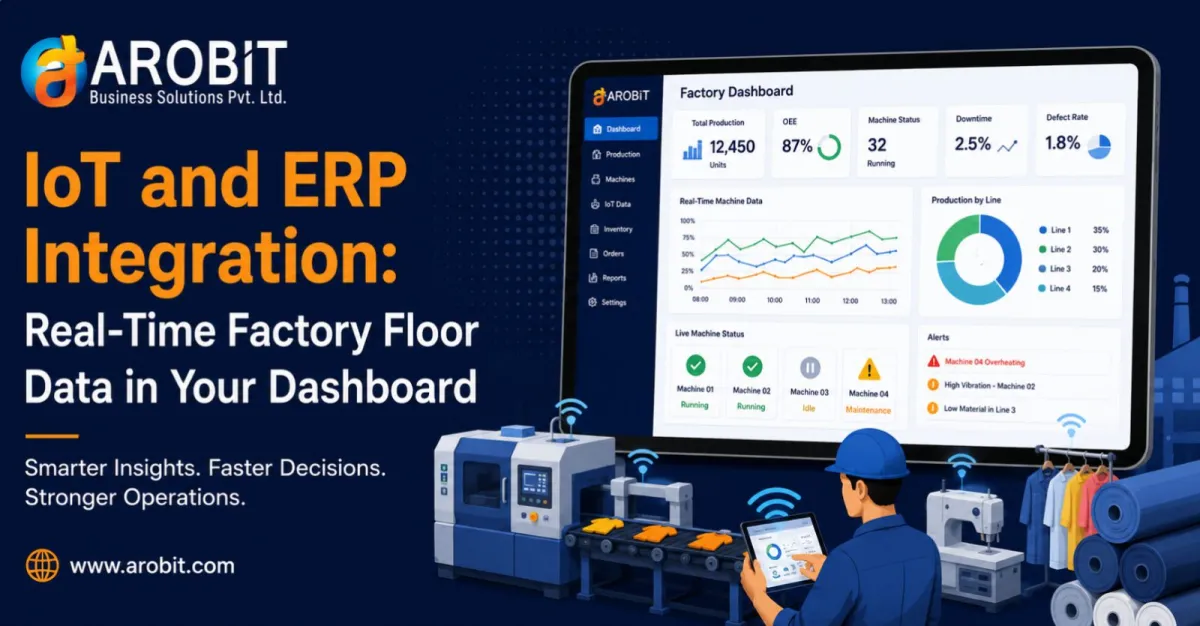
Most factory managers already have the data they need. It just arrives too late to act on.
A machine stops at 11:40 a.m. The supervisor notes it on a paper log. The log reaches the production office after the shift. By the time the number lands in the Enterprise Resource Planning (ERP) system, it is the next morning. The decision window has closed.
IoT and ERP integration removes that delay. Sensors, scanners, and weighbridges send readings straight into your ERP as events happen. Your dashboard stops showing yesterday's summary. It starts showing the plant as it is running right now.
This article explains how that connection works, what it changes operationally, and what to check before you start.
What IoT and ERP Integration Actually Means
The Internet of Things (IoT) refers to physical devices that collect and transmit data over a network. On a shop floor, that means machine sensors, barcode scanners, RFID readers, energy meters, and weighbridges.
Your ERP is the system of record. It holds work orders, inventory, purchase orders, dispatch schedules, and financial entries.
IoT and ERP integration is the layer that connects the two. Device readings are captured, cleaned, mapped to the correct ERP record, and written into the system automatically. A weighbridge reading updates the goods receipt note. A machine counter updates the work order. No one retypes anything.
The value is not the sensors themselves. Sensors have been on factory floors for years. The value is what happens when their output reaches the system where decisions get made.
McKinsey analysed where IoT economic value will concentrate. The factory setting sits at the top of the list:
"Factory, the setting with the largest potential economic value in 2030, could generate around $1.4 trillion to $3.3 trillion by 2030, or 26 percent of the total." — McKinsey & Company, IoT value set to accelerate through 2030
Manufacturers appear to agree on the direction. Deloitte's 2025 Smart Manufacturing Survey of 600 US manufacturing executives found strong consensus on its competitive weight:
92% of surveyed manufacturing executives believe smart manufacturing will be the main driver of competitiveness over the next three years. — Deloitte, 2025 Smart Manufacturing Survey
The Data Gap on Most Factory Floors
Manual data capture creates three predictable problems. Each one is a direct argument for IoT and ERP integration.
Lag. Production numbers reach management hours or days late. Corrective action arrives after the loss is already booked.
Transcription errors. A digit gets miskeyed on a dispatch challan. Stock records and physical stock drift apart. Someone spends a day reconciling them at month end.
Selective reporting. People record what looks reportable. Micro-stoppages, small rejections, and idle time often go unlogged. The gap between recorded output and actual capacity stays invisible.
Deloitte's research on asset maintenance quantifies part of that hidden cost. Poor maintenance strategies can reduce a plant's overall productive capacity by 5% to 20%. Unplanned downtime costs industrial manufacturers an estimated $50 billion each year.
Which Devices Feed Data Into Your ERP
| Device | Data captured | ERP record updated |
|---|---|---|
| Machine PLC or sensor | Cycle counts, run/stop status, temperature, vibration | Work order progress, downtime log |
| Barcode or QR scanner | Item movement, batch number, location | Inventory transaction, traceability record |
| Weighbridge | Inward and outward vehicle weight | Goods receipt note, dispatch note |
| RFID reader | Pallet or trolley movement | Work-in-progress location |
| Energy meter | Consumption per line or per shift | Cost centre allocation |
| Digital gauge | Dimensional or quality readings | Quality inspection record |
Most plants do not connect all of these at once. They start with one or two where the manual effort is heaviest.
What Changes After IoT and ERP Integration
Downtime becomes measurable. When machine status flows in automatically, you get accurate run hours and stoppage reasons. Overall equipment effectiveness stops being an estimate.
Inventory reflects reality. Scanner-driven movement entries keep book stock and physical stock aligned. Cycle counts get shorter.
Dispatch documentation speeds up. Weighbridge data populates the dispatch note directly. Vehicle turnaround time falls.
Costing improves. Actual machine hours and actual consumption replace standard assumptions. Your product costing gets closer to the truth.
Maintenance shifts from calendar to condition. Vibration and temperature trends flag developing faults. Work orders get scheduled before a breakdown, not after one.
Real examples exist outside manufacturing too. Deloitte's Industry 4.0 research documents Italian rail operator Trenitalia. The company moved from fixed-interval servicing to condition-based maintenance using sensor data. Its fleet covers more than 1,600 trains.
A Practical Scenario: The Weighbridge Problem
Consider a typical scenario in a mid-sized rolling mill that receives scrap by truck.
Before integration, the weighbridge operator writes the gross and tare weights on a slip. The slip travels to the stores office. A clerk keys the net weight into the ERP, usually the next day. Purchase reconciliation happens weekly. Disputes with suppliers over short receipts are common. No timestamped evidence exists to settle them.
After IoT and ERP integration, the weighbridge sends both weights directly to the ERP against the purchase order. The goods receipt note is generated the moment the truck leaves the bridge. The supplier's invoice is matched automatically. Disputes drop because every weighing carries a timestamp and a vehicle number.
The gain here is not exotic. It is one clerk's day returned each week, plus a reconciliation problem that stops recurring.
What to Check Before You Start
IoT and ERP integration is an engineering project, not a plug-in purchase. Four things determine whether it works.
Device readability. Older machines may not expose data. Some need a retrofit sensor or a PLC upgrade. Survey the floor before you budget.
Network coverage. Shop floors have metal, dust, and interference. Wi-Fi that works in the office may not reach the shed.
ERP openness. Your ERP needs Application Programming Interface (API) access or a supported integration layer. Closed systems limit what you can automate. This is one reason many manufacturers choose custom ERP software when device connectivity is a long-term requirement.
Data governance. Decide who owns each data point, what happens when a sensor fails, and how bad readings are flagged. Without this, the dashboard loses credibility fast.
Start with one production line and one or two device types. Prove the data is accurate. Then extend.
Frequently Asked Questions
Does IoT and ERP integration require replacing existing machines?
Usually not. Most older machines can be fitted with external sensors or connected through their existing controller. Full replacement is rarely the starting point.
How long does a first phase of IoT and ERP integration take?
A single-line pilot covering one or two device types typically runs a few weeks to a few months. The timeline depends on machine accessibility, network readiness, and how much ERP customisation is needed.
What if our ERP is a standard off-the-shelf product?
Many packaged systems support integration through APIs or middleware. If yours does not, an ERP software development company can build a connector layer, or you can evaluate a custom build.
How do we know the data is trustworthy?
Run parallel manual and automated capture for a short period. Compare the two sets. Investigate every gap before you retire the manual process.
Getting Started
The plants that get value from IoT and ERP integration are not the ones with the most sensors. They are the ones that picked a specific operational problem. They connected the minimum data needed to solve it. Then they made someone accountable for acting on what the dashboard showed.
Pick your slowest reconciliation. Pick your least understood downtime. Start there.
Speak with our team to explore an integration approach tailored to your plant and your existing ERP. Get in touch with Arobit




Comments
No comments yet. Be the first to share your thoughts!