





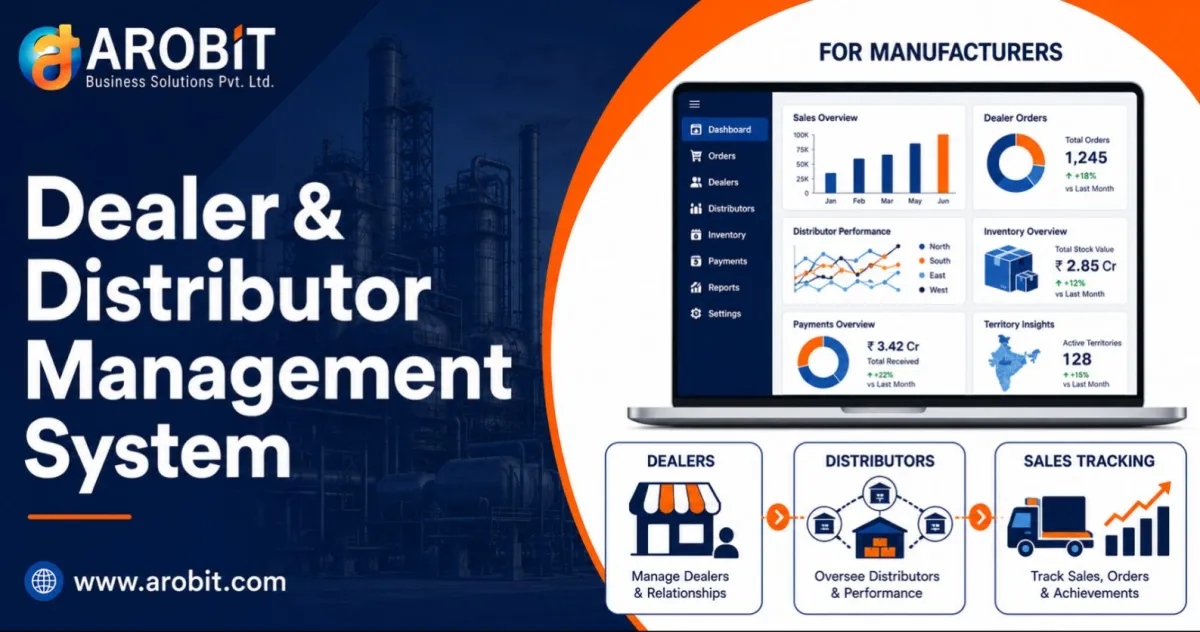
Most manufacturers don't run their dealer network through one system — they run it through phone calls, WhatsApp groups, and a sales team that remembers who ordered what last month. It works when the network is small. It stops working once there are 50, 100, or 300 dealers spread across states, each placing orders differently and reporting stock on their own schedule. This is usually the point where a dealer distributor management system for manufacturers stops being optional and becomes the only way to keep the channel visible. Most manufacturers reach this point without ever having worked with a crm software development company before, simply because the dealer network grew faster than the tools tracking it.
Where manual dealer and distributor management breaks down
A regional sales manager calls a dealer to check stock. The dealer isn't sure without checking a physical register. An order comes in over WhatsApp, gets typed into a spreadsheet later, and by the time it reaches billing, the discount slab has already changed. None of this is anyone's fault — it's what happens when a growing dealer network runs on manual processes.
The clearest sign of the gap is secondary sales — what dealers actually sell to retailers and end customers. Without secondary sales tracking software, manufacturers only see what they've shipped to a dealer, not what's actually moving off the shelf. That blind spot is exactly what a dealer distributor management system for manufacturers is built to close. It's usually the first thing sales leadership notices once they start asking questions a spreadsheet can't answer. Dealer management software for manufacturers exists specifically to make that blind spot visible again.
What a complete system should cover, end to end
A well-built dealer distributor management system for manufacturers isn't just an order form. It typically covers five connected stages that, together, define what a complete dealer distributor management system for manufacturers actually does:
- Lead capture: new dealer inquiries and onboarding requests logged in one place, not scattered across emails
- Order management: a dealer order management system where dealers place, track, and reorder without a phone call
- Stock visibility: dealer stock visibility software showing what's on hand at each dealer location, updated in real time
- Billing: distributor billing software that applies the right pricing, discount slab, and credit terms automatically
- Dispatch: a single dashboard showing what's shipped, what's in transit, and what's pending
Each stage feeds the next, so a lead becomes a dealer, a dealer's order becomes a shipment, and a shipment becomes an invoice — without re-entering the same information three times.
Lead capture and dealer onboarding
Most manufacturers still onboard new dealers through paperwork and phone follow-ups, with no record of who inquired, when, or why they didn't convert. A manufacturer dealer CRM fixes this by tracking every inquiry from first contact through approval and first order. CRM for dealer network management also gives regional managers visibility into which territories are under-served and which dealers have gone quiet, instead of relying on memory. This lead-capture stage is often the first module manufacturers add when they move to a dealer distributor management system for manufacturers, since it's the easiest gap to see and fix.
Order, stock, and secondary sales visibility
Once a dealer is onboarded, the real friction starts. A dealer portal for manufacturers lets dealers place orders directly through a dealer order management system. They can see live pricing and check their own credit limit, instead of calling a sales rep for basic information. On the manufacturer's side, an ERP for distributor management ties that order into production planning and inventory. That way, a sudden spike in demand from one region doesn't catch the factory off guard. Dealer stock visibility software closes the loop from the other direction — showing what's actually sitting at each dealer location, not just what was shipped. This is where manufacturing crm software and ERP start to overlap, since order, stock, and production planning all depend on the same live data.
Billing and dispatch, closing the loop
Billing is where many manual systems fall apart first. A single missed discount slab or an outdated credit limit can turn into a dispute that takes weeks to resolve. Distributor billing software removes most of this friction by applying the correct pricing and credit rules automatically, every time. This is one of the two places where manufacturing crm software earns its cost back quickly. Billing rules, once configured, apply the same way for every dealer under a dealer distributor management system for manufacturers. Dispatch works the same way — a shared view of what's packed, shipped, and delivered removes the daily "where is my order" calls that eat up a sales team's time.
McKinsey research on industrial B2B buyers found that only about 20% of industrial companies preferred digital interactions with suppliers in 2017. That figure has since risen to around 67%, as buyers increasingly expect the same order visibility and self-service they get as consumers.
Why manufacturers in India are moving this direction now
Adoption of structured systems for dealer and distributor management is still low relative to how common the problem is. Arobit worked with an auto components manufacturer whose dealer network placed orders over phone and WhatsApp, with secondary sales tracked only through monthly dealer visits. A distributor management software India deployment gave dealers a self-serve portal and added secondary sales tracking software. Combined with real-time stock visibility for the sales team, monthly reconciliation dropped from days to hours.
A nationwide survey of over 2,800 Indian MSMEs by the Research and Information System for Developing Countries (RIS), backed by the Mastercard Center for Inclusive Growth, found that only around 13% currently use CRM software of any kind — leaving most manufacturer-dealer relationships to run on manual coordination.
Custom crm development matters here. Most manufacturers' dealer workflows — credit terms, regional pricing, scheme-based discounts — don't map cleanly onto generic software built for a different kind of sales cycle. A dealer distributor management system for manufacturers built this way tends to see faster adoption from the dealer network itself. It fits how they already order, rather than forcing a new process on top of an old one. That's the real value custom crm development adds over an off-the-shelf template.
Is this worth it for your business right now
Not every manufacturer needs to move immediately. But it's worth a serious look when:
- Sales teams spend more time chasing order status than closing new business
- Secondary sales data only arrives through manual dealer visits or monthly calls
- Billing disputes over pricing or discount slabs are a recurring headache
- The dealer network has grown past what one or two people can track manually
Dealer management software for manufacturers doesn't need to cover every function on day one — starting with order visibility and secondary sales tracking usually delivers the fastest, most visible win. Even a lightweight rollout of CRM for dealer network management, focused only on lead capture and order status, tends to pay for itself within a few months.
Frequently asked questions
Does a dealer distributor management system replace the sales team? No. A dealer distributor management system for manufacturers removes the manual coordination work — order status calls, stock checks, billing corrections. That frees the sales team to spend more time on relationships and growth instead of admin.
How long does it take to roll out a dealer portal for manufacturers? Most rollouts start with one or two regions as a pilot, covering order management and stock visibility first. A full rollout across a national dealer network typically takes a few months, not a single cutover.
Is a custom system necessary, or can manufacturers use off-the-shelf CRM software? Generic CRM software rarely handles scheme-based pricing, credit limits, or multi-tier distributor hierarchies well. This is usually where a crm software development company builds something closer to how the business actually operates. A well-built manufacturer dealer CRM often combines the dealer relationship side with an ERP for distributor management on the operations side.
Bringing it together
Manufacturers don't lose visibility into their dealer network all at once — it happens gradually, as the number of dealers, orders, and regions outgrows what phone calls and spreadsheets can track. A dealer distributor management system for manufacturers closes that gap by connecting lead capture, orders, stock, billing, and dispatch into one system instead of five disconnected habits.
Arobit builds these systems around how manufacturers' dealer networks actually operate, rather than forcing a generic CRM template onto a channel structure it wasn't designed for. As more distributor management software India deployments move from pilots to full rollouts, manufacturers who start early tend to have an easier time bringing their dealer network along.
Build a Solution Tailored to Your Business — talk to Arobit about mapping your dealer workflows into one connected system.




Comments
No comments yet. Be the first to share your thoughts!