





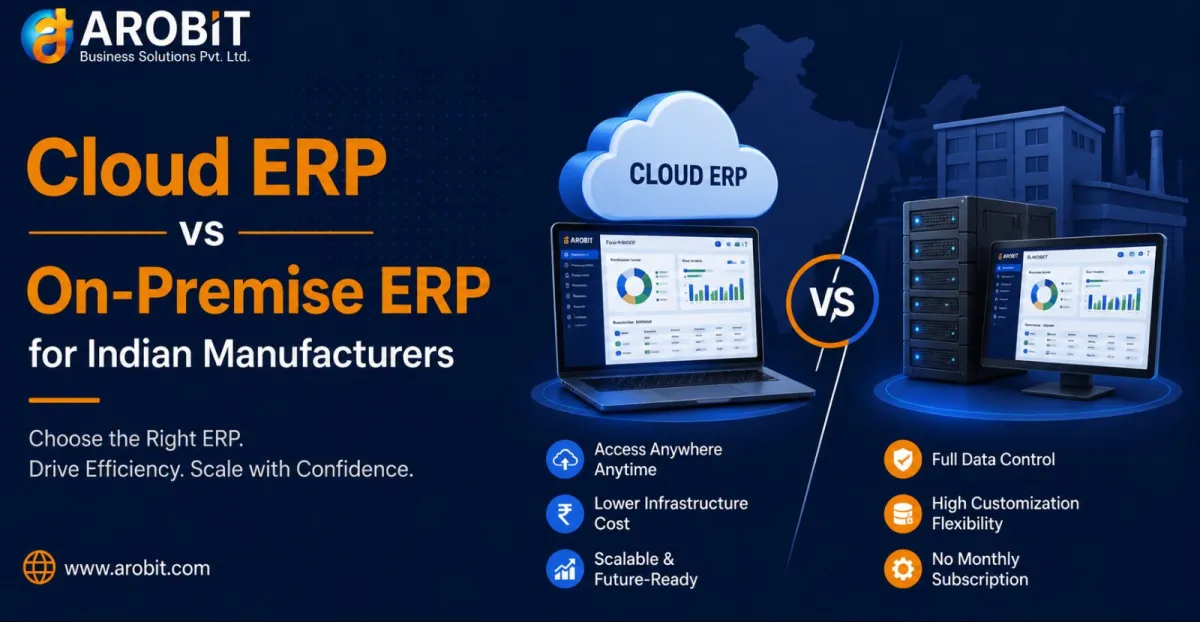
Every Indian manufacturer weighing an ERP eventually hits the same fork in the road. Should the system live on a vendor's servers, reached over the internet, or on hardware inside your own factory? The Cloud ERP vs On-Premise ERP question sounds technical, but it is really a business decision about cost, control, and how reliable your connectivity is.
There is no single right answer. A textile unit in a metro with fibre internet will reach one conclusion. A foundry in a small town with patchy power will reach another. Both can be correct. This guide compares the two models across the three factors that actually decide it for Indian manufacturers: cost, data control, and connectivity.
The Two Models in Plain Terms
Before comparing, it helps to define both clearly, without the jargon.
In the Cloud ERP vs On-Premise ERP pairing, here is what each side means.
Cloud ERP runs on the vendor's remote servers and is delivered over the internet as a subscription. There are no physical servers to buy, no manual upgrade cycles, and no dedicated IT team just to keep it running. You pay a recurring fee and access it through a browser.
On-Premise ERP runs on hardware you own, installed inside your own premises. You buy the software licence and the servers, and your team maintains both. You control the environment completely, and you carry the responsibility for it completely.
The Cloud ERP vs On-Premise ERP choice is really a trade between these two postures: renting a managed service, or owning and running your own.
The Cloud ERP vs On-Premise ERP comparison rests on three factors. Cost is the first.
Factor 1: Cost
In the Cloud ERP vs On-Premise ERP comparison, cost is where most manufacturers start. It is also where the headline price misleads them.
On-premise looks like a one-time purchase, but it is not. Beyond the software licence sit servers, infrastructure, periodic hardware refreshes, version upgrades, and the IT staff to manage it all. In India, on-premise licences for an SME typically run higher upfront than cloud, and the hidden costs stack up over the years.
Cloud shifts that spending from a large upfront capital outlay to a predictable monthly or annual subscription. A custom ERP software build can be delivered on either model, so the deployment choice is separate from whether the system is tailored to you. For Indian SMEs, cloud ERP commonly runs ₹2,000 to ₹10,000 per user per month for mid-range systems. There is no server hardware to buy.
The long-run comparison is where the gap shows clearly. Multiple 2026 analyses agree on total cost of ownership:
Cloud ERP reduces total cost of ownership by 30–50% over five years compared to on-premise deployments. — Industry TCO research, 2026
For an Indian SME specifically, the saving comes from avoiding server costs, annual infrastructure spend, periodic upgrade fees, and dedicated IT salaries. The market has noticed:
78.6% of organizations choosing a new ERP system in 2024 selected a cloud solution. — ERP adoption research, 2024
That said, cost is not one-directional. A manufacturer that already owns capable server infrastructure may find on-premise competitive. So might one running a very large user base on a flat-licence model over a long horizon. The honest answer depends on your specific numbers.
Factor 2: Data Control and Security
On data control, the Cloud ERP vs On-Premise ERP debate has shifted most, and old assumptions now mislead.
For years, the belief was that on-premise is inherently more secure because your data sits inside your own building. That framing is now outdated. Both models carry risk, and the real question is which model your organisation has the maturity to govern well.
On-premise gives you complete physical control of your data. For manufacturers with strict regulatory requirements, or genuine reasons to keep data entirely in-house, this control is a real advantage. The flip side is that all security, backups, and disaster recovery become your responsibility. That demands skilled IT staff many mid-sized manufacturers do not have.
Cloud places your data on the vendor's infrastructure, which unsettles some manufacturers instinctively. In practice, reputable cloud providers invest more in security, redundancy, and automated backups than most individual factories can. The trade is control for capability: you rely on the vendor, but you inherit their security scale.
There is a distinctly Indian angle here. Cloud systems apply compliance updates automatically, which matters under India's GST e-invoicing mandates. A cloud ERP updates for regulatory changes without a manual upgrade project, while an on-premise system needs someone to implement each change. For a manufacturer above the e-invoicing turnover threshold, that automatic compliance is a quiet but real benefit. Well-built custom ERP software handles these updates without a manual project each time.
Factor 3: Connectivity
Connectivity is the factor that most often settles the Cloud ERP vs On-Premise ERP question for an Indian manufacturer. It is also the one generic comparisons ignore.
Cloud ERP needs reliable internet. If your plant sits in a metro or an industrial area with stable broadband, this is a non-issue, and cloud's advantages apply fully. But if your factory sees frequent internet drops or unstable power, cloud-only becomes a risk. Core operations can halt every time the connection fails.
On-premise ERP keeps working without the internet, because it runs on local hardware. Picture a plant in a poorly connected area. A stalled production line or a blocked dispatch gate costs real money by the hour. There, offline resilience is not a minor feature. It can be the deciding factor.
This is why many Indian manufacturers land on a middle path. A hybrid approach keeps connectivity-critical operations running locally while using the cloud for reporting, analytics, and multi-site consolidation. The right build depends on your plants and your networks. That is exactly the assessment a deployment decision should start with, rather than assume.
A Side-by-Side Summary
| Factor | Cloud ERP | On-Premise ERP |
|---|---|---|
| Upfront cost | Low, subscription-based | High, hardware and licences |
| Five-year TCO | Typically 30–50% lower | Higher once hidden costs count |
| IT staff needed | Minimal | Dedicated team |
| Data control | Vendor-managed | Fully in-house |
| Compliance updates | Automatic | Manual |
| Works offline | No, needs internet | Yes, runs locally |
| Best suited to | Well-connected plants, lean IT | Poor-connectivity or strict-control sites |
How to Decide for Your Plant
The Cloud ERP vs On-Premise ERP decision comes down to a few honest questions about your own operation.
Ask how reliable your internet and power genuinely are, across every location, not just head office. Ask whether you have the IT staff to run and secure on-premise infrastructure. Ask whether any regulation or contract requires your data to stay physically in-house. Ask how much upfront capital you can commit versus a steady monthly cost.
The Cloud ERP vs On-Premise ERP answer then falls out naturally. If your connectivity is strong and your IT team is small, cloud usually wins on both cost and effort. If a plant runs in a poorly connected area or under strict data rules, on-premise or a hybrid earns its place. Most Indian manufacturers with multiple sites end up somewhere in between, which is why a tailored assessment beats a blanket recommendation.
What to Do Next
The Cloud ERP vs On-Premise ERP choice should follow the facts, not a preference. Do not start from a preference for cloud or on-premise. Start from your plants. Map the connectivity, IT capacity, compliance needs, and budget for each site. Then let those facts point to the model, or the hybrid mix, that fits.
The Cloud ERP vs On-Premise ERP trade-offs are rarely obvious. If they feel hard to weigh, that is worth a conversation before you commit budget. A capable ERP software development company will assess your specific plants and networks before recommending a deployment model, rather than pushing one by default.
Speak with our team to assess whether cloud, on-premise, or a hybrid ERP fits your manufacturing operation. Get in touch with Arobit


Comments
No comments yet. Be the first to share your thoughts!