





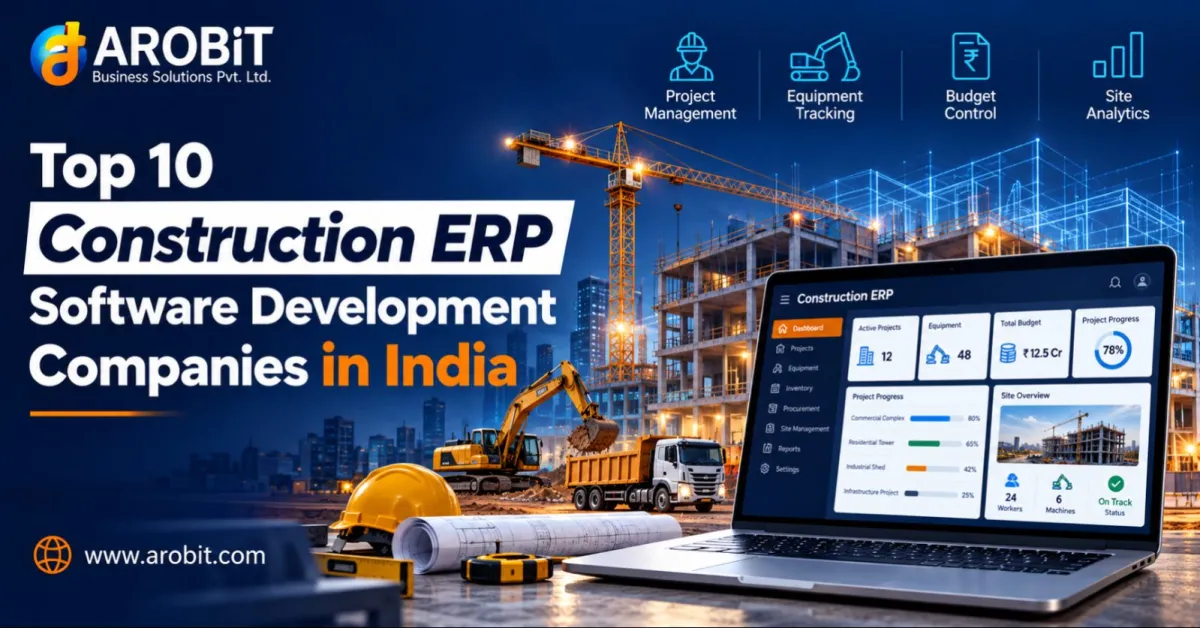
A site engineer texts a cement delivery update to a WhatsApp group. Two days later, someone at head office finally logs it against the budget. By then the site has already used more material than the work order allowed, and nobody notices until the numbers are reconciled at month-end.
That lag is exactly what construction ERP software development companies in India are built to close. This guide profiles ten of them, what each one is actually good at, and what to check before you sign a contract.
Why spreadsheets and generic software break down on construction sites
Construction runs on thin margins. Those margins disappear fast when three things stay disconnected: planned cost, actual material movement, and what a subcontractor is owed. A few patterns show up across almost every mid-sized construction and real estate firm.
- Stale cost data: budgeted-versus-actual cost by BOQ or WBS line sits in spreadsheets that nobody reconciles until the numbers are already out of date.
- No single owner for material stock: cement, steel, and other materials move across sites with no shared view, so wastage goes unnoticed until it shows up as an overrun.
- Hand-calculated subcontractor bills: running account (RA) bills worked out manually slow down payment and invite disputes over measured quantities.
- Paper-based site reporting: daily progress reports (DPRs) filed on paper reach head office days after the work actually happened.
Consider a contractor running eight active sites. On any given day, nobody could tell whether a specific work item was running over or under budget. That gap closed only once a month, at reconciliation. After moving cost tracking, material issue, and RA billing into one system, the same gap closed within hours instead of weeks.
"India's capital investment outlay for infrastructure was increased to ₹11.21 lakh crore (US$128.64 billion) for FY 2025-26, equal to 3.1% of GDP."
India Brand Equity Foundation, Infrastructure Sector Report
That scale of investment means more sites, more subcontractors, and more transactions running through whatever system a contractor currently relies on.
Top 10 construction ERP software development companies in India
The list below runs from custom development firms to established construction-focused platforms, drawn from public information about each company's construction ERP work. Most construction ERP software companies in India fall into one of these two camps.
1. Arobit Business Solutions
Arobit Business Solutions, based in Kolkata, works as an ERP software development company. It builds construction ERP around a contractor's own project structure, rather than a fixed template. Its systems typically cover BOQ-based costing, multi-site inventory, and subcontractor billing, alongside adjacent systems for building-materials producers supplying the same projects.
- Custom BOQ and WBS cost-control modules built around a contractor's existing cost codes
- Multi-site material tracking with site-to-site transfer visibility
- Automated RA billing tied to measured quantities
2. Xpedeon (Amphion)
Xpedeon offers an end-to-end construction ERP suite with strong cost control, multi-project support, and mobile-first field tools. It is positioned for mid-to-large contractors managing several concurrent projects.
- Cost control spanning multiple concurrent projects
- Mobile-first tools for field data capture
- Built for mid-to-large contracting firms
3. Ramco ERP (Engineering and Construction Suite)
Ramco's Engineering and Construction Suite is a full enterprise solution integrating finance, HR, and procurement with project management, aimed at larger construction and infrastructure firms.
- Finance, HR, and procurement integrated with project management
- Built for larger infrastructure and construction firms
- Enterprise-wide reporting across projects
4. In4Suite ERP (In4Velocity)
In4Suite covers the full land-to-handover lifecycle for real estate developers, connecting land acquisition, construction, sales, and customer handover in one platform.
- Land-to-handover lifecycle in a single platform
- Links land acquisition, construction, and sales data
- Purpose-built for real estate developers
5. StrategicERP (ITAakash)
StrategicERP combines AI-driven automation with highly customizable modules, targeting mid-to-large construction firms and real estate developers that need configurable workflows.
- AI-driven automation across configurable modules
- Suited to firms with non-standard workflows
- Targets mid-to-large construction and real estate firms
6. SoftTech OPTICON
SoftTech OPTICON offers comprehensive construction ERP modules with CAD and BIM integration. It also interfaces with Primavera and MS Project for firms already using those scheduling tools.
- Native CAD and BIM integration
- Interfaces with Primavera and MS Project
- Fits firms already invested in scheduling tools
7. Farvision ERP (Gamut)
Farvision ERP is an integrated platform covering construction financials, project tracking, and multi-site inventory. It is built for real estate and construction businesses managing several sites at once.
- Combines financials, project tracking, and inventory
- Built for multi-site real estate and construction firms
- Single platform across several concurrent projects
8. Tactive
Tactive focuses on infrastructure contractors, emphasizing tendering, budgeting, and equipment management for heavy civil and infrastructure work.
- Strong tendering and budgeting workflows
- Equipment management for heavy civil work
- Built specifically for infrastructure contractors
9. NWAY ERP
NWAY ERP is a GST-compliant platform with strong mobile apps, built for multi-location contractors who need field data captured directly from site.
- GST-compliant billing out of the box
- Strong mobile apps for field teams
- Built for multi-location contractors
10. Inniti ERP
Inniti ERP centers on project-based estimated-versus-actual cost tracking and BOQ or WBS management, aimed at contractors and infrastructure companies that need tight budget control.
- Estimated-versus-actual cost tracking by project
- BOQ or WBS-based budget management
- Aimed at contractors needing tight budget control
Quick comparison: construction ERP vendors
| Company | Type | Best for |
|---|---|---|
| Arobit Business Solutions | Custom development | Construction ERP built around your exact project and billing workflow |
| Xpedeon (Amphion) | Construction-specific product | Mid-to-large contractors running multiple concurrent projects |
| Ramco ERP | Enterprise suite | Large infrastructure firms needing full finance and HR integration |
| In4Suite ERP | Real estate lifecycle product | Developers managing land-to-handover workflows |
| StrategicERP | Configurable ERP product | Mid-to-large firms needing customizable, AI-assisted workflows |
| SoftTech OPTICON | Construction ERP product | Firms using CAD, BIM, or Primavera scheduling tools |
| Farvision ERP | Real estate and construction product | Multi-site financial and inventory tracking |
| Tactive | Infrastructure-focused product | Tendering, budgeting, and equipment-heavy contractors |
| NWAY ERP | Mobile-first product | Multi-location contractors needing field data capture |
| Inniti ERP | Cost-control product | Contractors focused on BOQ and WBS budget tracking |
What to check before you sign
Not every system built for general manufacturing or trading businesses handles construction well. Before you commit to construction ERP software development, run through this checklist:
- Does it handle BOQ or WBS costing the way your team already works? Ask for a demo using your actual cost codes, not a generic project view.
- Can it manage multi-site inventory without a manual reconciliation step? Transfers between sites should be traceable in the system itself.
- Does it automate RA billing? Subcontractor bills should calculate against measured quantities without a spreadsheet in between.
- Does it support GST-compliant billing built for construction-specific rules? Generic invoicing modules often miss construction-specific documentation needs.
- Is it a custom build or a packaged product? Both are valid, but a custom build costs more upfront and fits workflows a packaged product cannot.
- Does the vendor have construction references you can call? A live construction client running the system today is worth more than a feature list.
Does your current process still depend on WhatsApp updates from site engineers, paper DPRs, or hand-calculated RA bills? That is the signal to start shortlisting vendors. Patching the existing process further usually just delays the same conversation.
What the data says about India's construction sector
A few figures explain why digitization has become a priority for construction and building-materials businesses operating in India.
| Finding | Result | Source |
|---|---|---|
| Infrastructure capital outlay, FY 2025-26 | ₹11.21 lakh crore (US$128.64 billion) | India Brand Equity Foundation |
| Infrastructure investment share of GDP by FY29 | 6.5%, up from 5.3% in FY24 | Morgan Stanley, cited by IBEF |
| Cement demand growth, FY25-27 | 7-8% CAGR | India Brand Equity Foundation |
| Construction FDI inflows, Apr 2000-Jun 2025 | US$27.21 billion | India Brand Equity Foundation |
"Cement demand is projected to remain strong, with a compound annual growth rate of 7-8% over FY25-27."
India Brand Equity Foundation, Infrastructure Sector Report
Rising cement demand puts more pressure on the plants that run on concrete ready-mix manufacturing solutions. Their production and dispatch scheduling connects directly to the same construction projects.
"Labor-productivity growth in construction has averaged only 1 percent a year over the past two decades, compared with 2.8 percent for the total world economy."
McKinsey Global Institute, Reinventing Construction
Fragmented systems are a large part of that productivity gap. When cost tracking, material inventory, and billing data live in separate spreadsheets, firms lose the coordination gains that integrated software delivers on comparable projects.
What changes once ERP replaces the spreadsheets
The case for construction ERP software development becomes clear once the manual work behind it disappears.
- Real-time cost visibility, instead of discovering overruns weeks after they happened.
- Cleaner subcontractor billing, with RA bills calculated against measured quantities automatically.
- Better material control, since multi-site inventory tracking catches wastage before it hits the budget.
- Faster site-to-office reporting, as DPRs move into the system the same day work happens.
- Room to grow, since a custom system can add projects, sites, or reporting fields without a platform rebuild.
A well-implemented system pays for itself through the cost overruns it prevents. A contractor evaluating Top 10 Best Custom ERP Solutions Providers in India is often looking at exactly this kind of return. The same logic extends to manufacturers reviewed in Top 10 Custom Manufacturing ERP Software Development Companies in India.
Frequently asked questions
Q: What are the top construction ERP software development companies in India?
Ten companies stand out for construction ERP work in India. They include Arobit Business Solutions, Xpedeon, Ramco ERP, and In4Suite ERP. They also include StrategicERP, SoftTech OPTICON, Farvision ERP, Tactive, NWAY ERP, and Inniti ERP. Together they cover both custom development and established construction-focused platforms.
Q: How much does construction ERP software cost in India?
Cost depends on scope. A packaged construction ERP product can start in the low lakhs per year for a small contractor. A custom-built system covering BOQ costing, multi-site inventory, and RA billing for a large multi-project firm can run into several lakhs to a few crore. The exact figure depends on the number of modules and users.
Q: How long does construction ERP implementation take?
A packaged product with standard modules can go live in 6 to 10 weeks. A custom build that includes BOQ costing, multi-site inventory, and subcontractor billing workflows typically takes 3 to 6 months. The exact timeline depends on how many sites and integrations are involved.
Next steps for choosing a construction ERP partner
For contractors sizing up construction ERP software companies in India, Arobit works as a technology partner with 15+ years of experience across 15+ countries. Its client base includes contractors, real estate developers, and building-materials manufacturers running complex multi-site operations.
Request an ERP consultation to evaluate which construction ERP approach fits your project and site structure.





Comments
No comments yet. Be the first to share your thoughts!