





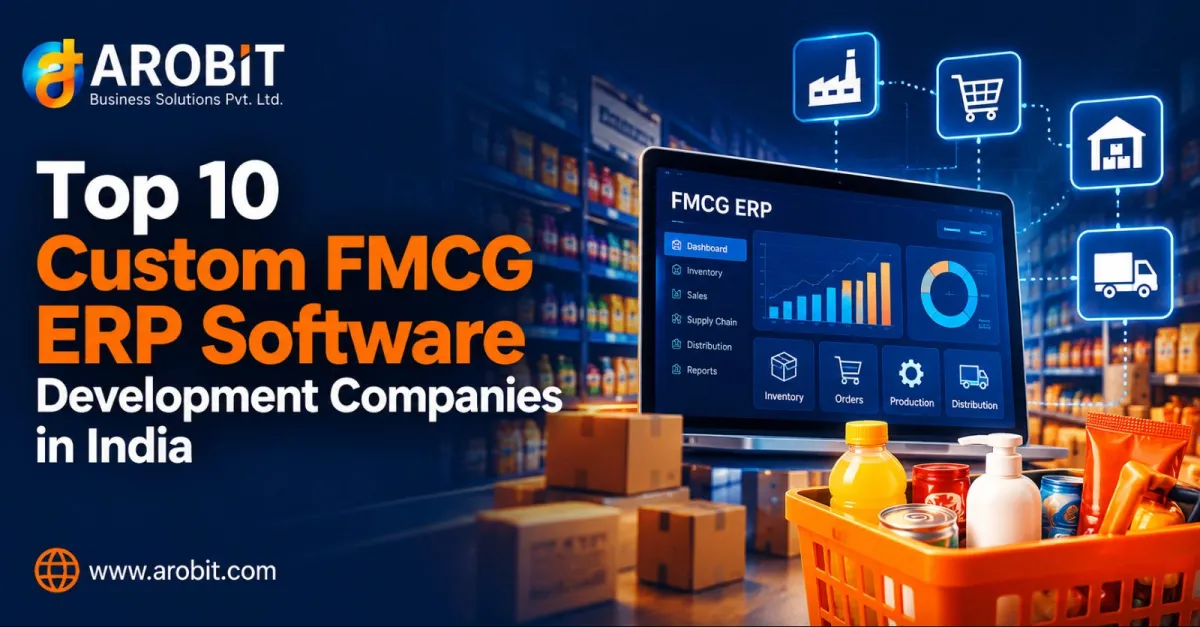
As of 2026, India's FMCG sector continues to expand rapidly, having generated ₹20,73,300 crore (US$245.39 billion) in 2024, according to the India Brand Equity Foundation. Behind that number sits a daily operational challenge: tracking stock, schemes and secondary sales across thousands of outlets. That is why FMCG manufacturers and distributors are turning to FMCG ERP software development companies in India. These companies build systems around a distributor's exact model, not a generic template.
This guide covers the top 10 companies building FMCG ERP software in India. It looks at what each one focuses on, and what to check before you choose one.
Why FMCG businesses need custom ERP software
Generic accounting tools rarely keep up with how fast FMCG products move. A few problems repeat across the industry:
- Expiry-sensitive stock: perishable and short-shelf-life items need batch tracking, not just a count in a ledger.
- Scheme leakage: discounts, trade schemes and loyalty offers are hard to reconcile by hand across distributors.
- Fragmented visibility: secondary sales data from field staff and van sales often reaches head office days late.
- GST compliance: high transaction volumes make manual e-invoicing and e-way bill generation error-prone.
A mid-sized FMCG distributor covering roughly 5,000 retail outlets across two states illustrates this well. When trade scheme discounts are tracked in spreadsheets, reconciliation often runs two to three weeks behind the sales cycle, and some scheme claims get paid twice while others get missed entirely. Moving that calculation into a rules-based system typically closes the gap within the first couple of billing cycles, since the system applies scheme logic the same way every time.
A system built for these patterns removes the manual reconciliation that eats into distributor and manufacturer margins. This is the gap that purpose-built ERP for FMCG manufacturers is designed to close.
What the data shows about FMCG operations in India
A few figures explain why distribution technology has become a priority for FMCG companies.
| Finding | Result | Source |
|---|---|---|
| India FMCG market size, 2024 | ₹20,73,300 crore (US$245.39 billion) | India Brand Equity Foundation |
| Rural India's share of affordable-premium FMCG volume, 2025 | 51% | India Brand Equity Foundation |
| Retail outlets reached by a single large FMCG distributor network | 1.42 million | India Brand Equity Foundation, citing Dabur's distribution network |
| GST e-invoicing mandatory turnover threshold | ₹5 crore | CBIC Notification No. 10/2023-Central Tax |
"In 2025, rural India overtook cities in affordable premium FMCG consumption, accounting for 51% of volume share and 42% of super-premium sales."
India Brand Equity Foundation, FMCG Industry Report
At this scale, a distributor or manufacturer running thousands of outlets on spreadsheets is working against the numbers, not with them.
Key features to look for in FMCG ERP software
Not every ERP for FMCG manufacturers covers the same ground. A system built for discrete manufacturing rarely handles scheme and expiry logic well, so this is not a checklist to skip. Before you shortlist a vendor, confirm the system handles these areas:
- Batch and expiry tracking with automated alerts before stock ages out.
- Scheme and promotion management that calculates discounts and rebates automatically.
- Van sales and secondary sales tracking that syncs field data in near real time.
- Multi-warehouse and multi-location inventory with transfer automation.
- GST-compliant billing, including e-invoicing above the ₹5 crore threshold.
- Distributor and retailer onboarding that scales without added headcount.
Top 10 FMCG ERP software development companies in India
The list below moves from custom development firms to established ERP platforms, based on public information about each company's FMCG focus.
1. Arobit Business Solutions
Arobit Business Solutions, based in Kolkata, builds FMCG software solutions designed around a distributor's or manufacturer's own workflow rather than a fixed template. Its work spans inventory control, distribution, mobile field-sales apps and reporting, built for companies that have outgrown spreadsheets or a generic accounting package. As a dedicated FMCG software development company, Arobit works directly with distributors and manufacturers to shape the system around their existing scheme and inventory rules, rather than asking them to adapt to a fixed product.
2. SAP Business One
SAP Business One is a widely used ERP platform with an edition built for wholesale and distribution, including van sales, scheme management and secondary sales tracking suited to FMCG operations. It fits mid-sized and larger FMCG businesses that need a globally supported platform.
3. Oracle NetSuite
Oracle NetSuite is a cloud-based ERP platform used by mid-sized and large FMCG businesses for financials, inventory and order management on a single system. Its cloud delivery model suits companies expanding across multiple states or countries.
4. Microsoft Dynamics 365
Microsoft Dynamics 365 combines ERP and CRM functions in one platform, which helps FMCG companies connect sales, distribution and finance data without separate systems. It is a common choice for businesses already using Microsoft's wider software ecosystem.
5. Odoo ERP
Odoo is a modular, open-source ERP platform that is popular with small and mid-sized FMCG manufacturers in India, largely because businesses can activate only the modules they need. Several Indian implementation partners build FMCG-specific customizations on top of it.
6. LOGIC ERP
LOGIC ERP offers a product built specifically for FMCG businesses, with batch and expiry tracking, auto-replenishment, scheme and promotion management, and omnichannel inventory across stores, e-commerce and field sales. It is positioned for companies that need FMCG-specific features out of the box.
7. Vasy ERP
Vasy ERP describes its FMCG product as built for fast-changing supply chains and distribution management, covering sales order processing, multi-warehouse inventory, procurement and customer tracking. It targets FMCG distributors and manufacturers running high-volume operations.
8. BatchMaster Software
BatchMaster Software focuses on recipe- and formula-based process manufacturing, including food and beverage production. It suits FMCG manufacturers whose core need is batch-level production control rather than distribution management alone.
9. SalesBabu
SalesBabu offers a cloud platform built around a dedicated Distribution Management System, aimed at helping FMCG companies manage distributor and retailer networks and improve distribution efficiency.
10. O2B Technologies
O2B Technologies is an Odoo implementation and customization partner that positions itself around FMCG-specific workflows rather than a proprietary product. It suits companies that want Odoo's flexibility with FMCG configuration handled by a specialist partner.
Quick comparison: FMCG ERP vendors
| Company | Type | Best for |
|---|---|---|
| Arobit Business Solutions | Custom development | Custom FMCG ERP built around your exact workflow |
| SAP Business One | Global platform | Mid-to-large FMCG distribution with van sales |
| Oracle NetSuite | Cloud platform | Multi-location or multi-country FMCG operations |
| Microsoft Dynamics 365 | Global platform | Combined ERP and CRM on one system |
| Odoo ERP | Modular open-source | Small and mid-sized FMCG manufacturers |
| LOGIC ERP | FMCG-specific product | Out-of-the-box scheme and expiry management |
| Vasy ERP | FMCG-specific product | High-volume distribution management |
| BatchMaster Software | Process manufacturing ERP | Batch and formula-based production control |
| SalesBabu | Distribution management platform | Distributor and retailer network management |
| O2B Technologies | Odoo implementation partner | Odoo customized for FMCG workflows |
How to choose the right FMCG ERP development company
A shortlist narrows quickly once you ask the right questions. Before signing a contract, check these points:
- Does it handle your scheme structure?
Trade schemes vary by category, so ask for a live demo using your own discount rules, not a generic example. - Can it scale with your distributor network?
A system that works for 200 outlets may not hold up at 20,000. Ask about performance at your target scale. - Is it a custom FMCG ERP development company or a product reseller?
Both are valid choices, but a custom build costs more upfront and fits unusual workflows a packaged product cannot. - What does post-launch support look like?
FMCG operations change with each new scheme cycle, so ask how change requests are handled after go-live. - Does the vendor have FMCG references you can call?
The best FMCG ERP software providers can point to a live distributor or manufacturer running their system today.
If your current process depends on spreadsheets, WhatsApp updates from field staff, or manual scheme calculations, that is usually the clearest sign it is time to shortlist FMCG ERP vendors in India rather than patch the existing process further.
Benefits of investing in custom FMCG ERP software
- Fewer expired or written-off goods, through batch tracking and automated alerts.
- Faster scheme reconciliation, since discounts calculate automatically instead of by hand.
- Same-day visibility into secondary sales, instead of waiting days for field reports.
- Lower compliance risk, with GST and e-invoicing built into the billing flow.
- Room to grow, since a custom system can add outlets, categories or warehouses without a platform rebuild.
A well-implemented system pays for itself through the manual work it removes. A mid-sized distributor that has read about cutting expiry losses through real-time data is often looking at exactly this kind of return. This is usually where the case for the best FMCG ERP software becomes easy to justify to finance.
Frequently asked questions
Q: What are the top FMCG ERP software development companies in India?
Ten companies stand out for FMCG work in India. They include Arobit Business Solutions, SAP Business One, Oracle NetSuite and Microsoft Dynamics 365. They also include Odoo, LOGIC ERP, Vasy ERP, BatchMaster Software, SalesBabu and O2B Technologies. Together they cover both custom development and established platforms.
Q: How much does FMCG ERP software cost in India?
Cost depends on scope. A packaged platform can start in the low lakhs per year for a small distributor. A custom-built system for a large multi-state operation can run into several lakhs to a few crore, depending on the number of modules, integrations and users.
Q: How long does FMCG ERP implementation take?
A packaged product with standard modules can go live in 6 to 10 weeks. A custom build that includes scheme logic, van sales and multi-warehouse workflows typically takes 3 to 6 months, depending on how many locations are involved.
Choosing the right FMCG ERP partner
The right choice depends on how close your operations are to the standard template. A packaged platform such as SAP Business One, Oracle NetSuite or Odoo can work well if your schemes and distribution model are fairly standard. A custom FMCG ERP development company is worth the extra time when your discount structures, van sales process or multi-state compliance needs do not fit a generic module. Weigh this against the wider pool of FMCG ERP vendors in India before you commit to either path.
Arobit Business Solutions works as a technology partner and ERP software development company, with 15+ years of experience serving clients across 15+ countries, including FMCG manufacturers and distributors managing complex scheme and distribution structures. Lessons from past FMCG rollouts are covered in Arobit's FMCG ERP implementation guide.
Request an ERP consultation to evaluate which FMCG ERP approach fits your distribution model.

Comments
No comments yet. Be the first to share your thoughts!