





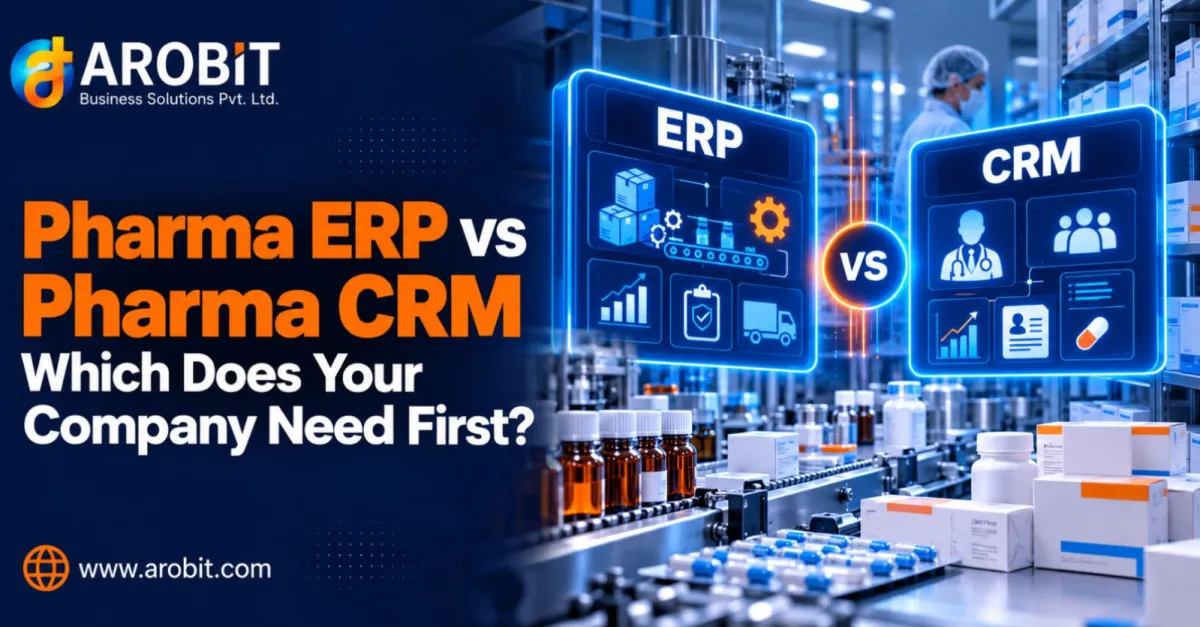
A pharmaceutical company preparing its 2026 budget often gets stuck on the same question: fix the back office first, or fix the sales pipeline first? The Pharma ERP vs Pharma CRM decision sounds like a preference call. In practice, it usually comes down to which operational gap is costing more money right now. One system tracks batches, inventory, and compliance records, while the other tracks doctors, prescriptions, and field visits.
Confusing the two, or trying to build both from a single generic platform, is how many pharma companies end up with systems nobody trusts. This guide breaks down what each system actually manages, where the two differ, and how to decide which one deserves your budget first.
How pharma ERP systems support manufacturing and compliance
Pharma ERP software runs the manufacturing and compliance backbone of the business. It is the system of record for everything that happens before a product leaves the warehouse. It is also the first place regulators look during an audit.
- Batch traceability: tracking raw materials and finished goods through every stage of production.
- Inventory and procurement: raw material stock levels, vendor purchase orders, and reorder points.
- Production planning: scheduling manufacturing lines against demand and material availability.
- Quality and compliance documentation: certificates of analysis, deviation records, and audit trails.
Demand for this kind of system keeps growing as manufacturers digitize compliance-heavy processes.
"The pharmaceutical manufacturing software market is projected to grow from $3.41 billion in 2025 to $5.52 billion by 2030, at a CAGR of 10.1%."
MarketsAndMarkets, Pharmaceutical Manufacturing Software Market Report, 2025
Without this system, most pharma manufacturers fall back on spreadsheets to track batches and stock. That approach works until a recall, an audit, or a stock-out exposes how little visibility the business actually has.
How pharma CRM systems support field engagement and sales
Pharma CRM software runs the commercial and field-force side of the business. It is built around how medical representatives engage doctors, chemists, and hospitals, not around a generic sales pipeline.
- Doctor and chemist engagement: visit history, prescribing patterns, and relationship notes.
- Field reporting: daily call reports and retail chemist and prescription audits.
- Sample and marketing compliance: gift, sample, and hospitality records that hold up under review.
- Territory and beat planning: geo-verified visit routes and coverage tracking.
This category has grown alongside the broader push toward measurable field engagement.
"The global life sciences CRM market is expected to grow from $1.24 billion in 2024 to $2.29 billion by 2034, at a CAGR of 6.32%."
Towards Healthcare, Life Sciences CRM Market Sizing Report, 2025
Without dedicated CRM software, field visibility usually arrives seven to ten days late, by phone call or WhatsApp update. By then, a stalled territory has already cost a sales cycle.
Pharma ERP vs Pharma CRM: the core difference
The two systems answer different business questions, and neither one substitutes for the other. The table below lays out where they split.
| Dimension | Pharma ERP | Pharma CRM |
|---|---|---|
| Primary focus | Production, inventory, compliance | Field force, doctor engagement, sales |
| Core users | Plant managers, quality teams, finance | Medical representatives, sales managers |
| Data it owns | Batch records, stock levels, purchase orders | Doctor profiles, call reports, sample logs |
| First symptom if missing | Stock-outs, recall risk, audit failures | Late field visibility, missed territories |
| Typical first buyer | Manufacturers and contract producers | Marketing companies and branded sales teams |
How to decide which one to implement first
Most pharma companies eventually need both systems. The question is sequencing, and the answer depends on where the current process is breaking down hardest.
Signs that point to ERP first:
- Stock reconciliation happens manually, and stock-outs or overstocking occur regularly.
- Batch and lot records are scattered across spreadsheets, not one traceable system.
- A recent audit raised questions the team could not answer quickly.
- Production planning depends on one person's memory of what is in the warehouse.
Signs that point to CRM first:
- Field reps report calls from memory, days after the visit actually happened.
- Nobody at headquarters can say which doctors were visited this week.
- Sample and gift records exist on paper, and compliance reviews take weeks.
- Sales leadership has no reliable view of territory coverage or prescriber trends.
A mid-sized pharmaceutical manufacturer expanding into new export markets illustrates this well. Its production and inventory records were already digitized, so audits and batch tracing were not the bottleneck. Its 120-person field force, however, was still filing call reports by phone at the end of each day.
Headquarters saw a rep's actual coverage nearly ten days after the fact. Lost territory gaps consistently ran longer than a full sales cycle as a result. For that company, dedicated CRM was the clear first investment, even though its pharma ERP software was still years from a planned upgrade.
What changes once you are ready for both systems
Companies that implement both eventually connect them, because the systems intersect at real business events. A confirmed order in CRM should trigger stock allocation in ERP. An ERP stock update should feed back into the CRM, so a rep knows what can actually be promised to a stockist.
This connection matters more than the sequencing decision itself. A detailed comparison of ERP and CRM systems shows that most mid-sized companies run both because each answers a distinct operational question. CRM without a connected ERP system still leaves sales promising stock that does not exist.
The practical takeaway: buy the system that fixes today's biggest operational gap. Choose a vendor that can integrate with the other system later, without needing a rebuild.
Cost, timeline, and build-vs-buy considerations
Packaged pharma ERP or CRM products are usually faster to deploy and cheaper upfront. They fit companies whose processes are close to the standard template for their industry. A custom build costs more and takes longer. It fits companies whose compliance workflows, territory structures, or manufacturing processes do not map cleanly onto a packaged product.
Compliance requirements also shape the timeline. A manufacturer selling into multiple markets needs a system that can adapt to different regulatory regimes. Examples include the United States' current good manufacturing practice regulations and India's Uniform Code for Pharmaceutical Marketing Practices.
Working with an experienced ERP software development company shortens this evaluation. A partner who has already mapped these requirements will not need to relearn them on your project.
- Packaged product: 6 to 10 weeks to go live, lower upfront cost, less flexibility later.
- Custom build: 3 to 6 months depending on scope, higher upfront cost, built around your exact workflow.
Choosing an implementation partner
A vendor that has never worked in pharmaceuticals will underestimate compliance requirements and batch traceability rules. It will also miss field-force nuances that a generic ERP or CRM implementation does not cover. Ask any shortlisted partner for pharma-specific references before signing anything.
A capable pharmaceutical software development company should be able to show live client examples on both sides of this decision, not just one. For deeper detail on the vendor landscape, see Top 10 Pharma CRM Software Development Companies in India. A separate guide covers Top Pharma Manufacturing ERP Companies in India.
Beyond pharma-specific experience, check how a vendor is rated on integration and support. Gartner's buyer reviews for CRM in pharmaceuticals and biotechnology are a useful reference point when comparing packaged vendors before a final decision.
Frequently asked questions
Q: Pharma ERP vs Pharma CRM: what's the core difference?
Pharma ERP manages production, inventory, and compliance records inside the business. Pharma CRM manages field-force activity and doctor relationships outside it. Most pharma companies eventually need both, but they solve different operational problems.
Q: Can a pharma company run on CRM alone without an ERP system?
Yes, for a period, especially if manufacturing and inventory are already tracked elsewhere or outsourced. But growth usually forces the issue once batch volume or audit complexity increases beyond what spreadsheets can handle reliably.
Q: How long does it take to implement pharma ERP or CRM software?
A packaged product can go live in 6 to 10 weeks. A custom system covering compliance workflows, batch traceability, or territory management typically takes 3 to 6 months. The exact timeline depends on scope and the number of integrations involved.
Arobit Business Solutions builds both pharma ERP and pharma CRM systems around a manufacturer's actual workflow, rather than forcing operations into a fixed template. It also integrates the two systems once a company is ready to connect them.
Request a technology assessment to identify which system fits your current operational gap first.



Comments
No comments yet. Be the first to share your thoughts!