





"How long will this take?" is the first question every leader asks about ERP, and the honest answer is rarely the one they want. It depends on your industry, your size, your data, and how disciplined you are about scope.
The reassuring news is that the numbers have moved in the right direction. What used to be a two-year commitment for a mid-sized company is now a lot shorter:
The median ERP project timeline dropped to around 9 months in 2025, down from roughly 15.5 months previously, driven by the shift to cloud deployments. — Panorama Consulting, 2025 ERP Report
That is a real improvement, but averages hide the range. A retail chain and a hospital replacing their core systems will spend very different amounts of time doing it. Treating them the same is where projects go wrong.
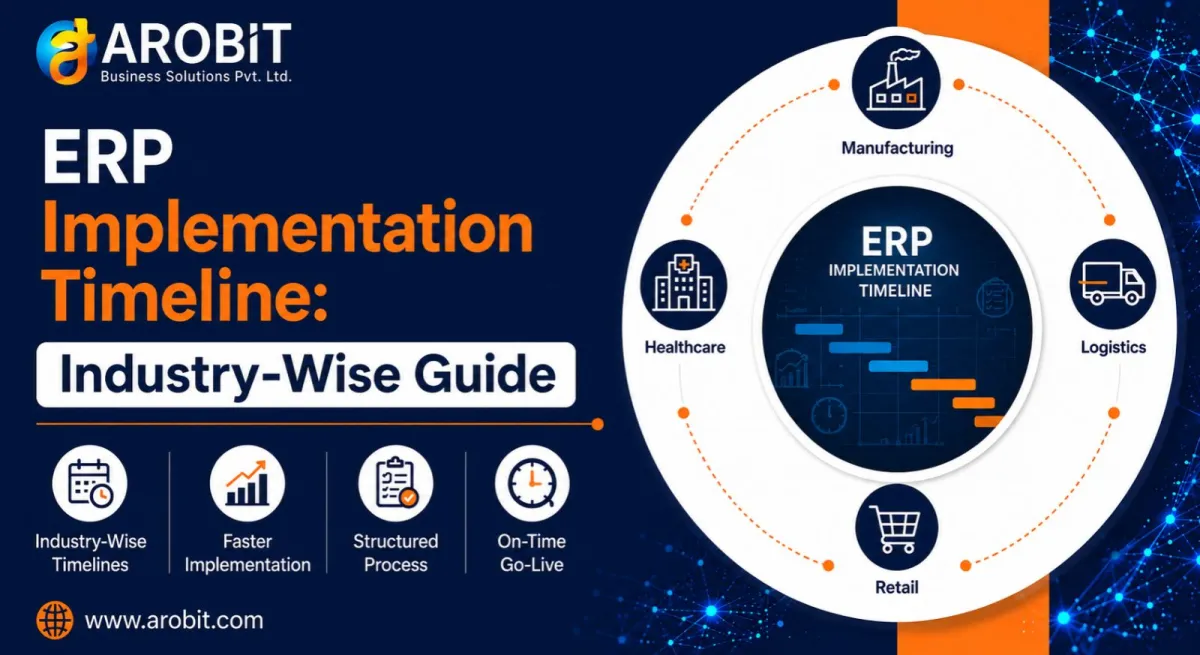
This guide breaks the ERP implementation timeline down by four industries: manufacturing, healthcare, logistics, and retail. It shows the milestones inside each so you know what you are actually committing to.
What Drives the Timeline
Before the industry-specific numbers, it helps to understand what actually moves an ERP implementation timeline. Four factors do most of the work:
- Scope. A finance-only rollout goes live far faster than a full finance, supply chain, manufacturing, and CRM deployment.
- Customisation. Every deviation from standard functionality adds build, test, and maintenance time.
- Data readiness. Messy master data extends every project. Clean it first and you save months later.
- Integrations. Each connection to another system, e-commerce, EDI, telematics, EHR, adds design, build, and test time.
Company size compounds all four. That is why the cross-industry ERP implementation timeline averages just over 14 months across all sizes. A focused mid-sized rollout can finish in half that.
The Six Milestones Every ERP Implementation Runs Through
Whatever the industry, an ERP implementation timeline passes through the same six phases. Skipping any of them is where projects fail.
- Discovery and scope. Requirements gathered, processes mapped, scope locked. Usually 2 to 6 weeks.
- Design. System configuration, integrations, and customisations designed against the scope. Usually 4 to 10 weeks.
- Build and configure. The system is configured, integrations are built, and initial data is migrated. Usually 8 to 20 weeks.
- Test. User acceptance testing, data validation, and dry runs. Usually 4 to 12 weeks.
- Go-live. Cutover, initial support, and stabilisation. Usually 2 to 4 weeks of intensive work.
- Hypercare and optimisation. Close support after go-live to fix issues and refine. Usually 4 to 12 weeks.
Industry differences do not change these phases. They change how long each one takes. That is what the next four sections cover.
Manufacturing: 6 to 24 Months
Manufacturing carries the longest ERP implementation timeline in most cases, because production is genuinely complex.
Typical ranges:
- Small manufacturer, standard processes: 6 to 9 months
- Mid-sized manufacturer, moderate complexity: 9 to 15 months
- Large manufacturer, multi-plant or export: 12 to 24 months
The extra time goes into the things that make manufacturing manufacturing. Bills of material validation, production planning, shop-floor and machine integration, quality control workflows, and multi-warehouse inventory all take time. If the operation runs multiple plants or across borders, add several months for consolidation and localisation.
Milestone shifts. Design and build stretch, because the workflows are specific. Testing is longer, because a mis-configured production flow breaks real output.
Healthcare: 9 to 18 Months and Up
Healthcare's ERP implementation timeline is long for one main reason: compliance and clinical validation cannot be rushed.
Typical ranges:
- Small clinic or single-site provider: 6 to 9 months
- Mid-sized hospital, multi-department: 9 to 15 months
- Large hospital or multi-facility group: 12 to 24 months
The stretch comes from patient data protection standards such as HIPAA in the United States, GDPR in Europe, and equivalent regimes elsewhere. Integrations with EHR, laboratory information systems, imaging, and pharmacy each add weeks. Every clinical workflow needs validation before it can be trusted with a patient.
Milestone shifts. Testing is the long phase here. A billing error is expensive; a clinical error is unacceptable.
Logistics: 4 to 12 Months
Logistics tends to be more moderate on the ERP implementation timeline, but with sharp variation depending on how much telematics and EDI you connect.
Typical ranges:
- Small fleet or single-site 3PL: 4 to 6 months
- Mid-sized carrier, multi-terminal: 6 to 9 months
- Large logistics network with EDI: 9 to 12+ months
The variables are GPS and telematics integration, EDI with major customers, driver settlement rules, and multi-modal operations if they apply. Simple, single-mode operations move fast because the workflows are well understood.
Milestone shifts. Integration work dominates. If your customers require EDI, budget more design and testing time from the start.
Retail: 3 to 9 Months
Retail has the shortest typical ERP implementation timeline, because processes are more standardised and packaged retail ERPs are mature.
Typical ranges:
- Small retailer, single channel: 3 to 6 months
- Mid-sized retailer, POS and e-commerce: 5 to 9 months
- Large multi-brand retailer: 9 to 15 months
Speed comes from established patterns: POS integration, inventory across stores and warehouses, standard promotion and loyalty logic. Time stretches when the retailer runs many channels, complex supply chains, or bespoke pricing.
Milestone shifts. Discovery is short because retail workflows are familiar. Build is dominated by POS and e-commerce integrations.
A Side-by-Side View
| Industry | Small | Mid-sized | Large / complex |
|---|---|---|---|
| Manufacturing | 6–9 months | 9–15 months | 12–24 months |
| Healthcare | 6–9 months | 9–15 months | 12–24 months |
| Logistics | 4–6 months | 6–9 months | 9–12+ months |
| Retail | 3–6 months | 5–9 months | 9–15 months |
Treat these as informed ranges. Two organisations in the same row can finish months apart, depending on the four drivers listed earlier.
Why Some Projects Take Longer Than the Average
Panorama's research is direct about this:
Nearly two-thirds of ERP implementations exceed six months, with the cross-industry average running just over 14 months. — Panorama Consulting, industry research
Projects overrun for predictable reasons, and every one of them is avoidable:
- Scope creep. New requirements added mid-project without adjusting the timeline.
- Poor data. Weeks lost cleaning and reconciling records that should have been ready.
- Skipped testing. Time saved before go-live is paid back many times over after.
- Weak change management. Users who do not understand the new system slow every phase.
None of these are technology problems. They are project-management problems, which is why choosing the right partner matters as much as choosing the right software.
Off-the-Shelf or Custom?
The ERP implementation timeline also shifts depending on which route you take.
- A packaged system with standard processes goes live faster and suits businesses whose operations are close to industry norms.
- A tailored custom ERP software build takes longer up front but fits operations that are structurally specific, and saves years of workarounds later.
The right answer depends on how much of your operation is standard and how much is genuinely yours. This is the kind of assessment an experienced ERP software development company should carry out before quoting a number. Fast timelines that assume a standard fit which does not exist end up as broken promises.
A Note on Arobit's Delivery Experience
Arobit builds custom ERP systems across manufacturing, healthcare, logistics, and retail. Documented work includes a Melbourne clinic management system and a US pharmacy billing platform. It also covers an FMCG and e-commerce ERP for a distribution client and apparel manufacturing at scale.
That cross-industry mix matters when scoping timelines. A partner who has run implementations across these sectors sees the specific drivers that stretch or shorten each ERP implementation timeline, and plans accordingly. Good custom ERP software is delivered fastest when the partner already knows where the time actually goes in your industry.
What to Check Before Committing to a Timeline
A few questions separate a realistic ERP implementation timeline from a fictional one:
- Is your data ready? If master data is messy today, add weeks to any quote.
- How much customisation? More configuration equals more build and test time.
- How many integrations? Every connection needs design, build, and testing.
- Are the phases named? A partner who cannot describe the six milestones probably has not planned them.
How to Set a Realistic Timeline
Roll out an ERP implementation timeline in a way that respects both scope and reality:
- Start with a locked, honest scope. Every deferred requirement is time saved.
- Clean your data before design begins, not during build.
- Insist on all six milestones, and resist the temptation to compress testing.
- Plan a phased rollout when the alternative is a rushed big-bang go-live.
A project that ships on time is almost always one where the timeline reflected the real work at the start. Not a number chosen to close the deal.
What to Do Next
Do not start with a target date. Start with your scope, your data, and your integrations, then let those facts point to a realistic timeline. Every serious ERP quote you receive should include the six milestones, the phase durations, and the assumptions behind them.
Then match the ERP implementation timeline ranges above to your reality. If you are a mid-sized manufacturer being promised a 4-month go-live, ask which drivers make you an outlier. If nothing does, the number is a sales pitch, not a plan.
Speak with our team to scope a realistic ERP implementation timeline for your business. Get in touch with Arobit








Comments
No comments yet. Be the first to share your thoughts!