





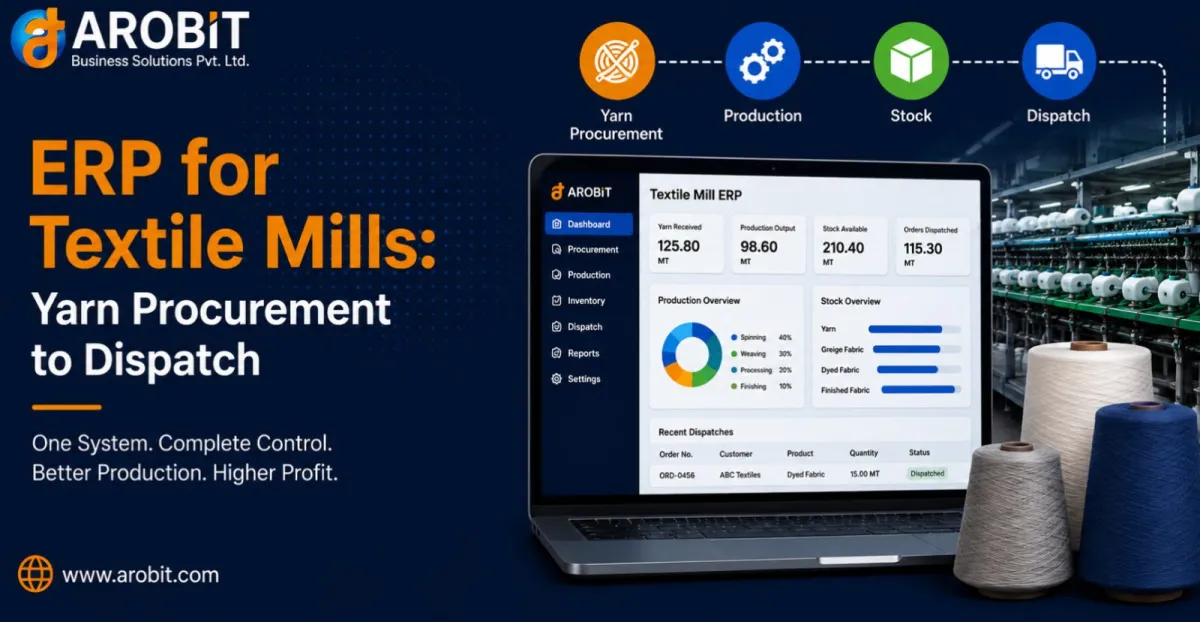
A textile mill changes its units at every stage. Cotton arrives in bales measured in kilograms. It leaves the spinning floor as yarn counted in cones and bags. It becomes fabric measured in metres. Somewhere in that chain of conversions, on paper registers and disconnected spreadsheets, a mill quietly loses track of its own material and its own margin.
That is the core challenge of running a mill. Procurement, spinning, weaving, dyeing, finishing, and dispatch each keep their own records, and the numbers rarely reconcile. By the time head office sees a consolidated picture, the production run is finished and the waste is already booked.
ERP for textile mills closes that gap. It follows material through every unit change, from raw bale to dispatched fabric, in one connected system. This guide walks the full chain and shows what a purpose-built system changes at each stage.
Why Efficiency Matters More Than Ever
Indian textile mills are competing in a market that is growing fast and getting stricter about cost.
India's textiles and apparel exports stood at US$ 37.8 billion in FY25, with the government targeting US$ 100 billion in exports by 2030. — India Brand Equity Foundation, Ministry of Commerce
That target means mills must scale output without scaling waste. The sector already contributes around 2% of India's GDP and roughly 11% of manufacturing gross value added, employing over 45 million people. Competing at that scale on thin margins rewards the mills that measure accurately and punishes those that estimate.
Why a Textile Mill Needs Industry-Specific ERP
A generic accounting package cannot run a mill, because it does not understand how a mill works.
It has no concept of a cotton bale with its own moisture and staple length. It cannot track a blend ratio, follow a beam through the loom shed, or handle the multi-level unit changes from kilograms to cones to metres. It has no way to record the waste generated at blowroom, carding, and spinning, which is where a surprising amount of a mill's margin disappears.
ERP for textile mills is built around exactly these realities. It models the mill's actual physics, so material is accounted for at every conversion rather than estimated at the end. This is why mills increasingly choose custom ERP software over a generic package. The processes are specific enough that the software has to fit the mill, not the other way around.
Yarn and Raw Material Procurement
Procurement is where a mill's money enters, and where the first leaks appear.
ERP for textile mills connects buying to the floor. Every cotton bale or yarn lot is recorded with its quality parameters, moisture, staple length, and count, against the supplier and purchase order. When material arrives, its weight and grade enter the system directly, not a day later from a paper slip. Rate adjustments for quality and moisture are applied automatically, and the supplier's account updates in real time.
For a mill buying across fluctuating cotton prices and inconsistent fibre quality, this matters. Purchase decisions rest on recorded quality data. Disputes with suppliers rest on timestamped records rather than memory.
Spinning and Production Tracking
Spinning is where raw material becomes product, and where most mills lose visibility. This is where ERP for textile mills proves its worth.
Without a system, output and waste are estimated at the end of a shift. Nobody knows the true yield of each yarn count from each bale lot. So nobody can tell whether a machine is underperforming or a fibre batch was poor.
A proper system records the real conversion. It tracks the material consumed, the yarn produced by count, and the waste generated at each stage, from blowroom through carding to spinning. Machine-level and shift-wise data show spindle utilisation and efficiency as they happen. When waste climbs above the expected range, the number is visible immediately, and a supervisor can ask why.
The gains here are well documented across manufacturing:
Companies implementing ERP systems experienced a 23% reduction in manufacturing cycle times and a 16% improvement in on-time deliveries. — Aberdeen Group, ERP in Manufacturing research
Quality Control and Defect Reduction
Defect control is where ERP for textile mills pays back fastest. A defect found at final inspection has already consumed fibre, machine time, labour, and dye. Catching it earlier is where real money is saved.
ERP for textile mills records quality data at each stage rather than only at the end. Batch-level traceability shows which material lot, machine, or shift produced a problem, so the cause gets fixed rather than absorbed into normal wastage.
Arobit's own work in garment manufacturing shows the effect. In an apparel operation handling 25,000 garments per day, an Arobit-built system reduced defects by 22%, alongside improved raw material accountability and production dashboards. At that volume, a 22% cut in defects recovers a substantial amount of material and labour that was previously being thrown away.
Weaving, Dyeing, and Job Work
ERP for textile mills must follow material beyond spinning. It moves through weaving, dyeing, and finishing, and often out to third parties for job work. This is where tracking usually breaks down.
A good system follows the material through every step. Beam movements and whereabouts are tracked through the loom shed. Loom allocation is coordinated with orders and workforce, so scheduling delays fall. When yarn or fabric goes out for outside processing, the system tracks it through the job-work cycle and back. Material that leaves the premises is never lost from the books.
This end-to-end traceability is what separates ERP for textile mills from a simple stock register. Every roll and every lot can be traced back through the process that made it.
Inventory Across Every Form
Inventory is where ERP for textile mills quietly saves money. A mill holds stock in several forms at once: raw cotton, work in progress, yarn, grey fabric, finished cloth, and waste.
Automation keeps every category aligned. Each movement is captured as it happens: bale into the mill, yarn off the spinning floor, fabric out for dispatch. The unit changes are handled automatically.
Good custom ERP software gives the mill owner a stock figure to trust without a physical count every week. The benchmark effect is significant:
Manufacturers using ERP achieved a 20% reduction in inventory levels while maintaining 97% inventory accuracy. — Aberdeen Group, ERP in Manufacturing benchmark
Shortages surface early, and slow-moving stock becomes visible before it ties up cash.
Dispatch and Export Documentation
Dispatch is the last mile, and for export-oriented mills it carries heavy documentation. This is the final stage ERP for textile mills has to close.
ERP for textile mills ties dispatch into the same system. An order is picked, the load is confirmed, and the dispatch note and invoice generate from one record. Stock reduces automatically as goods leave. For exporters, GST-ready invoicing, e-way bills, and export documentation are produced from the same data, rather than assembled separately by hand.
The paperwork stops holding up the gate, and the risk of a documentation error reaching a customer falls. Closed properly, the whole loop runs from raw bale to dispatched fabric inside one system.
A Note on Arobit's Textile Experience
This is not theoretical for Arobit. Arobit has deployed real-time ERP systems for textile manufacturers, including export-oriented units, with experience across spinning, weaving, dyeing, finishing, and fabric-processing workflows.
That matters for a reason every mill owner will recognise. A textile mill does not need a generic ERP with a mill label attached. It needs software shaped around how a mill actually runs, from bale intake to yarn count to beam movement to the dispatch gate. Building that requires a partner who understands the floor, not just the code.
What to Check Before You Start
Multi-level unit handling. The system must move cleanly between kilograms, cones, bags, and metres. This is the test most generic tools fail.
Waste tracking by stage. Confirm the software records waste at blowroom, carding, and spinning, not just a single output figure. Waste visibility is where much of the saving lives.
Job-work tracking. If you send material for outside processing, the system must follow it out and back, so nothing is lost from the books.
A partner who knows textiles. Software is only as good as the fit. Choosing an experienced ERP software development company that has built for spinning and weaving saves months of costly rework.
How to Get Started
Roll out ERP for textile mills in stages. Start with your biggest leak, which for most mills is procurement reconciliation or unmeasured production waste. Both pay back quickly. Connect the intake, get one stage accurate, then extend across the chain.
Do not try to digitise everything at once. Get one clean, trustworthy figure first, whether that is true stock or real waste per shift. A mill that measures its waste accurately has already found savings that were invisible before.
Baseline your numbers before you begin. If you do not know your current waste rate and stock accuracy, you cannot prove the saving later.
What to Do Next
Before you weigh up ERP for textile mills, measure one thing. How many days does it take your mill to close its books and know its true stock and waste each month?
Then fix the stage that leaks the most, and build from there. In a textile mill, where material changes form at every step and margins are thin, accurate real-time data across the chain is not overhead. It is the margin itself.
Speak with our team to scope ERP built around how your mill actually runs, from yarn to dispatch. Get in touch with Arobit








Comments
No comments yet. Be the first to share your thoughts!