





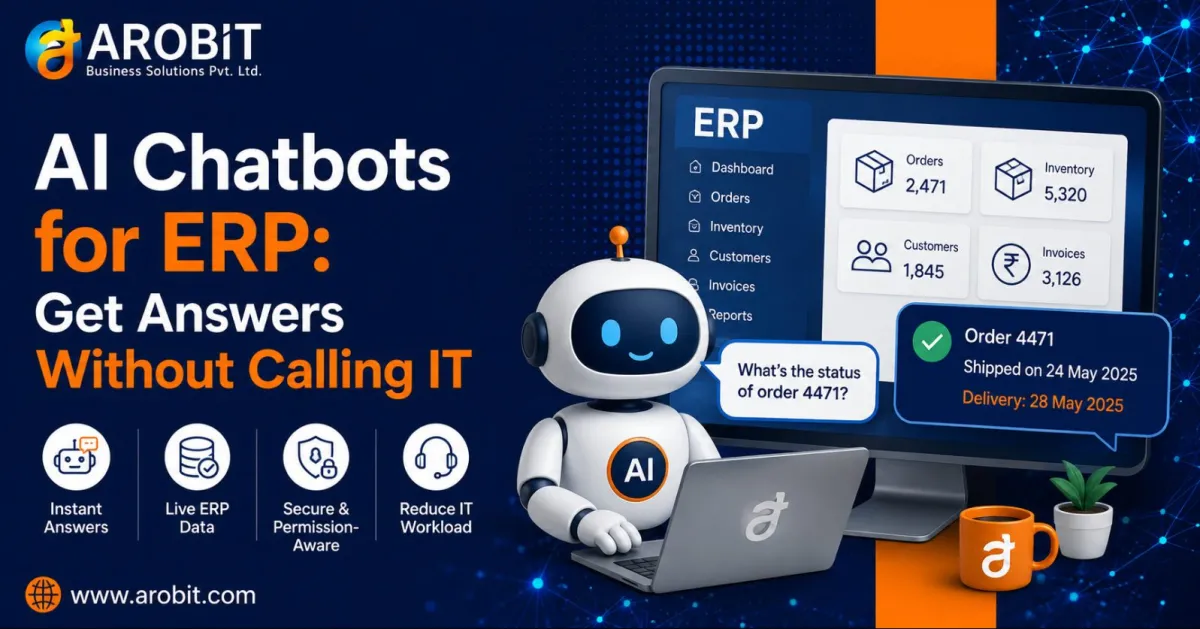
"Can someone pull the delivery date on order 4471?" That message, or one like it, lands in a company chat somewhere every few minutes. A warehouse lead needs a stock figure. A sales rep needs a customer's credit limit. A manager needs last month's numbers. The data exists inside the ERP, but getting it out means navigating screens they half-remember, or asking someone in IT and waiting.
That waiting has a cost, and it is larger than most businesses realise.
Employees spend about 1.8 hours every day, roughly a fifth of the workweek, searching for and gathering information. — McKinsey & Company
AI chatbots for ERP attack that waste directly. Instead of clicking through menus or filing a ticket, an employee asks a question in plain language. The answer is drawn straight from live ERP records. This guide explains how AI chatbots for ERP work, what makes them trustworthy, and where they deliver the most value.
The Problem: Data Locked Behind Screens
AI chatbots for ERP solve a problem every business with an ERP recognises. An ERP holds nearly everything a business runs on: orders, inventory, invoices, customers, production, and payroll. The information is all there. The trouble is getting to it.
Traditional ERP access has three friction points:
- Complexity. Pulling a specific figure often means knowing which module, screen, and filter to use. Most employees never learn more than the few screens their job requires.
- Training cost. Every new hire needs time to learn the system, and rarely uses more than a fraction of it.
- The IT bottleneck. When someone cannot find what they need, they ask IT or a power user, whose day fills up with routine lookup requests.
The result is a strange waste. The answer sits in a database the company already paid for. Yet reaching it consumes hours of staff time and creates a queue at the IT desk.
How AI Chatbots for ERP Actually Work
The technology that makes AI chatbots for ERP practical is retrieval-augmented generation, usually shortened to RAG. It is worth understanding in plain terms, because it is what separates a useful bot from a risky one.
A general AI chatbot answers from what it learned during training, which means it can sound confident while being wrong. A RAG-powered bot works differently:
- It retrieves first. When you ask a question, the system fetches the relevant, current records from your ERP.
- It answers from those records. The AI then forms its reply using that live data, not its general training.
- It stays current. Because every answer is built from live records, the bot reflects what the ERP says right now, not a stale snapshot.
This is the crucial distinction. A RAG-powered chatbot trained on your ERP data gives answers grounded in your actual records. Ask for the stock of an item and it reads the live inventory figure. Ask about an order and it pulls that order's real status. The answer is as current as the database itself.
Why RAG Makes the Difference
For AI chatbots for ERP, the retrieval step is not a technical detail. It is the difference between a tool employees can trust and one they cannot.
- Accuracy. Answers come from real records, so the bot reports what is actually in the system rather than a plausible guess.
- Freshness. A number pulled live is today's number, not last week's.
- Traceability. Because answers trace back to specific records, they can be verified rather than taken on faith.
A general chatbot bolted onto a business is a liability, because a confident wrong answer about stock or credit can cause a real mistake. The same risk applies to any ai customer support chatbot that guesses instead of retrieving. Good AI chatbots for ERP avoid this by grounding every response in retrieved data. This is the same principle behind a well-built ai customer support chatbot, which answers from a company's real knowledge base rather than improvising.
What Employees Can Actually Ask
The value of AI chatbots for ERP becomes concrete when you look at everyday questions a grounded bot can answer instantly.
- Inventory. "How many units of this product are in the main warehouse?"
- Orders. "What is the status of order 4471, and when does it ship?"
- Customers. "What is this client's outstanding balance and credit limit?"
- Reports. "What were last month's sales for the north region?"
- Procurement. "Which purchase orders are pending approval?"
Each of these normally means opening the ERP, finding the right screen, and applying filters, or asking a colleague. With AI chatbots for ERP, it is a single plain-language question answered in seconds, from any device the employee already uses.
The Business Case
The return on AI chatbots for ERP is not abstract. It shows up in three places a manager can measure.
- Time returned to employees. Every lookup that takes seconds instead of minutes, without a detour through IT, is time returned to real work.
- A lighter IT load. Routine "where do I find" requests stop landing on IT and power users, freeing them for higher-value work.
- Faster decisions. When anyone can get a number instantly, decisions stop waiting on someone to dig it out.
The scale of the opportunity is clear from the research:
Organisations with strong knowledge management can reduce the time lost to information search by up to 35%. — McKinsey & Company
An ERP chatbot is one of the most direct ways to capture that. It turns the company's core system into something anyone can simply ask.
Getting It Right: What to Look For
Not every one of the AI chatbots for ERP on the market is built well, and the difference matters. A few things separate a trustworthy deployment from a risky one.
- Grounded in live data. The bot must retrieve from real ERP records, not answer from general training. This is non-negotiable.
- Permission-aware. It must respect the same access rules as the ERP, so an employee only sees what their role allows. A bot that leaks salary or margin data is worse than no bot.
- Honest about limits. A good bot says when it does not know, rather than inventing an answer.
- Built for your system. The bot has to connect to your specific ERP and data structure, which is where custom ERP software and a proper integration matter.
That last point is the crucial one. An ERP chatbot is only as good as its connection to your data. It works best as part of a system built or integrated around how your business actually stores its information.
A Practical Example
Consider a mid-sized distributor running on custom ERP software, whose sales team constantly interrupted the operations desk for stock and order updates.
Before, a rep on a call would put the customer on hold, message operations, and wait for someone to check the ERP and reply. Answers took minutes, and the operations team lost hours a day to these interruptions.
With grounded AI chatbots for ERP, the rep now types the question and reads the live answer while still on the call. Stock levels, order status, and delivery dates come back in seconds. The operations desk stopped being a lookup service and returned to its actual work, and customers got faster answers. Nobody had to learn a new ERP screen.
What to Do Next
Start by counting the questions. For a week, note how often employees interrupt colleagues or IT for information that already lives in the ERP. That number is the hidden cost a chatbot removes.
Then look at where those questions cluster, usually inventory, orders, or customer data, and start there. In a business where the answer already exists in a system you paid for, the goal is simple. Let people ask for it in plain language, and trust what comes back.
Speak with our team about adding a grounded AI chatbot to your ERP, built around your live data. Get in touch with Arobit


Comments
No comments yet. Be the first to share your thoughts!