





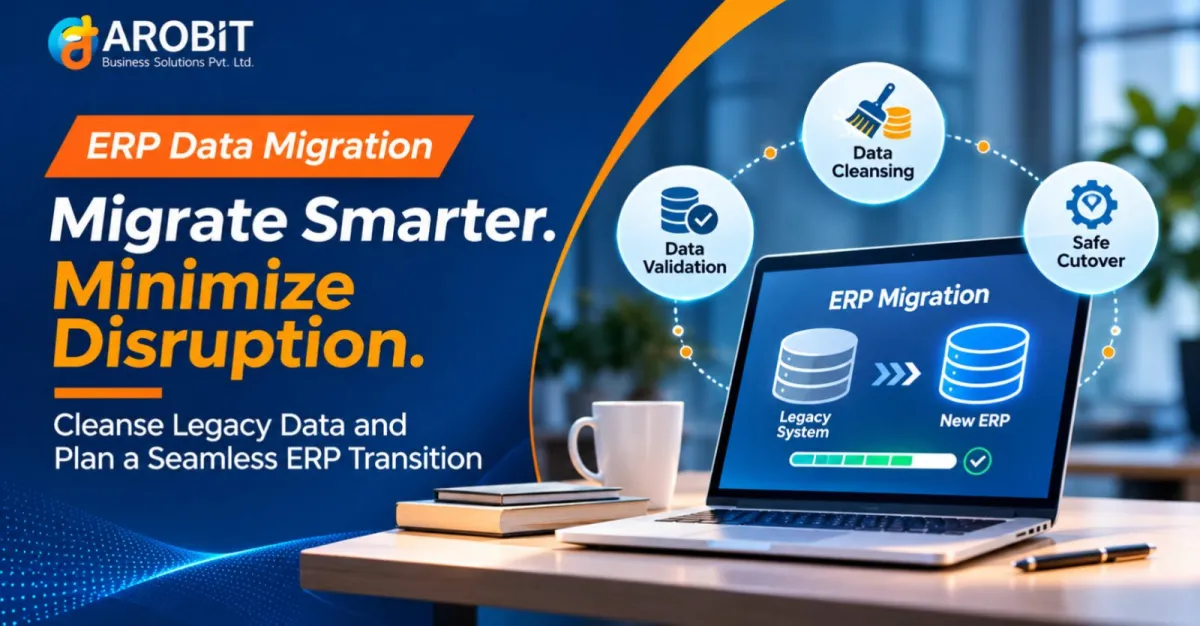
Most teams treat ERP migration as a software project. The software is usually the easy part. The hard part is a decade of customer records, stock codes and open invoices. All of it must arrive intact, balanced and trusted by the people who use it.
Get the data wrong and the new ERP inherits every old problem, plus new ones. Get it right and go-live becomes a planned weekend instead of a crisis. What follows is the sequence that makes the difference, from deciding what to move to proving the numbers at the first month-end.
Three Assumptions That Derail a Migration
Migration problems rarely start in the migration itself. They start with beliefs formed months earlier, when the project plan was written.
- "The vendor will handle the data." Most vendors load what you give them. Deciding which records are correct is a business task, and only your teams can do it.
- "We will clean it after go-live." Duplicates and wrong balances spread into every new transaction from day one. Fixing them later costs far more than fixing them first.
- "One test load is enough." A single trial proves the scripts run. It does not prove the totals reconcile or that the team can repeat the load under time pressure.
These assumptions are expensive because poor data has a measurable cost long before any migration begins.
"Poor data quality costs organizations an average of USD 12.9 million each year."
— Gartner research, as reported by IBM
Migration projects feel that cost directly. In Panorama Consulting's 2024 ERP Report, 35% of respondents said their budget overruns were caused by data issues. Treating ERP data migration as a first-class workstream, with its own owner and timeline, is the most reliable way to avoid joining them.
Decide What Moves Before You Clean Anything
Cleaning data you will never use wastes the scarcest resource in the project: the time of people who understand the records. So the first decision is scope, not quality. Every class of data needs a clear treatment before anyone opens a spreadsheet.
| Data type | Typical treatment | Reason |
|---|---|---|
| Customer, supplier and item masters | Move active records only, after cleaning | Every future transaction depends on them |
| Open sales and purchase orders | Move as live transactions | They must be fulfilled or received in the new system |
| Open receivables and payables | Move as open items with original dates | Ageing and collections need the true due dates |
| Recent closed transactions | Move as period balances or read-only history | Supports year-on-year reporting |
| Older history | Archive in a searchable, read-only store | Meets audit and retention needs without clutter |
| Inactive masters | Retire after sign-off | Keeps search, pricing and reporting clean |
The archive option matters more than most teams expect. Moving every historical record turns a legacy data migration into a years-long reconciliation exercise. A read-only archive keeps old records available for auditors while the new system starts lean.
Your target platform shapes these choices too. Bulk-load limits and integration tools differ widely, so decide early whether you are moving to cloud or on-premise ERP.
Cleaning Legacy Records Without Stalling the Project
Cleansing fails when it is treated as a one-off task for IT. It works when each data domain has a business owner who decides what "correct" means and signs off the result.
- Profile first: Count duplicates, blank mandatory fields and out-of-range values before fixing anything. The numbers tell you where effort will go.
- Assign owners: Sales owns customers, procurement owns suppliers and finance owns the chart of accounts. Owners approve every merge and deletion.
- Fix at the source: Correct records in the old system wherever possible, so every rehearsal pulls the same clean data.
- Write the rules down: Naming formats, unit conversions and tax code mappings belong in a shared rulebook, not in someone's memory.
Customer records usually need the most attention. Our explainer on deduplicating customer records covers the matching rules in detail.
Sources vary in difficulty. A legacy data migration from spreadsheets, Tally or QuickBooks usually needs more structuring than a move between two established ERPs. The old data was never forced into strict fields. That is one reason firms with unusual records choose custom ERP development, where the import logic is shaped around the data rather than the reverse.
Rehearsing the Load With Mock Runs
A mock migration is a full load of real data into a test copy of the new system, run exactly as it will be on cutover weekend. Plan for at least two, and keep running them until the results stop changing. Each rehearsal should be timed, because that time becomes the length of your cutover window.
After every run, the team checks the same evidence:
- Record counts per object match the extract, with every rejected record explained.
- Customer and supplier balances agree with the legacy ledger to the last unit of currency.
- Stock quantities and values match by item and location.
- A sample of users completes real tasks, such as raising an order or receiving goods, without workarounds.
Picture a distributor whose item master loads cleanly in the first rehearsal. Open orders then fail because the old system sold some items by the box and the new one by the unit. A rehearsal finds that problem on a quiet Tuesday rather than at 2 a.m. on go-live Sunday. This is where ERP data migration earns its budget, and where the matching logic behind real-time reconciliation pays off.
The Cutover Weekend, Hour by Hour
A cutover plan turns the final switch into a script with times, owners and exit checks. Nobody improvises, and nobody wonders whose turn it is. The illustrative runbook below assumes a Friday evening freeze and a Monday morning go-live.
| When | Activity | Owner | Exit check |
|---|---|---|---|
| Friday 18:00 | Freeze postings in the legacy system and take final backups | IT lead | Backup restored and verified |
| Friday 20:00 | Extract open orders, open items and stock positions | Data lead | Record counts logged |
| Saturday 08:00 | Load masters, then open transactions | Migration team | Every rejected record explained |
| Saturday 16:00 | Load counted stock and reconcile with the legacy system | Warehouse and finance | Variance within agreed tolerance |
| Sunday 10:00 | Reconcile trial balance and receivables and payables ageing | Finance controller | Totals match the freeze point |
| Sunday 16:00 | Go or no-go decision | Steering group | All exit checks signed |
| Monday 08:00 | Users go live with a support desk on call | Support lead | First orders, receipts and invoices posted |
Stock deserves its own count rather than a copied figure. Loading counted quantities into the inventory management module gives the new system a starting point that matches the shelves, not just the old screen.
The go or no-go meeting needs written criteria agreed weeks in advance. If an exit check fails and cannot be fixed by Sunday evening, the team rolls back to the legacy system. A rollback is disappointing, but it is far cheaper than trading for a month on unreconciled books.
Proving the Numbers at the First Month-End
Go-live is not the finish line. The first month-end close is the real test. It is the first time the new system produces numbers that management, auditors and tax authorities will rely on.
- Opening balances are signed off by the finance controller, with a variance report kept on file.
- Bank, receivables and payables reconciliations run in the new system before the close.
- Any data fix after go-live is logged, approved and traceable to its owner.
- The legacy system stays read-only for a set period, then is archived.
Well-structured opening entries in the finance and accounting module make this close routine instead of forensic. If the first close balances, the migration is done.
A Data Migration Checklist for Your ERP Migration
Use this list to test readiness before you book a cutover date. Each item should have a named owner and a status. For where these steps sit in the wider project, see how long ERP implementation takes.
- Scope: Every data class has a decision to move, archive or retire, signed by its owner.
- Quality: Profiling results are recorded, and duplicate and blank-field rates have reached agreed targets.
- Rules: Field mappings, unit conversions and code translations are documented and approved.
- Rehearsals: At least two full mock runs have reconciled, and the load time fits the cutover window.
- People: Users have tested real tasks, and support staff know the escalation path.
- Fallback: Rollback steps are written, tested and owned.
Frequently Asked Questions
How long does an ERP migration take?
It depends on data volume, the number of source systems and how clean the records are. A single-entity business moving from one system can often finish the data work in a few months. Multi-entity or multi-country moves take longer, mainly because cleansing and rehearsals multiply.
What should a data migration checklist include?
It should cover scope decisions, data quality targets, documented mapping rules and completed rehearsals. It also needs user testing and a written rollback procedure. Each item should have a named owner and a clear pass or fail status.
Can you roll back after cutover?
Yes, if you plan for it. A sound cutover plan keeps the legacy system frozen but intact and sets a go or no-go point before users start work. After users begin posting in the new system, rolling back becomes much harder, so the decision should happen before then.
Moving With Confidence
A safe migration is less about speed and more about evidence. Decide what moves, clean it with the people who own it, rehearse until the totals agree and run the final weekend from a script. Each step removes a reason for go-live to surprise you.
Arobit Business Solutions plans and runs migrations as part of its custom ERP builds, from first data profiling to the first month-end close. The team has delivered ERP and CRM platforms for clients across 15+ countries since 2011. Every project uses a written runbook and reconciliation sign-offs agreed with the client's finance team.
Schedule a Consultation
If you are planning a move from spreadsheets or an ageing ERP, start with a clear view of your data. Discuss Your Project Requirements with our team and get a migration approach built around your records.






Comments
No comments yet. Be the first to share your thoughts!