




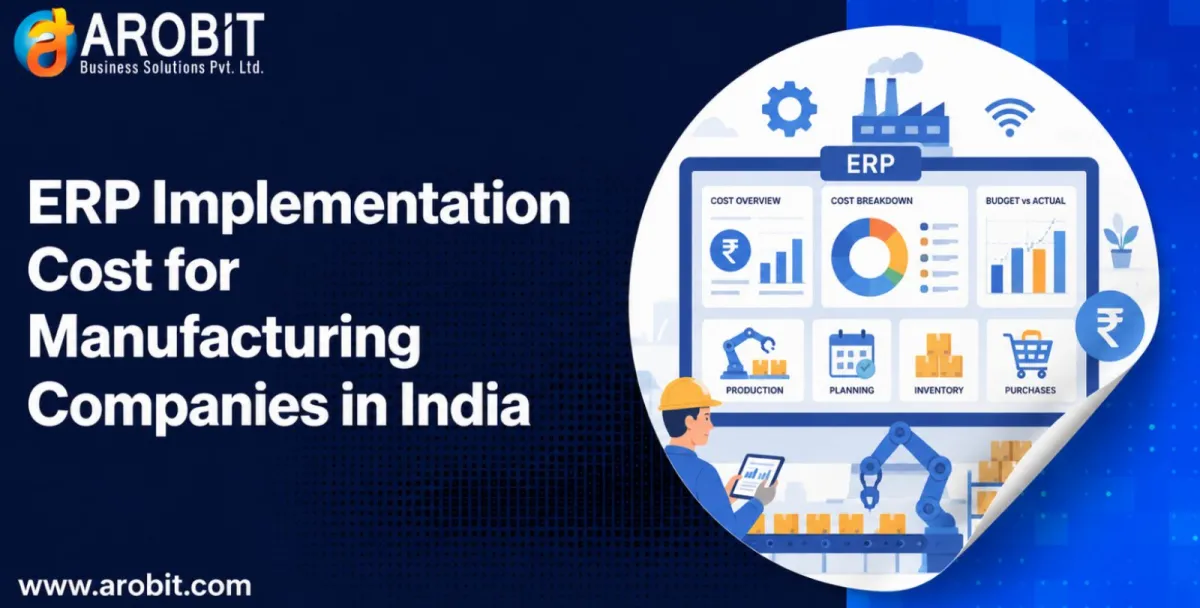
Manufacturing companies across India are investing in digital systems to improve production planning, inventory control, procurement management, and operational visibility. As businesses evaluate technology investments, one of the most common questions is about the ERP implementation cost for manufacturing organizations and whether the investment delivers measurable returns.
The answer is not straightforward because ERP costs vary based on company size, process complexity, customization requirements, deployment model, and integration needs. While software licensing is often the first cost businesses consider, several additional factors influence the total project budget.
Understanding the real costs, hidden expenses, and expected return on investment can help manufacturers make informed decisions in 2026.
Why Manufacturing Companies Are Investing in ERP Systems
Manufacturing operations involve multiple interconnected processes, including procurement, inventory management, production planning, warehouse operations, quality control, and finance.
When these functions operate through spreadsheets or disconnected systems, companies often experience:
Inventory inaccuracies
Delayed production planning
Procurement inefficiencies
Manual reporting challenges
Data duplication
Limited operational visibility
ERP systems address these issues by creating a centralized platform that connects departments and enables real-time information sharing.
As manufacturing competition increases and customer expectations evolve, ERP adoption is becoming a strategic investment rather than simply a technology upgrade.
Understanding ERP Implementation Cost for Manufacturing Companies
The ERP implementation cost for manufacturing businesses depends on several variables. Two manufacturers of similar size may have significantly different budgets based on their operational requirements.
Major cost components typically include:
Software licensing
Implementation services
Business process mapping
Customization
Data migration
Integration development
User training
Testing and deployment
Post-implementation support
Evaluating only the software price often leads to unrealistic budgeting and project planning.
Typical ERP Budget Ranges in India for 2026
While actual costs vary by project scope, manufacturers can use the following estimates as a general reference.
Manufacturing Business Type | Estimated ERP Budget Range |
Small Manufacturing Unit | ₹5 Lakh – ₹15 Lakh |
Growing MSME Manufacturer | ₹15 Lakh – ₹50 Lakh |
Mid-Sized Manufacturing Company | ₹50 Lakh – ₹1.5 Crore |
Large Multi-Plant Enterprise | ₹1.5 Crore+ |
These estimates generally include implementation services, configuration, and deployment activities.
The final budget depends on business complexity rather than employee count alone.
Factors That Influence ERP Costs
Number of Users
ERP pricing often increases with user count. Manufacturers should evaluate both current and future user requirements.
Departments commonly requiring ERP access include:
Production
Procurement
Inventory
Quality Control
Finance
Warehouse Operations
Sales
Manufacturing Process Complexity
Discrete manufacturing, process manufacturing, pharmaceutical production, and textile manufacturing each have unique requirements.
Advanced capabilities such as:
Batch traceability
Production scheduling
Quality management
Multi-level BOM management
Multi-plant operations
can significantly affect implementation scope.
Customization Requirements
Many manufacturers have workflows that differ from standard ERP templates.
Additional customization may be required for:
Approval processes
Production workflows
Specialized reporting
Industry-specific compliance requirements
Customer-specific operational processes
This is one reason businesses often explore custom manufacturing software development alongside ERP initiatives.
Deployment Model
ERP solutions may be deployed through:
Cloud-based environments
Hybrid environments
On-premise infrastructure
Cloud deployments often reduce infrastructure expenses but involve recurring subscription costs.
Hidden ERP Costs Manufacturing Companies Often Overlook
When evaluating the ERP implementation cost for manufacturing, businesses frequently focus on software and implementation fees while overlooking several indirect expenses.
Data Migration
Historical data often requires:
Cleansing
Validation
Mapping
Import preparation
Poor data quality can increase project timelines and costs.
Process Redesign
ERP implementation frequently exposes inefficient workflows.
Organizations may need to redesign:
Procurement processes
Inventory procedures
Approval structures
Reporting mechanisms
This effort requires internal resources and management involvement.
Employee Training
A successful ERP implementation depends heavily on user adoption.
Training costs may include:
Department-specific sessions
Documentation development
Ongoing support
Change management initiatives
Integration Development
Manufacturers commonly integrate ERP systems with:
Accounting software
CRM platforms
Warehouse systems
Production equipment
Business intelligence tools
Integration complexity can significantly affect project budgets.
Post-Go-Live Support
Many companies underestimate the support needed after deployment.
Common requirements include:
Issue resolution
Process adjustments
Additional reports
User assistance
System optimization
Calculating ERP ROI for Manufacturing Companies
ERP investments should be evaluated based on business outcomes rather than implementation cost alone.
The most successful projects deliver measurable improvements across operations.
Inventory Optimization
ERP systems help manufacturers:
Reduce excess inventory
Improve stock accuracy
Minimize stockouts
Improve inventory turnover
Even small inventory improvements can generate substantial financial savings.
Improved Production Efficiency
Production teams gain better visibility into:
Resource allocation
Production schedules
Work-in-progress inventory
Capacity planning
This often results in improved utilization and reduced production delays.
Reduced Manual Work
ERP automation eliminates many repetitive administrative tasks.
Examples include:
Automated purchase workflows
Production tracking
Inventory updates
Financial reporting
Reduced manual effort allows employees to focus on higher-value activities.
Better Decision-Making
Real-time dashboards and operational reporting help leadership make faster and more informed decisions.
Access to accurate information improves:
Procurement planning
Production scheduling
Demand forecasting
Financial management
When Standard ERP May Not Be Enough
Not all manufacturing businesses fit neatly into pre-configured ERP frameworks.
Companies with highly specialized operations often require:
Custom workflows
Industry-specific reporting
Specialized production processes
Unique compliance requirements
In such cases, custom manufacturing software development may complement or extend ERP functionality.
Rather than forcing operations to adapt to software limitations, customized solutions can align technology with actual business processes.
Choosing the Right Manufacturing ERP Partner
Selecting the right implementation partner is often more important than selecting the software itself.
Manufacturers should evaluate:
Industry experience
Manufacturing expertise
Customization capabilities
Integration knowledge
Support capabilities
Long-term partnership approach
Working with a provider that understands manufacturing operations reduces implementation risks and improves project outcomes.
A reliable manufacturing ERP software development company can help organizations define realistic budgets, identify operational priorities, and develop an implementation roadmap aligned with business goals.
Budget Planning Tips for 2026
Before beginning an ERP project, manufacturers should:
Define business objectives clearly
Document current operational challenges
Identify critical workflows
Allocate internal project resources
Budget for training and support
Plan for future growth requirements
Organizations that invest time in planning often achieve better implementation results and faster returns.
When estimating the ERP implementation cost for manufacturing, decision-makers should evaluate total ownership costs over several years rather than focusing solely on initial project expenses.
Conclusion
Understanding the true ERP implementation cost for manufacturing companies requires looking beyond software licensing fees. Implementation services, customization, integration, training, and post-deployment support all contribute to the overall investment.
Manufacturers that approach ERP projects strategically often achieve improvements in operational visibility, inventory management, production efficiency, and decision-making. The key is selecting a solution that aligns with business processes, growth plans, and industry requirements.
For manufacturers exploring ERP modernization initiatives, partnering with an experienced technology consulting and software development provider can make the process more effective. With extensive experience in manufacturing ERP solutions, enterprise software development, workflow automation, and digital transformation, Arobit helps manufacturing businesses implement technology solutions that support operational efficiency and long-term growth.
Frequently Asked Questions
1. What is the average ERP implementation cost for manufacturing companies in India?
For many manufacturing MSMEs, ERP implementation budgets typically range from ₹5 lakh to ₹50 lakh, while larger and more complex implementations may exceed ₹1 crore depending on customization and operational requirements.
2. What are the biggest hidden costs in ERP implementation?
Common hidden costs include data migration, process redesign, user training, integration development, change management, and post-go-live support.
3. How long does it take to recover ERP implementation costs?
ROI timelines vary by organization, but many manufacturers begin seeing measurable benefits within 12 to 24 months through inventory optimization, process automation, and improved operational efficiency.


Comments
No comments yet. Be the first to share your thoughts!