





Two salespeople sell the same unit on the same afternoon. Neither knew the other had booked it, because the only shared record was a spreadsheet updated whenever someone remembered. Now the developer owes an apology, a refund, and possibly a legal settlement. A single double-booking can cost a fortune in disputes and lost goodwill, and it damages a reputation that took years to build.
That failure has one root cause: no live, single source of truth. And it repeats across the whole life of a unit, from booking to agreement to payment schedule to legal documents to final registry. Each step carries money, deadlines, and legal weight. Each is a place where a spreadsheet quietly fails at scale.
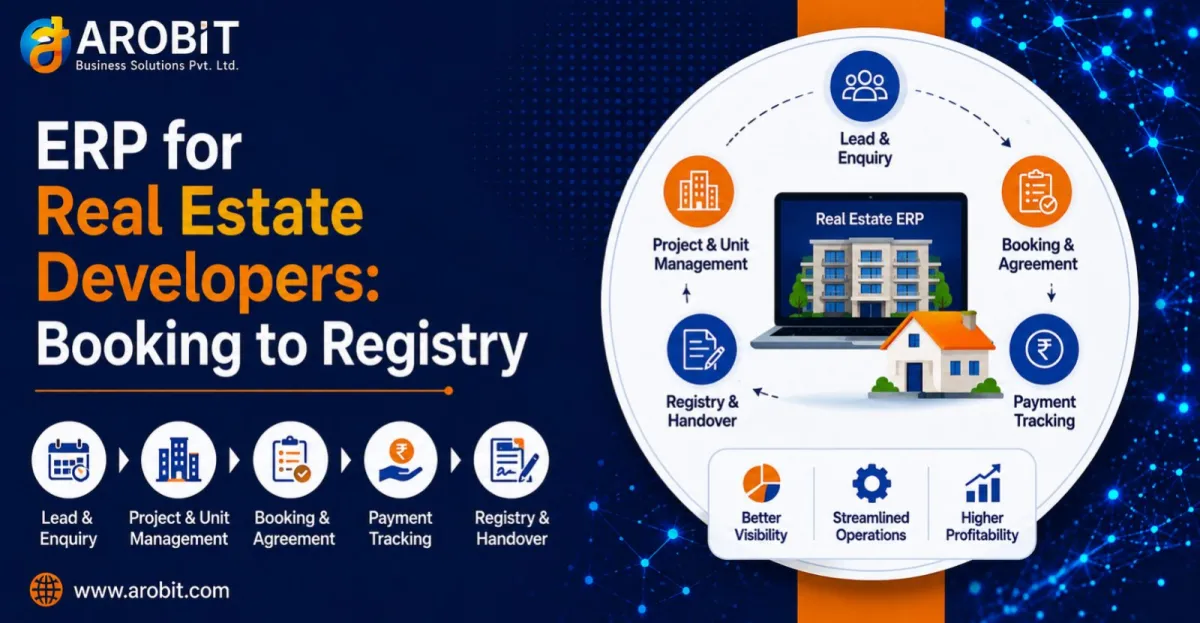
ERP for real estate developers exists to hold that entire lifecycle in one system. This guide walks the full journey from unit booking to registry. It shows what a purpose-built system changes at each stage.
Why Developers Are Outgrowing Spreadsheets
A surprising share of the industry still runs on tools it has outgrown.
42% of commercial and multifamily real estate owners and operators rely at least partly on spreadsheets or paper-based processes, and more than one in ten rely on them alone. — MRI Software industry survey
The market is moving the other way for a reason. Purpose-built systems are being adopted steadily as developers replace manual processes:
The global property management software market was valued at around US$ 3.6 billion in 2025 and is projected to reach roughly US$ 5.9 billion by 2033. — Property management software market research
For a developer, the logic is simple. There is more to build and sell, and more to disclose, document, and get right. A system that keeps bookings, payments, and compliance accurate is no longer a nice-to-have at any real scale.
Stage 1: Unit Booking and Inventory
The first job of an ERP for real estate developers is a clear, live picture of what is available. The single most damaging error in real estate sales is selling the same unit twice.
An ERP for real estate developers puts inventory at the centre:
- Live unit status shows every unit as available, held, booked, or sold, updated in real time.
- Instant booking lock marks a unit the moment it is booked, so no two salespeople can sell it.
- Multi-project, multi-wing views handle several towers, phases, and unit types from one system.
This removes the double-booking risk entirely, because the inventory grid cannot show a sold unit as available. Good custom ERP software makes that lock the default, not an optional setting. For a developer running multiple projects, that single control prevents the most expensive and reputation-damaging mistake in the business.
Stage 2: Payment Schedules and Collections
An ERP for real estate developers earns its keep on payments. Real estate runs on milestone-linked instalments, and chasing them manually is where cash flow quietly leaks.
A construction-linked plan ties each instalment to a stage of the build, and every stage triggers a demand. Handled by hand, demands get missed, delayed, or miscalculated. A system automates the whole cycle:
- Automatic demand generation raises the correct demand when a construction milestone is reached.
- Scheduled reminders go to buyers by email or WhatsApp, cutting the manual follow-up load.
- Live outstanding tracking shows exactly what is due, collected, and overdue across every unit.
The effect is steadier cash flow and far less leakage. Instead of a manager reconstructing who owes what from a spreadsheet, the system shows the real position at any moment. That is the foundation of accurate project finance.
Stage 3: Legal Documents and Agreements
An ERP for real estate developers also controls the paperwork. Every booking generates documents, and in real estate those documents carry legal consequence. A wrong clause or a lost agreement is not a clerical slip. It is a liability.
An ERP for real estate developers standardises and controls this paperwork:
- Template-driven generation produces allotment letters, agreements, and demand notices from approved templates, populated with the correct buyer and unit data.
- Version and audit trails record every document and change, so nothing is lost and everything is traceable.
- Digital storage keeps every buyer's paperwork linked to their unit, retrievable in seconds rather than dug out of a file room.
Standardisation is the real gain here. When documents generate from controlled templates rather than being retyped each time, the risk of a costly error in a legal instrument falls sharply.
Stage 4: Registry and Compliance
The final test of an ERP for real estate developers is handover and registration, sitting on top of continuous regulatory obligations.
Good real estate ERP software carries this load rather than leaving it to a scramble before each deadline:
- Regulatory reporting stores mandated project data, unit details, and financial disclosures in the format local authorities require. In markets governed by regimes such as India's RERA or the UAE's escrow and registration rules, this reporting is strict and periodic.
- Registry and handover tracking manages the possession and registration stage, linking each unit's status to its documentation.
- Consolidated audit trail ties bookings, payments, and documents into one record a regulator or auditor can follow.
Wherever a market enforces disclosure, this record-keeping is a direct protection. An ERP for real estate developers that produces complete, accurate project records on demand shields you from penalties and disputes. Compliance stops being a periodic emergency and becomes a by-product of daily operation.
Off-the-Shelf or Custom?
An ERP for real estate developers is not always a custom build. Not every developer needs a tailored system. The honest test is how specific the operation is.
- A developer running standard project structures may be well served by a packaged builder-ERP at lower cost.
- A developer with complex phasing, unusual payment structures, or specific approval workflows often finds a packaged tool forces awkward workarounds.
Where the differences are structural, custom ERP software earns its place. The data model can then be built around how the developer actually sells and builds. This is the kind of assessment a specialist development partner should carry out before recommending anything.
A Note on Arobit's Real Estate Work
This is not theoretical for Arobit. Arobit builds custom real estate software, CRM systems, booking portals, and automation tools for property businesses, covering residential, commercial, and industrial projects.
That domain fit matters. A developer does not need a generic ERP with a property label attached. It needs software that understands unit inventory, milestone payments, legal documentation, and the compliance a developer's market demands. Building that requires a partner who knows how a project actually runs from launch to handover. That is what an experienced ERP software development company delivers, and what a generic package cannot.
What to Check Before You Start
A few specifics separate a system that fits a developer from one that fights them:
- Live unit inventory. The system must lock a unit on booking so double-selling becomes impossible.
- Construction-linked payments. Confirm it auto-generates demands against build milestones and tracks outstanding amounts live.
- Document control. Agreements and notices should generate from approved templates with a full audit trail.
- Regulatory reporting. The system must export mandated project data in the format your local authority or regulator requires.
How to Get Started
Roll out an ERP for real estate developers in stages rather than all at once:
- Start with live unit inventory and booking, because it removes the most expensive risk first.
- Add payment schedules and automated demands next, to steady cash flow.
- Then extend into document control and regulatory reporting.
A developer who gets a single live view of inventory and collections has already removed the two biggest sources of loss and dispute.
What to Do Next
Measure one thing first. How long does it take your team today to answer three simple questions? What is available, what is due, and what is overdue across every project? If that answer lives in several spreadsheets and someone's memory, that gap is your opportunity.
Then fix the stage that causes the most disputes, usually inventory or collections, and build from there. An ERP for real estate developers pays back fastest when aimed at the biggest risk first. In real estate, where a single unit carries substantial value and years of legal exposure, accurate real-time data across the lifecycle is not overhead. It is protection.
Speak with our team to scope ERP built around your bookings, payments, and compliance needs. Get in touch with Arobit









Comments
No comments yet. Be the first to share your thoughts!