




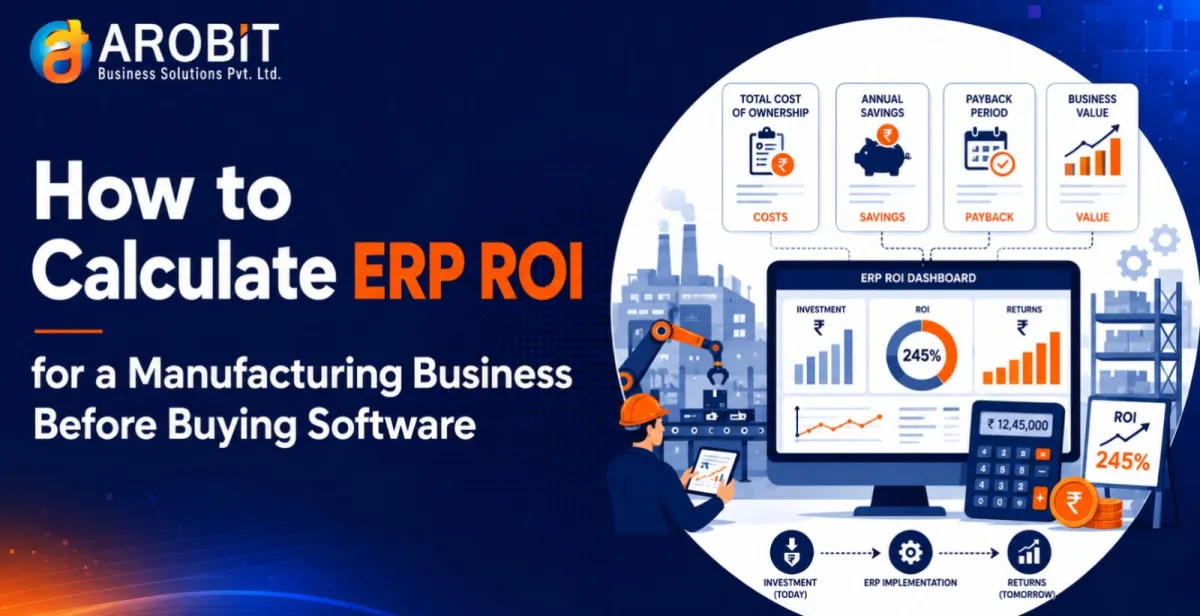
Investing in an ERP system is one of the most significant technology decisions a manufacturing business can make. While software features, implementation timelines, and vendor reputation are important considerations, decision-makers often focus on a more fundamental question: will the investment generate measurable business value?
Understanding ERP ROI for manufacturing businesses before implementation helps organizations make informed decisions, establish realistic expectations, and prioritize investments that support long-term growth.
Rather than viewing ERP solely as a software purchase, manufacturers should evaluate it as a business improvement initiative that can impact inventory management, production planning, procurement, reporting, and operational efficiency.
This article explains how manufacturers can calculate ERP ROI for manufacturing projects before selecting and implementing software.
Why ROI Matters in ERP Decision-Making
Many ERP projects are approved based on expected operational improvements. However, without a structured ROI assessment, businesses may struggle to determine whether the investment aligns with their objectives.
A clear ROI evaluation helps manufacturers:
Justify technology investments
Establish measurable goals
Compare ERP solutions effectively
Prioritize implementation initiatives
Identify expected financial benefits
Most importantly, ROI analysis shifts the conversation from software costs to business outcomes.
Understanding ERP ROI for Manufacturing Businesses
At its core, ROI measures the financial return generated by an investment compared to its total cost.
When evaluating ERP ROI for manufacturing, businesses should consider both direct and indirect benefits.
Direct benefits may include:
Reduced inventory carrying costs
Lower operational expenses
Improved production efficiency
Reduced manual data entry
Faster reporting
Indirect benefits often include:
Better decision-making
Improved customer service
Increased visibility
Stronger compliance management
Enhanced scalability
Both categories contribute to the overall value of an ERP investment.
Start by Calculating Total ERP Costs
Before estimating returns, businesses must understand the full cost of ownership.
Many organizations focus only on software licensing fees while overlooking implementation-related expenses.
Typical ERP costs include:
Software Licensing or Subscription Costs
Depending on deployment models, costs may include:
Annual licensing fees
Monthly subscriptions
User-based pricing
Implementation Services
Implementation often includes:
Business analysis
Process mapping
Configuration
Testing
Deployment
Customization
Manufacturers frequently require ERP customization to support specific operational workflows.
Integration Costs
ERP systems may need to connect with:
CRM platforms
Inventory systems
Accounting software
Production equipment
Business intelligence tools
Training and Support
User adoption plays a major role in ERP success.
Training costs often include:
Employee onboarding
Process documentation
Ongoing support
Understanding these expenses creates a realistic foundation for ROI calculations.
Identify Current Operational Costs
The next step in calculating ERP ROI for manufacturing is identifying the costs associated with current inefficiencies.
Common areas include:
Inventory Inefficiencies
Manufacturers often carry excess inventory because demand visibility is limited.
Examples include:
Overstocking
Obsolete inventory
Inventory discrepancies
Production Delays
Manual processes and limited visibility frequently lead to:
Scheduling conflicts
Machine downtime
Resource allocation issues
Administrative Work
Employees may spend significant time on:
Manual reporting
Data entry
Spreadsheet management
Cross-department communication
Procurement Inefficiencies
Poor visibility into inventory and supplier performance often results in:
Emergency purchases
Delayed procurement
Increased purchasing costs
Quantifying these expenses helps estimate potential savings after ERP implementation.
Estimate Potential Financial Benefits
Once current inefficiencies have been identified, businesses can estimate expected improvements.
Inventory Cost Reduction
ERP systems provide better inventory visibility and planning capabilities.
Potential benefits include:
Lower inventory holding costs
Reduced stockouts
Improved inventory turnover
For example, if a manufacturer carries ₹5 crore worth of inventory and reduces inventory costs by 10%, annual savings could reach ₹50 lakh.
Increased Production Efficiency
ERP platforms improve:
Production scheduling
Resource utilization
Work order management
Even modest productivity improvements can generate substantial financial returns.
Reduced Administrative Costs
Automation reduces repetitive manual activities.
Benefits may include:
Fewer reporting hours
Reduced paperwork
Faster data processing
These savings often accumulate across multiple departments.
Improved Procurement Performance
ERP visibility supports:
Better supplier management
More accurate purchasing
Reduced emergency procurement
The resulting savings can contribute significantly to overall ROI.
Use a Simple ERP ROI Formula
Once costs and expected benefits are estimated, manufacturers can calculate ROI using a standard formula.
For example:
ERP Investment: ₹40 lakh
Annual Savings: ₹20 lakh
Annual Productivity Gains: ₹10 lakh
Total Annual Benefits = ₹30 lakh
ROI:
(₹30 lakh – ₹40 lakh) ÷ ₹40 lakh × 100 = -25% after Year 1
However, ERP projects are long-term investments.
After two years:
Total Benefits = ₹60 lakh
ROI:
(₹60 lakh – ₹40 lakh) ÷ ₹40 lakh × 100 = 50%
This demonstrates why ERP investments should be evaluated over multiple years rather than a single implementation cycle.
Evaluate Payback Period
The payback period measures how long it takes for ERP benefits to recover the initial investment.
For example:
ERP Investment = ₹40 lakh
Annual Benefits = ₹20 lakh
Payback Period = 2 Years
Many manufacturing businesses consider ERP investments attractive when payback occurs within two to three years.
Consider Strategic Benefits Beyond Cost Savings
Not every ERP benefit can be measured immediately through direct financial calculations.
When assessing ERP ROI for manufacturing, businesses should also evaluate strategic advantages.
Better Decision-Making
Real-time reporting enables faster and more accurate business decisions.
Improved Customer Service
Better inventory visibility and production planning improve delivery performance.
Scalability
ERP systems support business growth without requiring proportional increases in administrative resources.
Compliance and Traceability
Industries such as pharmaceuticals and food manufacturing often require stronger process controls and reporting capabilities.
These benefits may not appear directly in ROI calculations but can significantly influence long-term business performance.
Common Mistakes When Calculating ERP ROI
Many manufacturers underestimate or overestimate ERP returns because they overlook key considerations.
Focusing Only on Software Costs
ERP investments involve implementation, training, integration, and support costs.
Ignoring Change Management
User adoption directly affects ROI outcomes.
Overestimating Immediate Benefits
Most ERP projects deliver value gradually as processes mature and employees adapt.
Excluding Indirect Benefits
Operational visibility, scalability, and improved decision-making often contribute substantial long-term value.
Avoiding these mistakes results in more realistic ROI projections.
The Role of Industry-Specific ERP Solutions
Manufacturing businesses often have unique workflows, production methods, and reporting requirements.
Working with providers that specialize in manufacturing software solutions can help organizations identify opportunities for operational improvements and more accurate ROI projections.
Industry-specific solutions often address manufacturing challenges more effectively than generic business software.
In many cases, tailored manufacturing software solutions generate stronger returns because they align closely with operational requirements and business objectives.
Conclusion
Calculating ERP ROI for manufacturing before purchasing software helps manufacturers make informed investment decisions and establish realistic expectations. By evaluating implementation costs, operational inefficiencies, expected savings, and strategic benefits, organizations can determine whether an ERP project supports their business goals.
The most successful ERP implementations focus on measurable business outcomes rather than software features alone. Manufacturers that take a structured approach to ROI analysis are better positioned to achieve improvements in inventory management, production efficiency, reporting, and overall operational performance. With expertise in manufacturing ERP systems, workflow automation, and enterprise software development, Arobit helps manufacturers evaluate technology investments and implement solutions that support long-term business growth.
Frequently Asked Questions
1. What is a good ERP ROI for a manufacturing business?
Many manufacturers target an ROI of 30% to 100% over the first three to five years, depending on operational complexity and implementation scope.
2. How long does it take to achieve ERP ROI?
Most manufacturing businesses begin seeing measurable benefits within 12 to 24 months, while full ROI is often realized over a two- to five-year period.
3. What factors have the biggest impact on ERP ROI?
Inventory optimization, production efficiency improvements, reduced manual work, procurement savings, and stronger operational visibility typically contribute the most to ERP ROI.

Comments
No comments yet. Be the first to share your thoughts!