




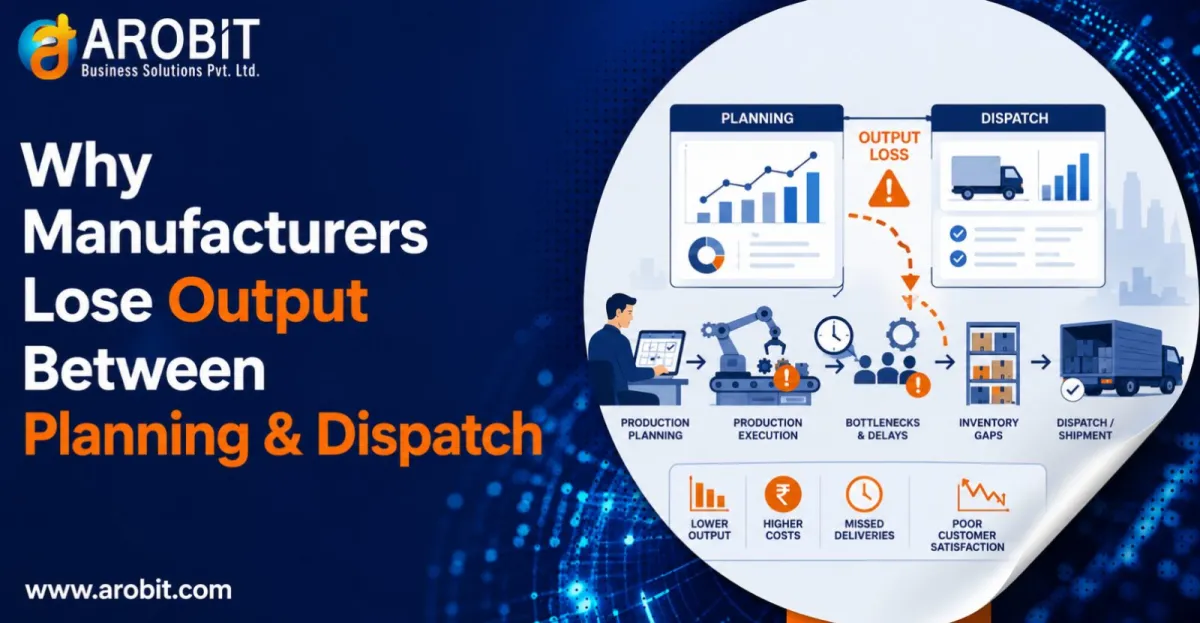
Manufacturers often invest heavily in production equipment, workforce training, and process improvements, yet many continue to struggle with a common problem: planned output does not always translate into dispatched output.
A production plan may indicate that 10,000 units can be manufactured this month, but only 8,500 units ultimately reach customers. The missing output is rarely caused by a single issue. Instead, it is the result of operational gaps that occur between planning, procurement, inventory management, production, warehousing, and dispatch.
According to industry studies, manufacturers can lose between 5% and 20% of planned output due to scheduling inefficiencies, inventory shortages, unplanned downtime, and process bottlenecks. These losses directly affect revenue, customer satisfaction, and operational efficiency.
This is why many manufacturers are investing in production planning software for manufacturing to create stronger connections between planning and execution.
Understanding the Planning-to-Dispatch Gap
Production planning defines what products need to be manufactured, the resources required, and the timeline for completion. Dispatch represents the final stage where finished goods are delivered to customers.
Between these two points, several interconnected activities take place:
Raw material procurement
Inventory allocation
Production scheduling
Machine utilization
Workforce deployment
Quality inspections
Packaging
Warehouse operations
Logistics coordination
When any of these processes become disconnected, output losses begin to accumulate.
A manufacturer may have sufficient customer demand and production capacity, but if inventory records are inaccurate or production schedules are not updated in real time, delivery commitments can quickly become difficult to achieve.
Where Output Losses Commonly Occur
Inventory Inaccuracies
Inventory discrepancies are one of the most common causes of production delays.
For example, a planning team may schedule production for 5,000 units based on inventory records showing adequate raw material stock. When production starts, warehouse teams discover that actual stock levels are lower because of unrecorded consumption or inventory adjustments.
Production stops while procurement sources additional materials.
The result is delayed orders, increased costs, and lost output.
Many manufacturers address this challenge through inventory forecasting software, which provides better visibility into inventory trends, material requirements, and future demand.
Demand Forecasting Errors
Production schedules depend on accurate demand forecasts.
If demand is underestimated, manufacturers may not have enough inventory or production capacity to fulfill customer orders. If demand is overestimated, excess inventory increases carrying costs and warehouse utilization.
A common example is seasonal demand fluctuations. Manufacturers relying on historical averages often struggle when customer demand shifts unexpectedly.
Organizations using inventory forecasting software for manufacturing can analyze historical sales patterns, seasonal trends, purchasing behavior, and inventory movement to improve planning accuracy.
Communication Gaps Between Departments
Manufacturing operations involve multiple teams working simultaneously.
A procurement delay can impact production schedules. A quality issue can delay warehouse transfers. A logistics bottleneck can postpone dispatch.
When departments rely on emails, spreadsheets, or disconnected systems, critical information may not reach decision-makers quickly enough.
The result is reactive problem-solving instead of proactive planning.
Production Bottlenecks
Every manufacturing process contains constraints.
Common bottlenecks include:
Limited machine availability
Skilled labor shortages
Equipment maintenance delays
Quality inspection backlogs
Material handling inefficiencies
Without operational visibility, bottlenecks may remain hidden until production output begins to decline.
A manufacturer producing automotive components, for example, may have sufficient capacity across most workstations, but a single inspection stage operating below capacity can reduce throughput across the entire production line.
Manual Planning Processes
Many manufacturers still depend on spreadsheets for production planning.
While spreadsheets may work for smaller operations, they become difficult to manage as production complexity increases.
Challenges often include:
Version control issues
Scheduling conflicts
Delayed updates
Human errors
Limited real-time visibility
A centralized production planning software for manufacturing environment helps ensure that planners, production managers, warehouse teams, and procurement departments work from the same data.
The Financial Impact of Output Losses
Output losses affect more than production metrics.
Increased Operational Costs
When schedules change unexpectedly, manufacturers often incur:
Overtime expenses
Emergency procurement costs
Expedited shipping charges
Additional warehouse handling costs
These costs reduce profitability and increase operational pressure.
Reduced Customer Satisfaction
Late deliveries can affect long-term customer relationships.
Research consistently shows that delivery reliability is one of the most important factors influencing supplier performance evaluations. Customers expect accurate delivery commitments and consistent execution.
Repeated delays can lead to lost contracts and reduced customer trust.
Lower Resource Utilization
Machines, labor, and inventory represent significant investments.
When production plans frequently change because of poor coordination or inventory shortages, these resources are not utilized effectively.
This reduces overall manufacturing efficiency and limits growth potential.
How Integrated Planning Reduces Output Losses
Manufacturers that consistently achieve high delivery performance typically operate with integrated planning systems.
Rather than managing planning, inventory, procurement, production, and dispatch separately, they connect these functions through a shared operational platform.
Real-Time Inventory Visibility
Real-time inventory tracking enables planners to see:
Available inventory
Reserved stock
Incoming materials
Consumption rates
Inventory aging
This helps prevent material shortages that disrupt production schedules.
Dynamic Production Scheduling
Manufacturing environments change constantly.
Equipment breakdowns, supplier delays, urgent customer orders, and workforce constraints require schedules to adapt quickly.
Modern production planning software for manufacturing allows planners to evaluate the impact of changes and adjust schedules accordingly.
Forecast-Driven Planning
Forecasting plays a critical role in operational stability.
Organizations that use inventory forecasting software for manufacturing can align procurement decisions with expected demand, reducing stockouts while avoiding excess inventory accumulation.
Improved Operational Visibility
Management teams benefit from dashboards that provide insight into:
Production progress
Work-in-progress inventory
Resource utilization
Order fulfillment performance
Delivery timelines
This visibility supports faster and more informed decision-making.
Manual Planning vs Integrated Planning
Area | Manual Planning | Integrated Planning |
Inventory Visibility | Periodic updates | Real-time visibility |
Schedule Adjustments | Manual | Automated and dynamic |
Forecast Accuracy | Limited | Data-driven |
Department Coordination | Siloed communication | Connected workflows |
Reporting | Time-consuming | Real-time dashboards |
Dispatch Reliability | Variable | More predictable |
Manufacturers that move toward integrated operations often experience measurable improvements in planning accuracy, inventory control, and delivery performance.
What Manufacturers Should Look for in a Planning Solution
When evaluating operational technology, manufacturers should prioritize features that connect planning with execution.
Important capabilities include:
Production scheduling
Material requirement planning
Inventory management
Demand forecasting
Shop floor monitoring
Quality management integration
Warehouse management
Dispatch tracking
Business intelligence dashboards
The goal is not simply to create production schedules but to ensure those schedules can be executed successfully.
Key Takeaways
Output losses between planning and dispatch are usually the result of disconnected processes rather than insufficient production capacity.
Inventory inaccuracies, forecasting errors, communication gaps, manual planning methods, and production bottlenecks all contribute to the gap between planned and actual output.
By connecting planning activities with real-time operational data, manufacturers can improve visibility, reduce disruptions, and increase delivery reliability.
Conclusion
The difference between planned output and dispatched output often determines how efficiently a manufacturing business operates. Organizations that rely on disconnected systems and manual coordination frequently encounter delays, inventory shortages, and production bottlenecks that reduce overall performance.
Investing in production planning software for manufacturing helps businesses create stronger alignment between planning, inventory management, production, warehousing, and dispatch. Combined with accurate forecasting and operational visibility, these systems enable manufacturers to make better decisions and improve delivery performance.
Many organizations are also adopting manufacturing IT solutions to connect critical business processes and eliminate operational silos. The right technology foundation can significantly improve efficiency, resource utilization, and customer satisfaction.
For manufacturers looking to strengthen operational control and improve planning accuracy, partnering with experienced providers of manufacturing IT solutions can make a measurable difference. Arobit helps manufacturing businesses develop tailored software systems that improve visibility, streamline workflows, and support data-driven production management.
FAQs
1. Why is there often a gap between production planning and dispatch?
The gap is typically caused by inventory shortages, inaccurate forecasting, production bottlenecks, communication delays, and manual planning processes that reduce operational visibility.
2. How does production planning software improve manufacturing performance?
Production planning software for manufacturing connects scheduling, inventory, procurement, and production activities, enabling better coordination and reducing disruptions throughout the production cycle.
3. Why is inventory forecasting important for manufacturers?
Forecasting helps manufacturers anticipate demand and material requirements. Tools such as inventory forecasting software and inventory forecasting software for manufacturing support better purchasing decisions, improved inventory control, and more reliable production planning.









Comments
No comments yet. Be the first to share your thoughts!