




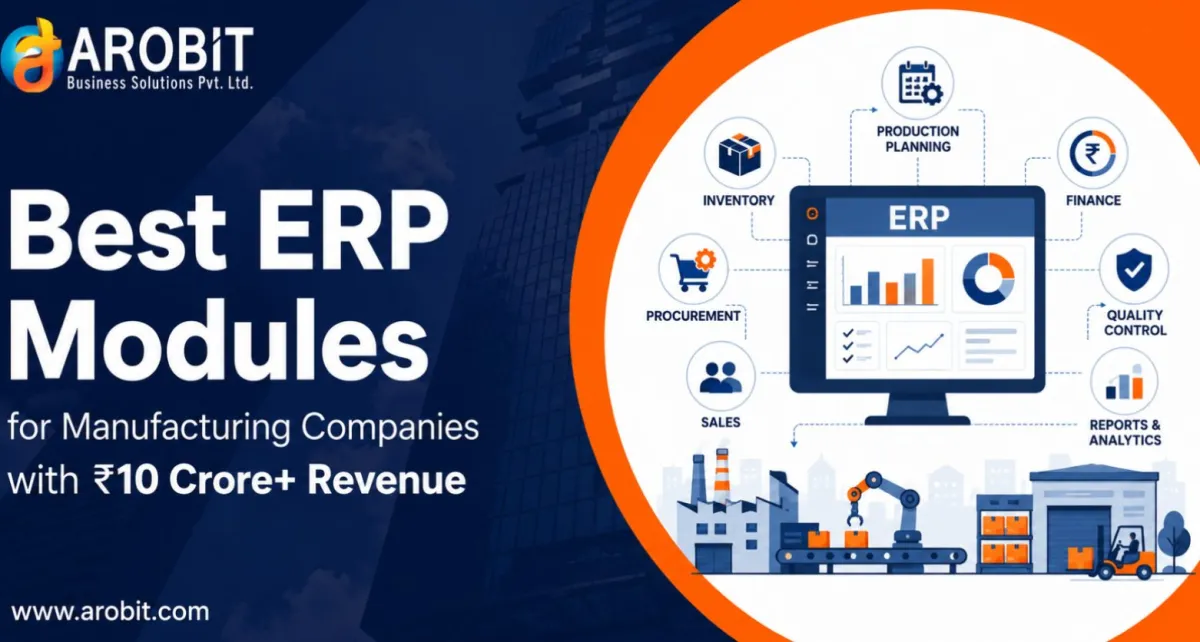
Manufacturing companies crossing the ₹10 crore revenue mark often face a new set of operational challenges. What worked during the early growth stages may no longer support increasing production volumes, larger inventories, expanding supplier networks, and more complex reporting requirements.
At this stage, ERP systems become critical for maintaining operational control and supporting future growth. However, the success of an ERP implementation depends heavily on selecting the right manufacturing ERP modules rather than simply deploying software with a long list of features.
The most effective ERP solutions align with actual business processes, provide visibility across departments, and help leadership make informed decisions. This article explores the most important manufacturing ERP modules that growing manufacturing companies should prioritize in 2026.
Why ERP Module Selection Matters
Many manufacturing businesses invest in ERP systems expecting immediate operational improvements. However, problems often arise when organizations implement modules that do not align with their workflows or overlook critical functions required for day-to-day operations.
A well-structured ERP environment should help businesses:
Improve production planning
Control inventory more effectively
Streamline procurement
Increase operational visibility
Enhance reporting accuracy
Support business scalability
For companies generating ₹10 crore or more in annual revenue, choosing the right manufacturing ERP modules can significantly impact productivity and profitability.
Production Planning and Control Module
Production planning is at the heart of manufacturing operations.
A Production Planning and Control (PPC) module helps businesses manage:
Production schedules
Resource allocation
Work orders
Machine utilization
Capacity planning
Without structured planning, manufacturers often experience production delays, bottlenecks, and inefficient resource usage.
A strong PPC module provides real-time visibility into production activities and enables managers to adjust schedules based on changing demand or operational conditions.
For many growing manufacturers, this is one of the most valuable manufacturing ERP modules available.
Inventory Management Module
Inventory directly affects cash flow, production continuity, and customer satisfaction.
An inventory management module helps businesses:
Monitor stock levels
Track material movement
Manage raw materials
Control finished goods inventory
Reduce inventory discrepancies
Manufacturers with multiple warehouses or storage locations particularly benefit from advanced inventory management capabilities.
When inventory data is accurate and accessible in real time, purchasing decisions become more effective and production disruptions are reduced.
Procurement and Purchase Management Module
Procurement processes become increasingly complex as businesses scale.
A procurement module helps manage:
Vendor relationships
Purchase requests
Purchase orders
Supplier performance
Material availability
Manufacturers often struggle with delayed procurement cycles, inconsistent vendor performance, and manual purchasing workflows.
Automating procurement activities improves transparency and ensures that production teams have access to the materials they need when they need them.
Warehouse Management Module
As revenue grows, warehouse operations typically become more complex.
A warehouse management module provides:
Location tracking
Stock transfers
Material movement monitoring
Picking and dispatch management
Warehouse performance reporting
Manufacturers managing large inventories can benefit significantly from warehouse optimization.
Among modern manufacturing ERP modules, warehouse management plays a critical role in improving operational efficiency and reducing inventory handling errors.
Quality Management Module
Maintaining product quality becomes increasingly important as manufacturing volumes increase.
A quality management module supports:
Inspection processes
Quality checkpoints
Non-conformance tracking
Corrective actions
Compliance documentation
Industries such as pharmaceuticals, chemicals, food processing, and engineering manufacturing often require structured quality control processes.
Integrating quality management directly into ERP workflows helps reduce defects and improve compliance readiness.
Bill of Materials (BOM) Management Module
The Bill of Materials serves as the foundation of production planning.
A BOM management module helps manufacturers:
Define product structures
Manage component relationships
Track material requirements
Support production planning
Without accurate BOM management, organizations may experience material shortages, production delays, and cost inaccuracies.
Manufacturers producing multiple product variants particularly benefit from advanced BOM functionality.
Supply Chain Management Module
Supply chain disruptions continue to affect manufacturers across industries.
A supply chain management module provides visibility into:
Supplier performance
Material availability
Procurement timelines
Logistics coordination
Distribution planning
The ability to monitor supply chain activities in real time helps manufacturers respond more effectively to disruptions and changing market conditions.
For companies experiencing rapid growth, supply chain visibility is often one of the most important benefits delivered by modern manufacturing ERP modules.
Finance and Accounting Module
While manufacturing operations drive production, financial visibility remains essential for business success.
An integrated finance module helps organizations manage:
Accounts payable
Accounts receivable
Cost tracking
Budget management
Financial reporting
Tax compliance
When operational and financial data exist within the same ERP environment, leadership teams gain a more accurate understanding of business performance.
This integrated visibility supports better strategic planning and investment decisions.
Business Intelligence and Reporting Module
Manufacturers generate significant volumes of operational data every day.
A business intelligence module transforms this data into actionable insights through:
Real-time dashboards
KPI tracking
Production reports
Inventory analysis
Financial reporting
Forecasting support
Executives and plant managers can quickly identify trends, monitor performance, and address operational issues before they become larger problems.
Organizations with ₹10 crore+ revenue often find that advanced reporting capabilities create substantial decision-making advantages.
Maintenance Management Module
Equipment downtime can have a direct impact on production schedules and profitability.
A maintenance management module helps manufacturers:
Schedule preventive maintenance
Monitor equipment performance
Track service history
Reduce unplanned downtime
Improve asset utilization
Manufacturers relying heavily on machinery should strongly consider including maintenance functionality within their ERP strategy.
Human Resource and Workforce Management Module
Manufacturing businesses depend on skilled labor, supervisors, and operational staff.
An HR module supports:
Attendance management
Shift scheduling
Employee records
Performance tracking
Workforce planning
Integrating workforce information with operational data improves resource planning and production management.
How to Prioritize ERP Modules
Not every company needs every module immediately.
Decision-makers should evaluate:
Current Operational Challenges
Which processes create the most inefficiencies?
Growth Objectives
What operational requirements will emerge over the next three to five years?
Industry Requirements
Are there compliance, traceability, or quality requirements that require specialized functionality?
Integration Requirements
Will ERP need to connect with existing systems?
Organizations that prioritize business needs rather than software features typically achieve stronger ERP outcomes.
The Role of Industry-Specific ERP Solutions
Standard ERP platforms often provide a strong foundation, but many manufacturers require industry-specific workflows and reporting capabilities.
Working with an experienced provider of manufacturing software solutions can help businesses identify the modules most relevant to their operations and future growth plans.
Rather than implementing unnecessary functionality, manufacturers can focus on capabilities that directly support operational efficiency and decision-making.
Conclusion
Selecting the right manufacturing ERP modules is one of the most important technology decisions for manufacturing companies with ₹10 crore or more in annual revenue. Production planning, inventory management, procurement, warehouse operations, quality control, business intelligence, and maintenance management all contribute to stronger operational performance.
The ideal ERP strategy should align with business objectives, manufacturing processes, and long-term growth plans. Partnering with experts in manufacturing software solutions can help manufacturers evaluate requirements and implement systems that deliver measurable business value. With extensive experience in ERP development, workflow automation, enterprise software, and manufacturing technology, Arobit helps businesses build scalable solutions that improve visibility, efficiency, and operational control.
Frequently Asked Questions
1. Which ERP module is most important for manufacturing companies?
Production Planning and Inventory Management are often considered foundational modules because they directly impact production efficiency, inventory accuracy, and operational visibility.
2. Do manufacturing companies need all ERP modules at once?
Not necessarily. Many businesses implement ERP in phases, prioritizing critical operational modules first and adding additional functionality as requirements evolve.
3. How do companies determine which ERP modules they need?
The best approach is to evaluate current operational challenges, growth objectives, compliance requirements, and process inefficiencies before selecting ERP modules.

Comments
No comments yet. Be the first to share your thoughts!