





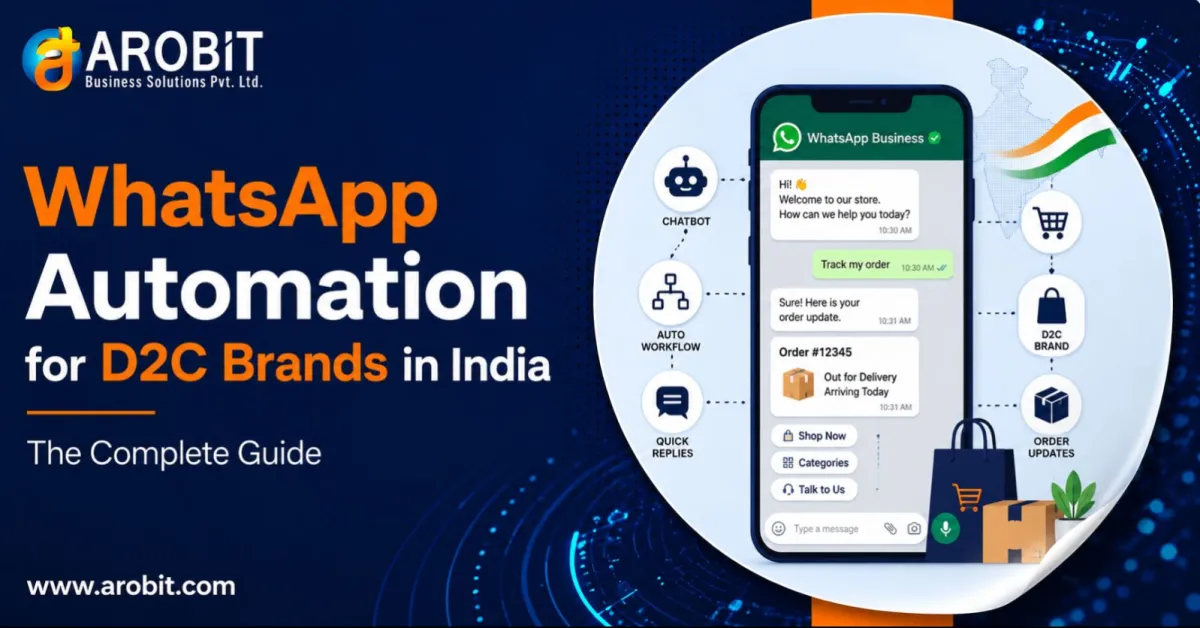
For a D2C brand in India, the customer is already on WhatsApp. The question is whether your brand is there too, or still emailing into a promotions folder nobody opens.
WhatsApp is where Indian shoppers talk to family, check order updates, and ask "is this in stock?" at 11 p.m. Email cannot match that attention. This guide covers how D2C brands use WhatsApp Automation to sell, support, and retain. It shows what the numbers actually look like, and how to set it up without getting your number blocked.
Why WhatsApp, and Why Now
Email built the first wave of D2C in India. It is no longer enough on its own.
The gap shows up most clearly in abandoned carts, the single biggest leak in any online store. Roughly 70% of online carts are abandoned before checkout. Recovering even a slice of them is among the highest-return activities a D2C brand can run.
This is where the channel difference becomes stark. Analysis of D2C brands in India shows a wide performance gap between the two channels:
WhatsApp cart-recovery flows recover 15–25% of abandoned carts, compared to 5–8% from email. — Product Growth Intelligence, WhatsApp Commerce for D2C Brands (India)
The reason is simple. A WhatsApp message from a brand you recognise arrives as a notification on the same screen where you chat with family. Email open rates for Indian D2C cart recovery sit at just 5–8%. WhatsApp messages are seen almost every time.
What D2C Brands Actually Automate on WhatsApp
WhatsApp Automation is not one feature. It is a set of workflows, each solving a specific revenue or support problem.
- Abandoned cart recovery: An automated sequence reminds a shopper about the product they left behind. A warm nudge first, a soft offer later, a last-chance message after that. This is usually the first flow a brand builds, because the ROI is easiest to prove.
- Order and shipping updates: Confirmation, dispatch, and delivery messages go out automatically. These are transactional, high-open, and reduce "where is my order" support load.
- Customer support: An AI customer support chatbot answers routine questions instantly. Size, availability, return policy, order status. The customer gets an answer at midnight without a human awake to give it.
- Post-purchase and re-engagement: Review requests, replenishment reminders, and new-arrival broadcasts bring customers back. This is the most underused flow in Indian D2C.
- Catalogue and checkout: Some brands sell inside the chat itself, showing products and collecting payment without the customer leaving WhatsApp.
The ROI Case, Honestly
WhatsApp Automation is not free money. It costs money to run. The returns depend on one number most guides skip: your opt-in rate.
A 20% recovery rate means little if only a handful of buyers have consented to WhatsApp messages. The math works once you build a real opt-in base through shop pop-ups, checkout consent, and lead-magnet offers.
When the opt-in base is there, the economics are strong. Revenue per message sent on WhatsApp consistently runs well above email for mid-market D2C brands in India. The reason is not magic. It is attention. A channel with near-universal open rates simply converts more of the intent you already captured.
Treat the numbers as a range, not a promise. Your category, your average order value, and your list quality all move the result.
A Practical Example: The Skincare Brand's Cart Problem
Consider a common scenario for a mid-sized D2C skincare brand running on Shopify.
Before automating, the brand relied on email for cart recovery. Open rates hovered around 6%. Most abandoning customers never saw the reminder. The founder knew revenue was leaking but could not plug it without hiring.
The brand connected a WhatsApp Automation flow to its store. When a cart was abandoned, a reminder went out within the hour. A gentle offer followed if the first message did not convert. Support questions that arrived through the day were handled by an ai chatbot for ecommerce. A shopper asking about ingredients got an instant answer instead of waiting.
Recovered carts climbed into the mid-teens as a percentage, from a base near 6% on email. No new hire was needed. The gain came from reaching customers on a channel they actually check, and from answering questions at the moment of hesitation.
The lesson is not that WhatsApp is magic. It is that intent captured must be met with a response fast enough to matter.
Where WhatsApp Automation Goes Wrong
Three mistakes cost brands their results, and sometimes their WhatsApp number.
- Treating it as a spam channel: Blasting every contact with daily offers gets you blocked and opted out. WhatsApp rewards relevance and punishes noise. Keep templates useful and infrequent.
- Skipping the opt-in base: Automation without consented contacts has nobody to talk to. Build the list before you build the flows.
- Over-sequencing: Recovery performance breaks down after three or four messages. More pressure drives opt-outs, not orders. Stop when the sequence stops working.
- No human handover: Some questions need a person. A flow with no escalation path frustrates the exact customers most likely to buy. An ai customer support chatbot should hand off cleanly when it hits its limit.
Using WiseBot for WhatsApp Automation
WiseBot is Arobit's own WhatsApp Automation product, built for exactly the workflows above. It runs on the official WhatsApp Business API, so it is compliant rather than a grey-market workaround.
It covers the full D2C stack. A no-code, drag-and-drop builder lets non-technical teams design conversation flows. WooCommerce and Shopify connectors push order and shipping updates automatically. A WhatsApp catalogue and in-chat payments let customers buy without leaving the app. When the bot reaches its limit, live human handover routes the chat to an agent with the full context.
For support, WiseBot works as an ai chatbot for ecommerce that answers routine queries around the clock. It has vision capability to read images a customer sends, such as a photo of a damaged product. Bulk broadcasting handles offers and new-arrival announcements at scale, within WhatsApp's template rules.
The point of naming it here is not a hard sell. It is that the workflows in this guide are not theoretical. They are what a purpose-built platform like WiseBot is designed to run.
How to Get Started
Start with one WhatsApp Automation flow, not the whole stack. Abandoned cart recovery is the usual first choice, because its return is the clearest to measure.
Before that, build your opt-in base. Add a WhatsApp consent option at checkout and a shop pop-up offering a small incentive. Without consented contacts, no automation has anyone to reach.
Then connect your store, launch the single flow, and measure recovery over a month. Once the number is proven, add order updates, then support, then re-engagement. Phase it. Do not automate everything at once.
What to Do Next
Pick your biggest leak. For most D2C brands it is the abandoned cart. Measure what you recover today on email, then compare it to what WhatsApp can reach.
Decide who owns your opt-in growth before you buy any tool. That base determines whether the automation has anyone to talk to.
Speak with our team about automating cart recovery and support with WiseBot. Get in touch with Arobit



Comments
No comments yet. Be the first to share your thoughts!