





For most Indian small businesses, AI Automation did not arrive as a strategy. It arrived one task at a time.
A WhatsApp bot answered the questions the owner used to field at midnight. A tool started sorting invoices. Follow-ups that a salesperson forgot began sending themselves. Nobody wrote a transformation plan. The work simply got quieter.
That quiet spread fast in 2025. The scale of it is now measurable, and it tells a clear story about where small and medium businesses in India are placing their bets.
This article looks at what Indian SMBs are actually automating, where the value shows up, and how to start without wasting money.
The Adoption Numbers Are Not Subtle
Indian SMBs have moved past the experiment stage. A LinkedIn-YouGov study of 1,027 SMB and MSME decision-makers, published in November 2025, found adoption is now near-universal in intent:
95.6% of Indian SMBs are already investing in or planning AI adoption. — LinkedIn-YouGov SMB Study, November 2025
That is not curiosity. It is commitment. And the reasoning behind it is defensive as much as ambitious. The same study found the motivation is survival, not novelty:
57% of SMBs view AI and automation as essential to stay competitive. — LinkedIn-YouGov SMB Study, November 2025
More than half the market now treats the technology as a competitive floor. The question stops being whether to adopt. It becomes where to start.
What Indian SMBs Are Actually Automating
The pattern across small businesses is consistent. AI Automation gets pointed at the repetitive, high-volume work first, because that is where the pain is loudest.
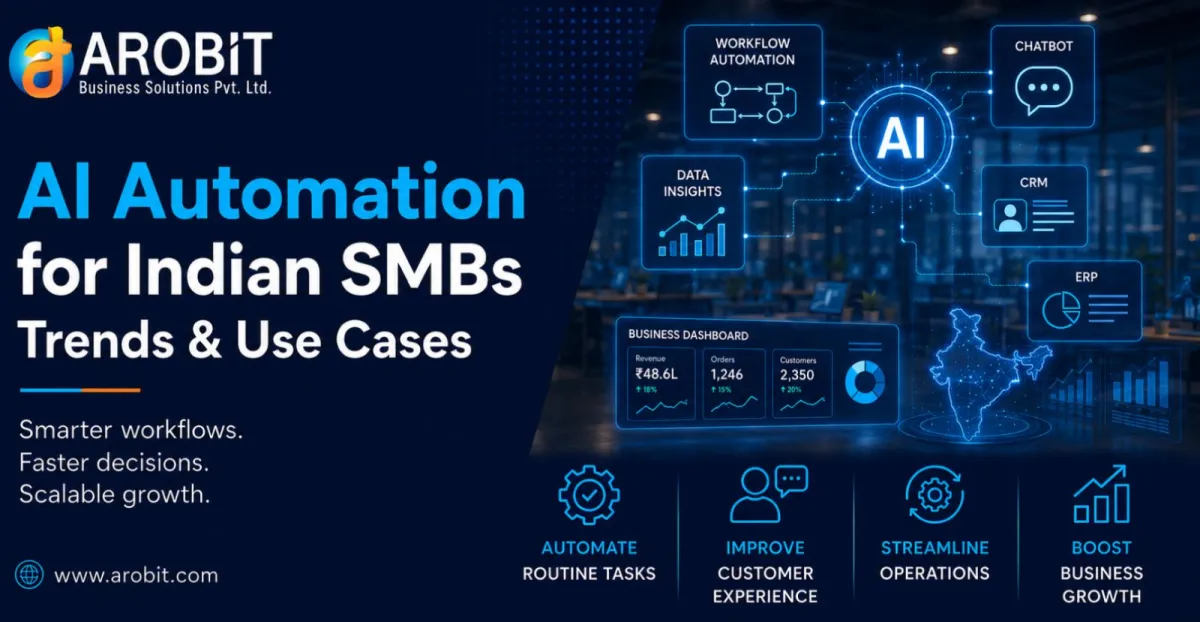
Customer conversations. WhatsApp and chat bots handle first-response queries, order status, and basic support. For a business fielding hundreds of "where is my order" messages a day, this is the fastest relief.
Lead follow-up. Automated sequences chase enquiries that a busy sales team drops. A lead that fills a form at 11 p.m. gets a reply immediately, not the next afternoon.
Invoicing and data entry. Tools read documents and post entries, cutting the manual keying that produces errors and month-end reconciliation work.
Marketing content. Small teams use AI to draft posts, product descriptions, and ad copy, then edit rather than write from scratch.
Reporting. Owners get daily sales and stock summaries pulled together automatically, instead of waiting for someone to compile a spreadsheet.
None of these is glamorous. All of them return hours that a small team does not have to spare.
Why AI Automation Fits the SMB Reality
Large enterprises adopt AI to squeeze marginal gains from big operations. Small businesses adopt it for a different reason. They are short-staffed, and every automated task is a task an overloaded person no longer does by hand.
This is the core fit. An SMB rarely has a spare employee to absorb a growth spike. AI Automation lets a five-person team handle the query volume of a fifteen-person one. The technology substitutes for headcount the business could not afford anyway.
There is a second fit. Indian SMBs operate on thin margins and cannot risk a large software project failing. The current wave of AI Automation is modular. A business can automate one workflow, prove the saving, then automate the next. The commitment is small at each step.
A Practical Example: The Distributor's Follow-Up Problem
Consider a common scenario for a regional distributor with two salespeople and a few hundred retailers.
Before automating, the salespeople lived in WhatsApp. They fielded order queries, price checks, and stock questions all day. Follow-ups on pending orders happened when someone remembered. Many did not happen at all. The owner could not see which retailers had gone quiet.
The business added a chat automation layer connected to its order system. Routine queries got instant answers. Pending-order reminders sent themselves on a schedule. The owner got a daily list of retailers with no recent activity.
The two salespeople did not lose their jobs. They stopped answering the same three questions two hundred times a day. They spent that time on the accounts the report flagged. Orders from lapsed retailers recovered, not through new hiring, but through work that no longer fell through the cracks.
The gain here was not exotic technology. AI Automation simply redirected attention to where it mattered.
Where SMBs Go Wrong
Three mistakes show up repeatedly.
Automating a broken process. If your sales process is chaotic, automating it produces faster chaos. Fix the workflow first, then automate it.
Buying tools nobody adopts. A subscription that the team ignores is pure cost. Adoption matters more than features. Start with the one task people most want off their plate.
No owner. Someone has to maintain the automation, check its output, and fix it when it drifts. Without an owner, it decays quietly and trust erodes.
The businesses that get value are not the ones with the most tools. They are the ones that picked one painful task and saw it through.
How to Start Without Wasting Money
Pick your single most repetitive task. Count how many hours a week your team spends on it. That number tells you whether automation is worth a conversation.
Then choose one tool for that task, prove the saving over a month, and only then expand. Resist the urge to automate everything at once.
Some businesses have the internal skill to set this up themselves. Others benefit from a partner. A capable AI automation agency can map which of your workflows will return the most for the least effort. It can also build integrations that off-the-shelf tools do not cover. For businesses without in-house technical resources, structured AI automation services remove the trial-and-error that wastes the first few months.
What to Do Next
Do not start with the technology. Start with the task. List the five jobs your team repeats most, rank them by hours consumed, and automate the top one.
Decide who owns the automation before you buy it. That single decision separates the SMBs that get value from the ones that add another unused subscription.
Speak with our team to explore which of your workflows are worth automating first. Get in touch with Arobit












Comments
No comments yet. Be the first to share your thoughts!