





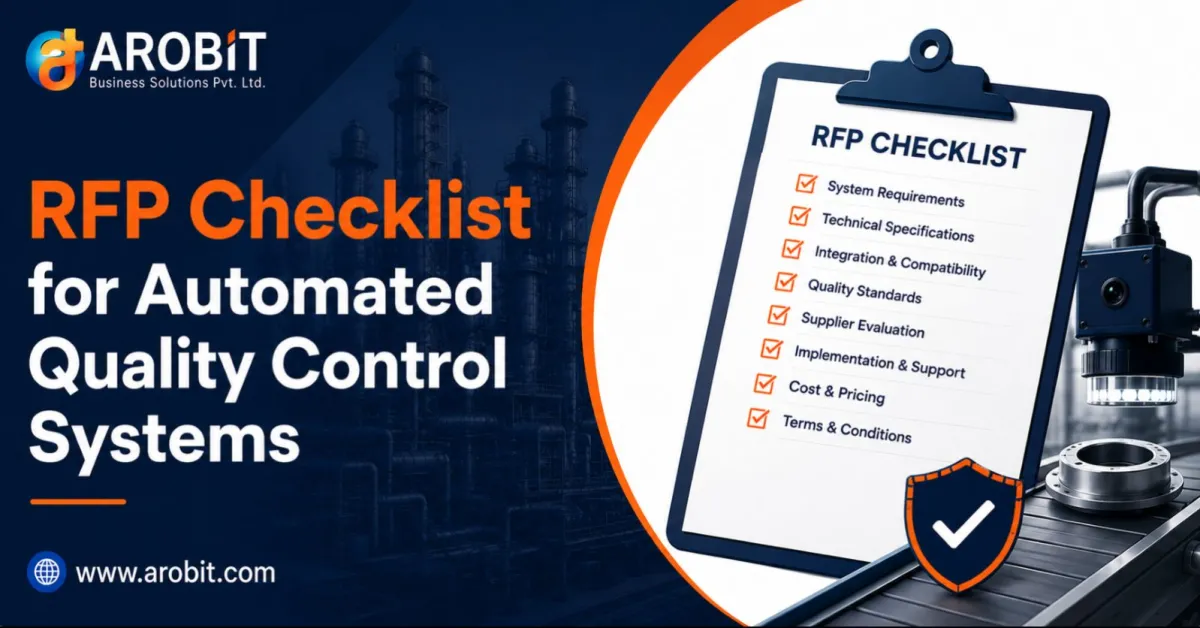
Auto component manufacturers today face mounting pressure from OEMs to reduce rejection rates, improve inspection accuracy, and maintain consistent production quality — all while managing higher volumes and tighter timelines. A single quality failure at the supplier level can trigger costly OEM rejections, line stoppages, or penalties.
This is where an automated quality control system for auto component plants becomes a critical operational investment. But selecting the right system requires more than reviewing vendor brochures. A well-structured RFP (Request for Proposal) process ensures that you evaluate vendors on the metrics that matter most to your plant.
This checklist is designed for plant managers, quality heads, and operations leaders at auto component manufacturing facilities who are in the process of evaluating and procuring a quality management solution.
Why an RFP Process Matters for Quality System Procurement
Choosing a quality control system without a structured RFP leads to poor vendor comparisons, missed technical requirements, and misaligned expectations on integration and support.
A QC software vendor checklist ensures:
- All vendors are evaluated against the same criteria
- Technical and operational requirements are clearly communicated
- Budget and timeline expectations are set upfront
- Post-implementation support terms are defined before signing
Vendor Background and Experience
Before evaluating features, assess whether the vendor has relevant manufacturing experience.
Ask vendors to provide:
- Number of years in manufacturing software development
- Auto component or automotive manufacturing clients served
- Case studies demonstrating measurable quality improvement outcomes
- References from plants with similar production volumes and complexity
A vendor with direct experience in quality control system RFP automotive manufacturing contexts will understand your environment — shift-based production, multi-line inspection, OEM documentation requirements, and supplier audit compliance.
Core Functional Requirements
This section of the RFP should define the non-negotiable capabilities your plant needs.
Inspection and Defect Tracking
- Does the system support an automated inspection system for auto component plants, including vision-based defect detection?
- Can it capture defect data at each inspection stage — incoming, in-process, and final?
- Does it support a defect tracking system for auto parts suppliers with defect classification, severity levels, and root cause tagging?
- Can defect data be linked to specific machines, operators, shifts, or batches?
OEM Rejection and Rework Tracking
- Does the system include an OEM rejection tracking system that logs customer complaints, returned parts, and field rejections?
- Can it generate 8D reports, corrective action records, and PPAP-related documentation?
- Is there a rework tracking system automotive suppliers can use to monitor rework costs, cycle times, and repeat defect rates?
Quality Inspection Workflow Automation
- Does the system support quality inspection workflow automation — routing inspection tasks, escalation alerts, and approvals without manual handoffs?
- Can inspection workflows be configured per part number, customer, or production line?
- Are mobile or tablet-based inspection interfaces available for shop floor use?
AI-Based Inspection Capabilities
- Does the vendor offer an AI inspection system for auto parts, including machine vision, image-based defect classification, or predictive defect detection?
- What training data is required, and how long does the AI model take to become accurate for your part types?
- Is the AI component a core product feature or a third-party integration?
Reporting and Analytics
Quality data is only useful if it drives decisions. Evaluate reporting capabilities carefully.
- Does the system include a quality dashboard for manufacturing plants with real-time visibility into defect rates, yield, and inspection throughput?
- Can dashboards be configured per role — plant manager, quality engineer, production supervisor?
- Does the system support Pareto analysis, trend charts, and SPC (Statistical Process Control)?
- Can reports be exported in formats required for OEM submissions and internal audits?
An automated QC system for auto parts manufacturers should make it easy to answer the question: What is our current rejection rate, where is it coming from, and what are we doing about it?
Integration Requirements
A quality management system that operates in isolation creates data silos. Your RFP must address integration requirements explicitly.
Ask vendors:
- Does the system integrate with your existing ERP or MES platform (SAP, Oracle, or custom ERP)?
- Can it receive production orders and bill of materials data from upstream systems?
- Does it push quality data back to your ERP for inventory disposition and costing?
- Are APIs or standard connectors available, or is integration custom-built?
- What is the integration timeline and cost estimate?
Plants already using custom ERP or manufacturing execution systems should look for vendors who have experience building connected quality modules — similar to what Plants already using custom ERP or manufacturing execution systems should look for vendors with experience integrating quality modules into existing plant systems—similar to Arobit's Custom Automotive Software Development Services, which specialize in integrating quality workflows with existing plant systems.
Compliance and Standards Support
Auto component plants must comply with IATF 16949, ISO 9001, customer-specific requirements (CSRs), and OEM quality portals. Your RFP should verify:
- Does the system support IATF 16949 documentation requirements out of the box?
- Can it manage control plans, MSA records, and FMEA linkages?
- Does it support customer-specific quality portal submissions (e.g., Stellantis SQMS, GM Supplier Quality)?
- Is audit trail and electronic signature functionality available for compliance verification?
Implementation, Training, and Support
A quality system is only as effective as its adoption. Evaluate vendor implementation capabilities:
- What is the typical go-live timeline for a plant of your size and complexity?
- Is on-site implementation support available, or is it entirely remote?
- What training is provided for quality engineers, line supervisors, and IT staff?
- What are the SLA terms for post-go-live support, bug fixes, and system updates?
- Is there a dedicated account manager or technical contact post-implementation?
Section 7: Total Cost of Ownership
Many plants underestimate the true cost of a quality control system. Your RFP should require vendors to provide:
- One-time implementation and licensing fees
- Annual maintenance and support costs
- Integration development costs (if applicable)
- Per-user or per-plant licensing model
- Cost of AI model training or customization (if applicable)
- Upgrade costs for future versions
Request a 3-year total cost of ownership estimate to make a fair comparison across vendors.
Section 8: Pilot and Evaluation Terms
Before full-scale deployment, a pilot phase reduces risk. Include the following in your RFP:
- Is a pilot deployment available on one line or one part family?
- What success criteria will be used to evaluate the pilot?
- What is the timeline and cost of the pilot phase?
- What happens to pilot data and configurations at full deployment?
Frequently Asked Questions
Q1. What is the difference between an automated quality control system and a manual QMS?
A manual QMS relies on paper-based records, spreadsheets, and human inspection at defined checkpoints. An automated quality control system for auto component plants uses digital data capture, real-time inspection workflows, and connected dashboards to monitor quality continuously — reducing the risk of missed defects, delayed reporting, and inconsistent inspection outcomes.
Q2. How long does it typically take to implement a quality management system in an auto component plant?
Implementation timelines vary based on plant size, number of part families, and integration complexity. A basic deployment with standard inspection workflows can take 8-12 weeks. Plants requiring ERP integration, custom dashboards, or AI-based inspection modules typically require 16-24 weeks for full go-live.
Q3. Should we build a custom quality system or buy an off-the-shelf solution?
This depends on your plant's complexity and existing technology landscape. Off-the-shelf solutions work well for plants with standard inspection requirements. Custom-built systems are better suited for plants with unique part families, complex OEM documentation requirements, or specific integration needs with existing ERP systems. For companies already using custom manufacturing software, extending it to include quality modules is often more cost-effective. Vendors offering Software for Automotive Industry with configurable quality modules can bridge the gap between off-the-shelf and fully custom.
Conclusion
Selecting the right automated quality control system for auto component plants is a decision that will affect your rejection rates, OEM relationships, and operational costs for years. A structured RFP process — covering functional requirements, integrations, compliance support, implementation terms, and total cost — ensures you evaluate vendors fairly and choose a system that fits your plant's actual needs.
If your plant is also evaluating how a quality system fits within a broader manufacturing technology stack, Arobit Business Solutions brings over 13 years of experience helping auto component manufacturers connect quality, production, and inventory systems into a unified operational platform. Schedule a Consultation with Arobit's manufacturing technology team to discuss your requirements.



Comments
No comments yet. Be the first to share your thoughts!