





Most leads are not lost to a competitor with a better product. They are lost to silence.
A prospect fills out your form at 9 p.m. Your sales team sees it the next morning, or the morning after. By then the prospect has filled out three other forms, spoken to whoever replied first, and forgotten your name. The lead was never bad. The follow-up was just too slow.
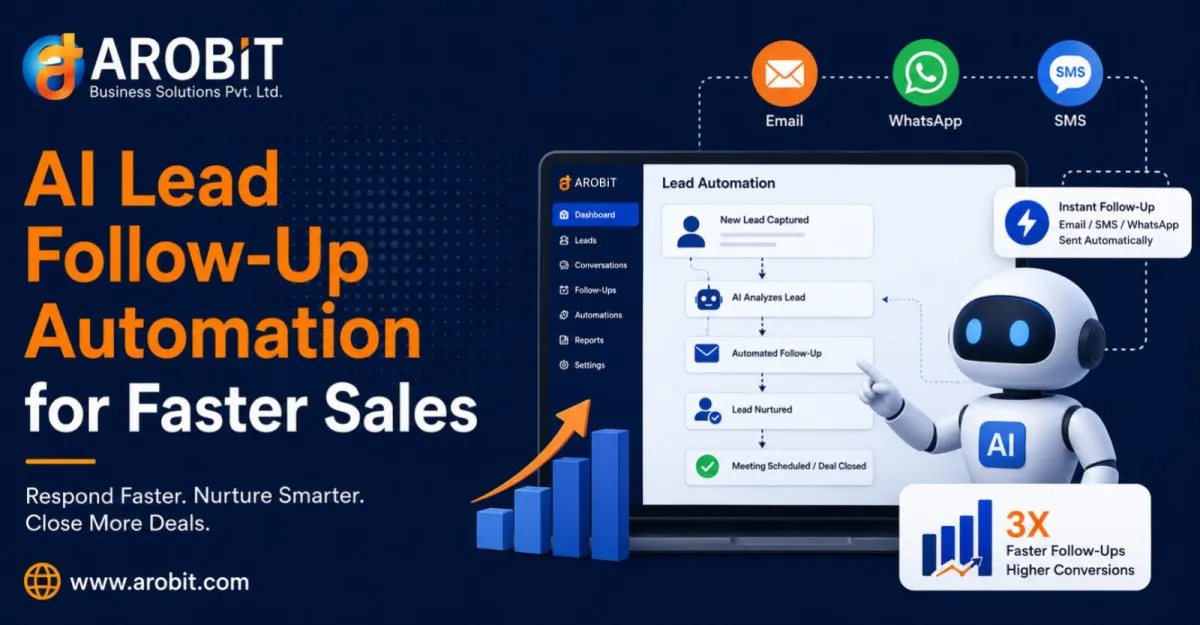
AI lead follow-up automation closes that gap. It responds the moment a lead arrives, qualifies them, and hands the hot ones to your sales team with context. This guide explains how AI lead follow-up automation works, what to automate, and how to connect it to your CRM and WhatsApp.
Why Speed Decides the Sale
The cost of slow follow-up is not a matter of opinion. It has been measured, repeatedly, for over a decade.
The most-cited research is a Harvard Business Review study. It audited how quickly real companies respond to inbound leads:
Firms that contacted a lead within an hour were nearly seven times as likely to qualify it, yet the average first response took 42 hours. — Harvard Business Review, "The Short Life of Online Sales Leads"
The earlier the contact, the sharper the effect. A landmark MIT and InsideSales study analysed over 100,000 call attempts. It found the drop-off is brutally fast:
Leads contacted within five minutes were 21 times more likely to qualify than those contacted after 30 minutes. — Lead Response Management Study, MIT / InsideSales
No human team can respond to every lead in five minutes, around the clock, including weekends. AI lead follow-up automation exists to close that specific gap. That is precisely the job AI lead follow-up automation is built to do.
What AI Lead Follow-Up Automation Actually Does
This is not a single feature. It is a sequence of steps that used to need a person, now handled automatically.
Here is what a working AI lead follow-up automation setup handles.
Instant first response. The moment a lead submits a form, the system sends a personalised reply within seconds. The prospect gets acknowledged while their interest is still warm.
Qualification. The system asks a few structured questions. Budget, requirement, timeline. It sorts serious buyers from casual browsers before a salesperson spends a minute.
Routing. Hot leads are handed to the right salesperson with the full conversation attached. No cold start, no lost context.
Nurture sequences. Leads that are not ready yet get a paced series of follow-ups, so they are not forgotten and not spammed.
Logging. Every interaction is recorded automatically, so your pipeline reflects reality rather than what someone remembered to type.
Done well, AI lead follow-up automation means no inbound enquiry ever sits unanswered overnight again.
The CRM Is the Foundation
Follow-up automation is only as good as the system it writes to. That system is your CRM.
Without a connected CRM, an automated reply is just a message into the void. With one, every lead becomes a record. The AI captures the enquiry, creates or updates the contact, logs the qualification answers, and assigns the lead to a rep, all inside the CRM. Your sales team opens one system and sees the full picture.
This is where CRM integration turns AI lead follow-up automation from a series of disconnected messages into a managed process. Good AI workflow automation connects the lead source, the messaging channel, and the CRM into one loop. The lead arrives, the AI responds and qualifies, the CRM records and routes, and the salesperson picks up a warm, documented prospect.
For businesses without a tidy CRM already in place, this is often the first fix. Sound business process automation AI starts with a clean system of record, because automation built on messy data simply produces faster mess.
Following Up Where Your Leads Actually Are: WhatsApp
In India, the follow-up that matters most often does not happen by email. It happens on WhatsApp.
A prospect is far more likely to read and reply to a WhatsApp message than an email that lands in a promotions folder. This is why WhatsApp has become the primary follow-up channel for Indian businesses, and why connecting your automation to it changes results.
WiseBot, Arobit's own WhatsApp platform, is built for exactly this kind of AI lead follow-up automation. When a lead comes in, a WiseBot flow sends an instant WhatsApp acknowledgement. It asks qualifying questions in a natural back-and-forth, and captures the answers automatically. Its Facebook and Instagram lead integration triggers a WhatsApp message the moment someone submits an ad form. The response reaches them before their interest cools.
When the conversation needs a person, WiseBot hands the chat to a live agent with the full history attached. The AI handles speed and volume. The human handles judgment. The lead never feels dropped.
A Practical Example: The Coaching Institute's Enquiries
Consider a common scenario for an education business, a coaching institute running ads for its courses.
Before automating, enquiries from Facebook ads landed in a spreadsheet. A counsellor called them back during office hours, often a day later. Many prospects had already enrolled elsewhere. The institute was paying for leads it could not answer fast enough.
The institute connected its ad forms to a WiseBot WhatsApp flow linked to its CRM. Now, the instant a prospect submits the form, they get a WhatsApp message with course details and a question about their preferred timing. Interested prospects are qualified in the chat. Their details land in the CRM, and a counsellor follows up with someone who is already engaged, not cold.
The counsellors did not work harder. They stopped chasing dead leads and started talking to warm ones. The ad spend began to convert, because the follow-up finally matched the speed of the enquiry.
Where Businesses Get It Wrong
Three mistakes undermine AI lead follow-up automation.
Automating without a CRM. If replies are not recorded and routed, you have speed without a system. The leads still slip.
Over-messaging. A relentless sequence of follow-ups drives opt-outs. Pace the nurture, and stop when a lead goes cold.
No human handover. AI is excellent at speed and qualification. It is not a replacement for a salesperson closing a considered deal. A flow with no escalation frustrates your best prospects.
The businesses that win treat AI as the first responder, not the whole sales team. Sound business process automation AI supports your people; it does not pretend to replace them.
How to Get Started
Roll out AI lead follow-up automation in stages. Start with your single biggest leak. For most businesses it is the inbound lead that waits too long for a reply. Automate the instant first response first, because its return is the easiest to see.
Then connect the loop. Link your lead source to your messaging channel and your CRM, so a lead flows from enquiry to qualified record without anyone retyping anything. Add nurture sequences once the core loop works. This kind of AI workflow automation compounds: each connected step makes the next one more useful.
If your systems are scattered or your CRM is not ready, a short AI automation consulting engagement can map the loop and build the integrations. That is usually faster and lower-risk than months of trial and error. A focused AI automation consulting engagement pays for itself in the leads it stops you losing.
What to Do Next
Measure one number first: how long your business currently takes to respond to a new lead. Compare it to the five-minute benchmark. That gap is the revenue you are leaving on the table.
Then decide who owns the loop, the lead source, the CRM, and the follow-up channel, before you buy any tool. That ownership matters more than the software.
Speak with our team to connect your CRM, WhatsApp, and lead sources into one loop. Get in touch with Arobit



Comments
No comments yet. Be the first to share your thoughts!