





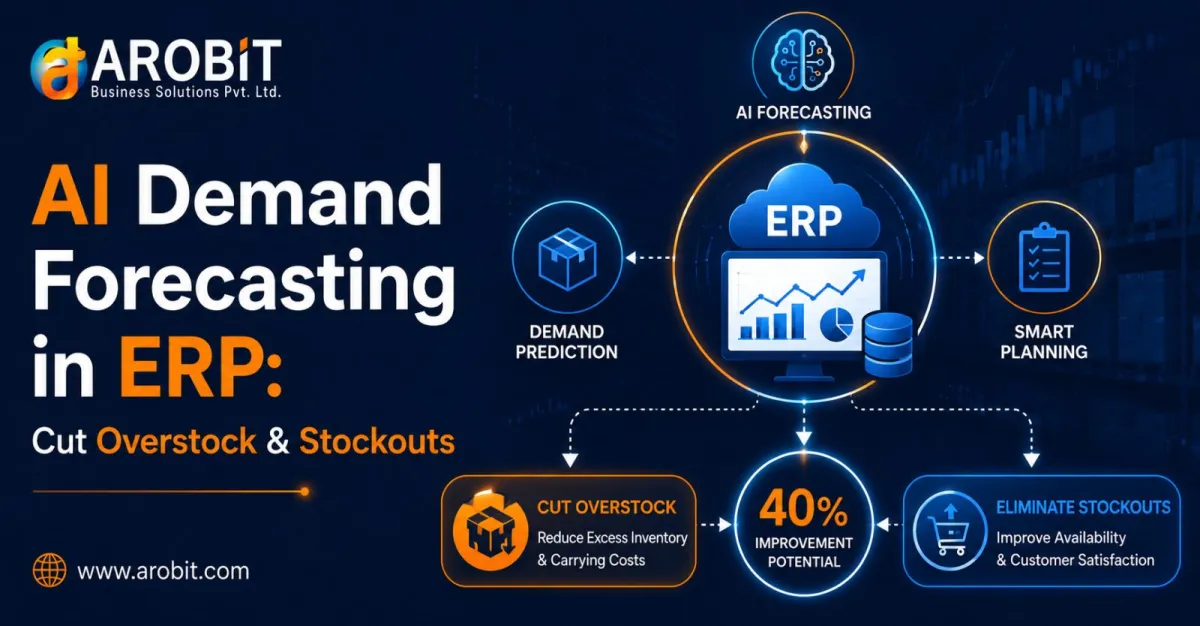
A warehouse full of the wrong products is one of the most expensive mistakes a business can make quietly. The cash is tied up on shelves, the storage costs mount, and some of it will eventually be marked down or written off. Meanwhile, the products customers actually wanted sold out weeks ago. Both problems, the overstock and the stockout, trace back to the same root cause: a forecast that was wrong.
AI Demand Forecasting in ERP exists because traditional forecasting is wrong more often than most businesses admit. It mostly projects the past forward and assumes next year looks like last year. AI-powered forecasting takes a different approach, and the measured results are significant:
McKinsey research found that AI-driven forecasting can reduce forecasting errors by 20% to 50%, while cutting lost sales from stockouts by up to 65%. — McKinsey & Company
AI Demand Forecasting in ERP brings that capability into the system that already runs your operation. This guide explains how it works, in plain terms, and how it attacks overstock and stockouts at the same time.
Why Traditional Forecasting Falls Short
Most demand forecasting still rests on simple math: take last year's sales, adjust for a trend, and project forward. It is easy to understand, and it is wrong in predictable ways.
The weakness is that the real world is not a straight line. Demand is shaped by seasonality, promotions, weather, competitor moves, and economic shifts, and a simple projection captures almost none of that. The result is a forecast that is confidently wrong, which shows up as two costly symptoms.
- Overstock. Order too much based on a bad forecast, and cash sits frozen in inventory that may never sell at full price.
- Stockouts. Order too little, and you lose the sale, and often the customer, to a competitor who had the item.
Every business runs somewhere between these two failures. AI Demand Forecasting in ERP narrows the gap between them by making the forecast itself far more accurate.
AI Demand Forecasting in ERP rests on a handful of ideas worth understanding plainly.
What AI-Powered Demand Forecasting Actually Does
The phrase sounds complex, but the core idea is straightforward. Instead of projecting the past forward with simple math, machine-learning models learn the real patterns in your demand and predict what comes next.
The difference is in what the model can see and weigh:
- Many signals at once. It considers sales history, seasonality, promotions, and other factors together, rather than one trend line.
- Patterns humans miss. It detects subtle, repeating relationships across large volumes of data that no planner could track by hand.
- Continuous learning. As new sales data arrives, the model updates, so the forecast improves over time instead of going stale.
In plain terms, AI-powered demand forecasting changes the question. Instead of guessing that next month resembles last month, it calculates what next month will actually look like, based on everything the data reveals.
How the Machine Learning Works, Without the Jargon
It is worth understanding what is happening inside, briefly, because it demystifies the technology.
A machine-learning model is shown years of your historical demand and the conditions around it: which products sold, when, during which season, alongside which promotions. From that, it learns the relationships. It notices that a particular product rises every autumn, that a promotion lifts demand by a certain amount, that two products sell together. Then, given the upcoming conditions, it predicts demand for each product.
The models behind AI Demand Forecasting in ERP, such as gradient boosting and sequence models, all do the same essential job. They turn a large history of messy, real-world sales data into a forward-looking prediction. The important point for a business is not the algorithm's name. It is that these methods reliably outperform the straight-line projections most companies still rely on.
Attacking Overstock and Stockouts Together
AI Demand Forecasting in ERP matters because it fixes both inventory failures at once, rather than trading one for the other.
- Less overstock. When the forecast is accurate, you buy closer to real demand, so less cash is frozen in excess stock and less inventory ages into markdowns or write-offs.
- Fewer stockouts. More accurate prediction of what will sell, and when, means the products customers want are on the shelf when they arrive. Good custom ERP software ties that prediction straight to replenishment.
- Better cash flow. Inventory is one of the largest uses of working capital, so holding the right amount frees cash for the rest of the business.
The published outcomes are consistent across studies. McKinsey's research links AI-driven forecasting to inventory reductions in the range of 20% to 30%. Some analyses of excess and expired stock report reductions around 30%, with warehousing cost savings between 10% and 40%. The exact figure depends on the business, the data, and the execution. An experienced ERP software development company will model the realistic gain for your specific catalogue. The direction is dependable: more accurate forecasts mean less money trapped in the wrong stock.
Handling Seasonality and Demand Spikes
Seasonality is where AI Demand Forecasting in ERP separates most clearly from the old way. Seasonality and sudden spikes are exactly what simple projections handle worst.
AI Demand Forecasting in ERP manages these patterns directly:
- Layered seasonality. It learns yearly, monthly, and even weekly cycles at the same time, rather than a single annual bump.
- Event awareness. Promotions, holidays, and known events are factored into the forecast rather than distorting it.
- Early spike detection. Emerging demand shifts are picked up from the data sooner than a human reviewing monthly reports would notice.
For any business with strong seasonal swings, this is often the single most valuable capability. The periods of highest demand are also where the cost of getting the forecast wrong is highest.
Why This Belongs Inside Your ERP
Forecasting is only useful if it drives action. That is the argument for AI Demand Forecasting in ERP rather than a separate tool.
When AI Demand Forecasting in ERP lives inside the system that already holds your sales, inventory, and procurement, the forecast connects directly to what happens next:
- Live data. The model forecasts from current sales and stock, not an exported snapshot that is already out of date.
- Straight to action. A forecast can inform reorder points and purchasing directly, rather than being retyped into another system.
- One source of truth. Planning, buying, and inventory all work from the same numbers, so the forecast actually gets used.
This is what makes ERP demand forecasting more useful than a standalone tool. A forecast that sits in a separate spreadsheet often goes unread. One built into the ERP becomes part of how the business buys and plans, which is what makes it deliver in practice. Well-built custom ERP software makes this connection the default rather than an integration project.
Keeping the Claims Honest
The figures behind AI Demand Forecasting in ERP are compelling, but they deserve context, because forecasting is not magic.
AI forecasting improves accuracy substantially. It does not make it perfect. The strong results reported in research come from mature deployments with good historical data, not from switching on a tool overnight. A model needs enough clean history to learn from, typically well over a year, to capture annual seasonality reliably. For brand-new products with no history, forecasting is genuinely harder, and honest providers say so.
The reasonable expectation is a meaningful, measurable improvement in forecast accuracy, and a corresponding reduction in both overstock and stockouts. That is worth a great deal. Promises of a specific guaranteed percentage, regardless of your data or industry, are worth treating with caution.
What to Check Before You Start
A few things separate a forecasting deployment that delivers from one that disappoints:
- Enough clean history. Confirm you have sufficient, accurate sales data for the models to learn from.
- Integrated with your ERP. The forecast should connect to live sales, inventory, and purchasing, not sit in isolation.
- Handles your seasonality. The system must model the seasonal and promotional patterns specific to your business.
- Honest about limits. A good partner sets realistic expectations, especially for new products with little history.
How to Get Started
Roll out ERP demand forecasting in stages rather than all at once:
- Start with your highest-value or most volatile products, where AI Demand Forecasting in ERP pays back fastest.
- Prove the accuracy gain on that group before extending across the full catalogue.
- Then connect the forecast to reordering, so the improved prediction actually drives purchasing.
A business that improves forecast accuracy on even its most important products has already begun to change its position. It releases the cash that overstock traps and recovers the sales that stockouts lose.
What to Do Next
Before weighing AI Demand Forecasting in ERP, measure one thing. What did you write off last year to excess or obsolete stock, and how often did you lose a sale to a stockout? Those two numbers are the cost of forecasting on straight-line assumptions, and they are usually larger than expected.
Then improve the forecast that drives both, and connect it to how you buy. That is what AI Demand Forecasting in ERP is built to do. Inventory is both your largest asset and your biggest risk. A forecast that reflects reality rather than repeating the past is not just a technical upgrade. It is one of the clearest ways to protect margin and cash at the same time.
Speak with our team about building AI demand forecasting into your ERP, connected to your live inventory and purchasing. Get in touch with Arobit


Comments
No comments yet. Be the first to share your thoughts!