





A patient is admitted through the emergency department at 2 a.m. Over the next three days they see four doctors and have blood drawn twice. They collect medicines from the pharmacy, use a bed, and leave with an insurance claim to settle. In many hospitals, each of those events is recorded in a different system, or on paper, and someone has to stitch them together afterward. Bills get missed. Claims get delayed. Stock runs out unnoticed.
That fragmentation is expensive, and not only in money. When clinical, pharmacy, lab, and billing data live in separate silos, staff waste hours reconciling them. Errors slip through where the systems fail to meet.
Nearly 80% of medical bills are estimated to contain errors, and hospitals spend billions each year overturning denied claims. — Medical billing industry research
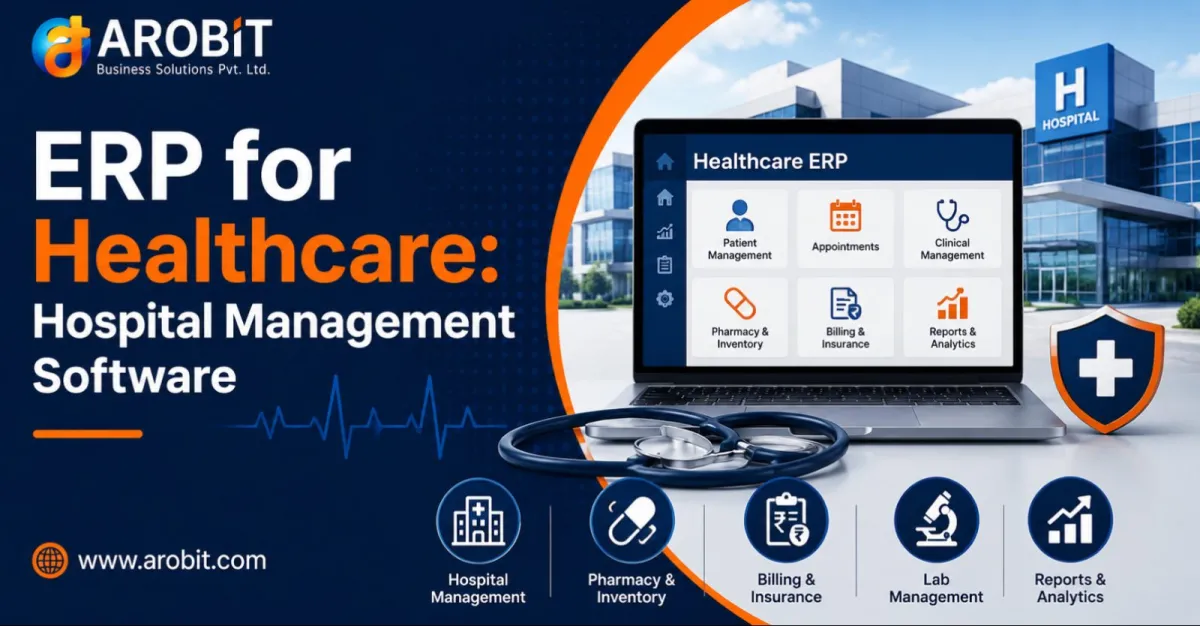
ERP for Healthcare exists to close those gaps. An ERP for Healthcare brings hospital management, billing, pharmacy, lab, and inventory into one connected system. A patient's entire journey is captured once and flows everywhere it is needed. This guide walks the areas where that integration matters most.
Why Hospitals Outgrow Disconnected Systems
Healthcare is one of the most operationally complex businesses there is. A hospital runs clinical care, a pharmacy, a diagnostic lab, a supply chain, and a billing operation at once, each with its own rules.
The demand for systems that unify all of this is growing steadily:
The global healthcare ERP market was valued at around US$ 8.4 billion in 2025 and is projected to reach roughly US$ 15.1 billion by 2033. — Grand View Research
The reason is simple. Good custom ERP software closes the gaps between departments, which is exactly where money and safety leak away when tools are separate. Healthcare ERP software makes every department part of one record. A medicine dispensed but not billed. A test done but not charged. A claim filed with a coding error that gets denied. Healthcare ERP software removes those gaps by making every department part of one record.
The value of ERP for Healthcare shows up across every department it connects.
Patient Flow: OPD and IPD in One Record
In an ERP for Healthcare, everything starts with the patient. Their journey splits into two paths: outpatient and inpatient.
A capable ERP for Healthcare handles both in a single record:
- OPD (outpatient). Registration, appointments, consultation notes, and prescriptions are captured and linked, so a returning patient's history is instantly available.
- IPD (inpatient). Admission, bed allocation, ward transfers, treatment charts, and discharge are tracked continuously through the stay.
- One patient identity. Whether a person visits the OPD or is admitted, they are the same record, so their history follows them rather than fragmenting.
The value is continuity. A doctor sees the full picture, a nurse sees current orders, and administration sees the real occupancy, all from the same underlying data.
Pharmacy and Inventory, Connected to Care
The pharmacy is where ERP for Healthcare proves its worth daily. A hospital pharmacy is not a shop. It is a clinical function tied directly to patient treatment, and it carries dated, sensitive stock.
A Hospital Management ERP connects the pharmacy to everything around it:
- Prescription to dispensing. A doctor's order flows to the pharmacy, and what is dispensed links back to the patient and their bill automatically.
- Batch and expiry tracking. Every medicine is tracked by batch and expiry, with first-expiry-first-out logic to cut waste from expired stock.
- Automatic reordering. Stock levels trigger reorder alerts, so critical medicines do not run out unnoticed.
A Hospital Management ERP makes this automatic. Because the pharmacy is connected to billing, a dispensed medicine is charged accurately. Because it is connected to inventory, stock stays accurate in real time. This is where the "one system" idea pays off directly.
The Lab: From Order to Result to Bill
The lab is the next test of an ERP for Healthcare. Diagnostics follow the same principle. A test ordered on a screen should flow through the lab and back to the patient record without anyone retyping anything.
Integrated lab management ties the whole cycle together:
- Order to sample. A test ordered by a doctor generates a lab request and sample tracking automatically.
- Result to record. Results are entered once and appear directly in the patient's record, visible to the treating doctor.
- Charge capture. The test is billed as it is ordered, so no diagnostic service is performed without being charged.
The result is faster turnaround and no lost revenue from tests that were done but never billed, a common and avoidable leak.
Billing and Insurance Claims
Billing is where all of a hospital's activity finally converges, and where the most money is lost to errors. Every consultation, medicine, test, and bed-day has to reach the bill accurately.
An ERP for Healthcare builds the bill from the activity itself:
- Automatic charge capture. Services flow to the bill as they happen, so nothing billable is missed.
- Consolidated billing. OPD, IPD, pharmacy, and lab charges combine into one clear patient bill.
- Insurance and claims. Coverage details, pre-authorisation, and claim generation are handled from the same record, with the coding and documentation a clean claim needs.
This directly attacks the denial problem. A claim built from complete, accurate, connected data is far less likely to be rejected for a missing detail or a coding error. That protects a revenue stream hospitals routinely lose to denials.
Data Security and Compliance
An ERP for Healthcare also has to protect what it holds. Healthcare data is among the most sensitive there is, and handling it carries obligations no other industry matches.
A serious ERP for Healthcare treats this as foundational, not optional:
- Role-based access. Staff see only the data their role requires, protecting patient privacy.
- Audit trails. Every access and change is logged, so the system can answer who did what and when.
- Encryption and controls. Patient data is protected in line with the privacy standards a healthcare provider must meet.
Strict data-protection rules govern the sector, from HIPAA in the United States to GDPR in Europe and equivalent regimes elsewhere. Against that backdrop, this reliability is not a feature. It is a condition of operating.
A Note on Arobit's Healthcare Work
This is not theoretical for Arobit. Arobit provides end-to-end medical IT solutions and custom healthcare software development for providers worldwide, building real-time ERP, CRM, and mobile systems for the sector.
Its documented work includes a Clinic Management System for a clinic in Melbourne that automated processes, improved patient care, and strengthened financial management. It also includes a custom billing system built for a pharmacy in the United States. That kind of result comes from software shaped around how a specific provider works. That is what experienced healthcare software development delivers, and what a generic package cannot.
What to Check Before You Start
A few specifics separate a system that fits a healthcare provider from one that fights it:
- One patient record. OPD, IPD, pharmacy, lab, and billing must all tie to a single patient identity.
- Connected pharmacy and lab. Dispensing and test results should flow to both the patient record and the bill automatically.
- Complete charge capture. Every service should reach the bill without manual entry, to stop revenue leakage.
- Security by design. Role-based access, audit trails, and encryption must be built in, not added later.
How to Get Started
Roll out an ERP for Healthcare in stages rather than all at once:
- Start with patient registration and billing, because they touch every department and show returns fast.
- Connect pharmacy and lab next, to close the biggest revenue-leak and stock gaps.
- Then extend into insurance claims, analytics, and deeper clinical workflows.
A provider that gets one patient record and complete charge capture in place has already removed its largest sources of lost revenue and administrative waste. This is where well-built custom ERP software earns its return.
What to Do Next
Measure one thing first. How much of your billable activity, across pharmacy, lab, and services, actually reaches the patient's bill, and how many claims do you lose to errors? Those numbers reveal the cost of running on disconnected systems.
Then unify the departments that leak the most, usually pharmacy, lab, and billing, and build from there. An ERP for Healthcare pays back fastest when aimed at the biggest leak first. In healthcare, where a single patient's care spans many departments, connected real-time data is not overhead. It protects both revenue and the quality of care.
Speak with our team to scope an ERP that unifies your patient records, billing, and inventory. Get in touch with Arobit










Comments
No comments yet. Be the first to share your thoughts!