





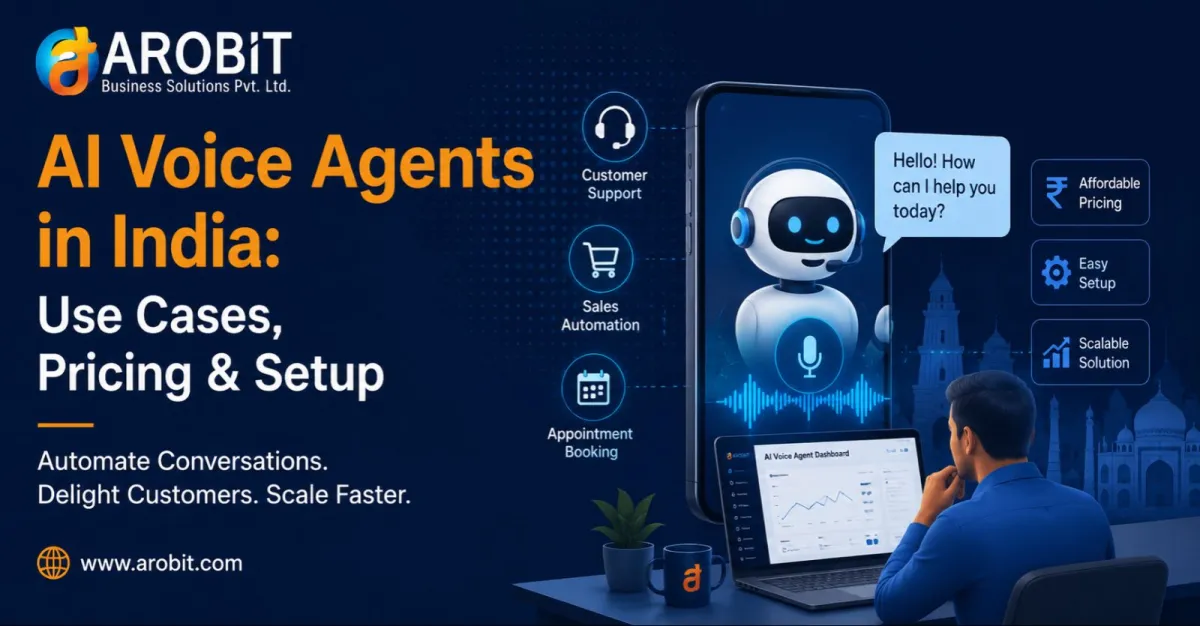
The old phone menu is dying. "Press 1 for Hindi, press 2 for English" is fading out. In its place is a system you can simply talk to, in your own language, at any hour.
That system is an AI voice agent: software that answers or makes phone calls, understands what the caller says, and responds in a natural voice. AI Voice Agents in India are moving from novelty to everyday tool. For Indian businesses drowning in repetitive calls, the appeal is obvious. But the technology only recently became good enough for Indian conditions, and the pricing is easy to misjudge.
This guide covers what AI Voice Agents in India are used for, what they cost in rupees, and how to set one up. That includes the platforms and the language question that decides whether they work at all.
Why AI Voice Agents in India Are Only Now Practical
AI voice technology has existed for years. It failed in India for one reason: language.
A speech model with a 5% error rate on American English could hit 25% or higher on Hindi, Tamil, or Marathi. Noisy mobile lines made it worse. Add Hinglish, the constant code-switching between Hindi and English in a single sentence, and Western-built systems simply broke down.
That barrier has fallen. A newer generation of speech engines is trained specifically on Indian accents, regional languages, and code-switched speech. An AI voice agent can now hold a natural conversation in Hindi, Tamil, Telugu, Bengali, or Marathi. It switches between Hindi and English mid-sentence the way real callers do. This is the single change that made AI Voice Agents in India viable for everyday business use.
What Indian Businesses Use AI Voice Agents in India For
The use cases cluster around high-volume, repetitive calling, exactly the work that burns out human agents.
Appointment booking and reminders. Clinics and salons confirm bookings and send reminder calls automatically. This cuts no-shows without tying up front-desk staff.
Lead qualification. An AI calling agent rings inbound leads within seconds, asks a few qualifying questions, and passes hot ones to sales. Speed of response is the difference between a converted lead and a lost one.
Customer support. An AI voice assistant for business answers routine queries instantly, in the caller's language. Order status, balance checks, and delivery updates run day or night.
Collections and follow-ups. Polite, consistent reminder calls for payments go out at scale, without the awkwardness or cost of a human chasing every account.
Surveys and feedback. Post-service feedback calls run automatically, capturing responses that would otherwise never be collected.
Across all of these, the pattern is the same. AI Voice Agents in India handle volume and speed. A human steps in for the calls that need judgment.
Pricing for AI Voice Agents in India: What You Actually Pay
Pricing for AI Voice Agents in India confuses people, because the advertised rate is never the full rate. Understanding the structure protects you from a surprise bill.
Every AI voice call chains four services together. These are telephony (the phone line), speech-to-text (understanding the caller), the language model (deciding the reply), and text-to-speech (the voice). Each bills separately unless a platform bundles them.
Global platforms. Vapi advertises a base orchestration fee of about $0.05 per minute, roughly ₹4 per minute. Retell starts around $0.07 per minute. But those are only the platform layer. Once you add the model, voice, and telephony, the real all-in cost is higher. It lands closer to $0.15 to $0.33 per minute, roughly ₹13 to ₹28 per minute for a standard setup.
India-native platforms. Several India-focused providers bundle everything and price directly in rupees, often starting around ₹6 to ₹8 per minute, with regional-language support built in. For rupee-conscious businesses, these can be simpler to budget than assembling a global stack.
Treat every figure as a range, not a fixed price. Your language, call length, and model choice all move the number. Prices also change often, so confirm current rates before committing.
To put it in perspective: a human tele-caller handling similar volume costs far more per productive minute once salary, training, and idle time are included. The economics favour automation at scale, which is the whole point.
Vapi and Retell: The Developer Platforms
Two platforms come up constantly in any discussion of AI Voice Agents in India, and both are worth understanding.
Vapi is a programmable voice platform for developers. It coordinates the four services above but expects you to bring your own model, voice, and telephony providers. It is flexible and cheap at the orchestration layer, but it is a builder's tool, not a no-code product. You need technical ownership to run it well.
Retell works on a similar bring-your-own-keys model. It has a slightly higher base rate and a reputation for lower latency. It can run either an inbound assistant or an outbound AI calling agent. Like Vapi, it suits teams with development capacity.
Both are powerful, and both share a catch for Indian use. Their default speech and voice providers are tuned for English. To handle Hindi or regional languages well, you must pair them with India-optimised speech engines. This is exactly the kind of integration work where good AI Agents deployment separates a system that impresses from one that frustrates callers.
The Setup: How It Actually Comes Together
Building working AI Voice Agents in India is an integration job, not a single purchase. Four pieces have to fit.
The script and logic. Define what the agent should say, what it should ask, and when it should hand off to a human. This is the part that decides whether callers trust it.
The language stack. Choose speech-to-text and text-to-speech engines that handle your callers' languages and accents. For Indian deployments, this choice matters more than any other.
The telephony. Connect a phone number and call network so the agent can make and receive real calls.
The integrations. Link the agent to your CRM or booking system, so a booked appointment or a qualified lead lands in your records automatically.
Get these four right and the agent works. Get the language stack wrong and no amount of clever scripting saves it.
A Practical Example: The Diagnostic Lab's Reminder Calls
Consider a common scenario for a diagnostic lab chain running across a few cities.
Before automating, the lab's staff spent hours each day calling patients to confirm appointments and remind them about fasting requirements before tests. Many calls went unanswered on the first try. No-shows were high, and staff had little time left for walk-in patients.
The lab deployed an AI voice agent that called patients in Hindi and the local regional language a day before each appointment. It confirmed the slot, explained the preparation, and rescheduled anyone who could not make it. The conversation felt natural because the agent spoke the patient's language, not a stilted translation.
No-shows dropped, and front-desk staff got their day back. The lab did not replace its people. It removed a repetitive calling task that no one enjoyed and that a machine could do around the clock.
Where Businesses Get It Wrong
Three mistakes undermine AI Voice Agents in India projects.
Ignoring the language stack. Deploying a globally-tuned agent for Hindi or Tamil callers produces high error rates and frustrated customers. The Indian language layer is not optional.
Underestimating true cost. Budgeting on the advertised $0.05 rate and ignoring the four-service stack leads to a shock at the first invoice. Model the full per-minute cost before you commit.
No human handover. An agent with no escalation path traps callers with complex problems. The best deployments hand off cleanly to a person when the AI reaches its limit.
How to Get Started
Roll out AI Voice Agents in India in stages. Start with one high-volume, low-complexity calling task. Appointment reminders and lead-qualification calls are ideal first projects, because the script is simple and the return is easy to measure.
Prove the language quality first. Whether you are deploying an AI voice assistant for business support or an outbound calling agent, test on real calls first. Run a small batch in your callers' actual languages before scaling. If the speech recognition stumbles on regional accents, fix that before anything else.
For most Indian businesses, the fastest path is not building it alone. Assembling telephony, an India-tuned language stack, a model, and CRM integration is genuinely fiddly. A focused engagement with a partner who has deployed AI Agents before removes the trial and error, and gets a working system live faster.
What to Do Next
Pick the one calling task that eats the most staff time. Estimate the monthly minutes, run it against a realistic per-minute cost, and compare that to the hours it currently consumes.
Then test the language quality on real calls before you scale. In India, that single factor decides whether an AI voice agent delights your customers or drives them away.
Speak with our team to scope an AI voice agent for your workflows and languages. Get in touch with Arobit






Comments
No comments yet. Be the first to share your thoughts!