




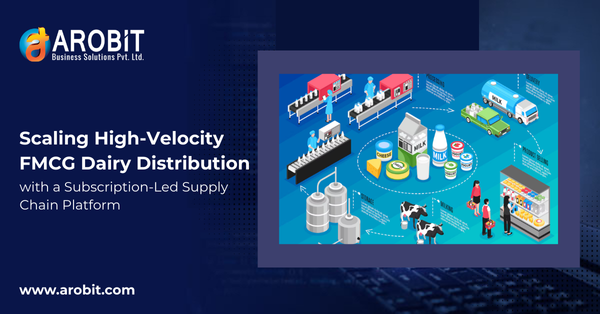
The client operates in the FMCG dairy and perishable goods segment, where products move at extremely high velocity, and operational margins depend on daily execution accuracy. Unlike traditional FMCG retail models, the business runs on subscription-based demand, early-morning last-mile delivery, and cold-chain-dependent inventory.
In such environments, there is zero tolerance for delays, stock mismatches, or spoilage. Even small inefficiencies in route planning, inventory allocation, or delivery confirmation can cascade into customer churn, revenue leakage, and brand erosion. Managing this complexity at scale requires a purpose-built FMCG distribution platform rather than generic logistics or retail systems.
Business Challenges in High-Frequency FMCG Operations
As the organization scaled across multiple cities, the challenges typical to enterprise FMCG distribution networks became more pronounced.
Demand Volatility & Subscription Complexity
Thousands of customers placed daily recurring orders with frequent pauses, resumptions, skips, and quantity changes. Subscription demand was often layered with ad hoc orders, making manual coordination unreliable. Without a structured subscription-based FMCG delivery mechanism, forecasting accuracy suffered and operational planning became inconsistent.
Inventory & Cold-Chain Control Issues
Dairy inventory required daily hub-level allocation rather than weekly planning. Spoilage, leakage, and short supply were difficult to track in real time, and there was no single source of truth for planned versus actual consumption. The absence of robust dairy supply chain software increased wastage and inventory reconciliation effort.
Last-Mile & Route Execution Constraints
Delivery agents operated within fixed early-morning windows, while route loads changed daily based on subscription updates. There was limited visibility into route completion and delivery exceptions. Missed deliveries directly impacted customer trust, highlighting the need for stronger last-mile delivery FMCG control and route optimization FMCG capabilities.
Financial Adjustments & Reconciliation Gaps
Missed or partial deliveries required instant refunds or credits. Manual wallet adjustments introduced accounting inconsistencies, and leadership lacked daily financial visibility. Inventory reconciliation FMCG processes remained reactive, slowing financial closure and decision-making.
Solution Overview—FMCG Distribution & Delivery Management Platform
A centralized, subscription-led FMCG ERP for distribution was implemented by Arobit to unify demand planning, cold-chain inventory control, distributor operations, last-mile execution, and financial reconciliation. Architected specifically for high-velocity perishable goods, the platform enforced strict daily cut-off windows for planning, dispatch, and fulfillment.
The system was designed using advanced FMCG software solutions and tailored FMCG software development to ensure scalability, reliability, and operational discipline across rapidly changing daily cycles.
Core FMCG Modules Implemented
Subscription & Demand Management
The platform supported daily, alternate-day, and custom subscription models with pause, resume, skip, and holiday logic. Ad-hoc orders were seamlessly overlaid on subscription demand, ensuring predictable aggregation each morning and reliable subscription-based FMCG delivery execution.
Inventory & Cold-Chain Management
A centralized cold chain management system enabled hub-wise inventory allocation per delivery cycle, near-expiry alerts, spoilage tracking, and variance monitoring. Stock reconciliation aligned closely with actual deliveries, strengthening control over perishable goods ERP workflows.
Distributor & Route Management
The distributor management system consolidated orders route-wise, enabled precise load planning, and supported dynamic route balancing based on demand density. Exception handling improved accountability and route optimization of FMCG performance.
Delivery Execution & Financial Reconciliation
Delivery agents operated through mobile workflows with confirmation and exception logging. Automated refunds, wallet-based credits, and daily reconciliation improved financial accuracy and reduced disputes, reinforcing inventory reconciliation FMCG discipline.
Distribution & Logistics Complexity Handled
From an operational standpoint, the platform managed:
- Thousands of active subscriptions processed every morning
- Daily route reconfiguration based on demand changes
- Synchronization between cold storage hubs and delivery teams
- Zero spillover tolerance due to early-morning delivery windows
The system orchestrated the entire flow from hub to route to doorstep without manual intervention.
Scale & Operational Impact
The platform successfully handled over 20,000 daily FMCG deliveries across multiple cities. Near real-time visibility into route execution became standard, stock variance was reduced to negligible levels, and the FMCG distribution platform continued to operate reliably under peak load conditions without service degradation.
Business Outcomes & Leadership Value
Leadership gained end-to-end visibility into demand versus fulfillment, loss and wastage, route performance, and daily operational health. Delivery-related customer complaints reduced significantly, route efficiency improved, and on-time delivery performance strengthened.
Most importantly, the organization scaled perishable FMCG operations without increasing operational overhead—while maintaining freshness, reliability, and customer trust.
Conclusion
This case study demonstrates how Arobit enables complex FMCG businesses to scale with execution certainty. By building purpose-driven platforms for high-frequency, perishable supply chains, Arobit helps organizations move beyond manual coordination toward predictable, data-driven operations. With deep domain understanding and reliable engineering, Arobit continues to deliver systems that support growth, resilience, and long-term operational excellence in FMCG distribution.











Comments
No comments yet. Be the first to share your thoughts!