





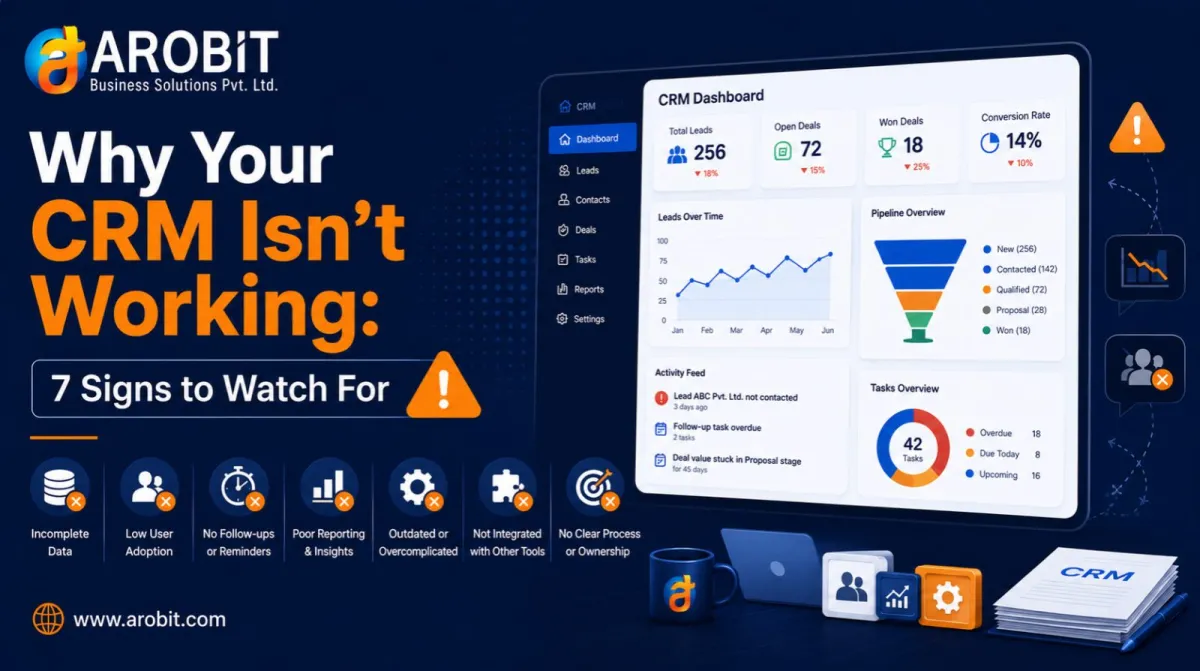
Nobody buys a CRM expecting it to sit unused. Yet that is where many end up.
The licence renews every year. The dashboard exists. But the sales team runs on WhatsApp and a shared spreadsheet, and the CRM holds a version of reality nobody quite trusts.
The instinct is to blame the software. Usually the software is fine. The problem is fit, which is why custom CRM software solutions keep coming up in these conversations. A packaged CRM encodes one company's assumptions about how selling works. When your process differs, the gap shows up as manual workarounds.
Here are seven signs that gap has grown too wide, and what custom CRM software solutions actually fix.
The Real Cost of a CRM Nobody Trusts
Bad CRM data does not stay inside the CRM. It flows into forecasts, territory plans, and renewal reminders. Gartner puts a number on it:
Poor data quality costs organizations at least $12.9 million a year on average. — Gartner, Data Quality: Best Practices for Accurate Insights (2020 research)
Most companies cannot even see the problem. Gartner's surveys found a measurement gap:
59% of organizations do not measure data quality. — Gartner, Data Quality: Best Practices for Accurate Insights
If you are not measuring it, the cost is still there. You just cannot point at it. The signs below are how that cost shows up day to day, and each one is a case for custom CRM software solutions.
7 Signs You Need Custom CRM Software Solutions
1. Your team keeps a shadow spreadsheet
Reps track their real pipeline somewhere else. The CRM gets updated on Friday afternoon, or before a review. This is the clearest signal of all. People do not maintain two systems unless the official one fails them.
2. Reports need cleaning before anyone believes them
Someone exports to Excel, fixes duplicates, corrects stage names, then circulates the "real" numbers. That cleanup work is a recurring tax. It also means decisions run on a file, not the system. Custom CRM software solutions remove the cleanup step by fixing the rules at source.
3. You pay for modules nobody opens
Audit your licence. If your plan includes marketing automation, field service, and forecasting that nobody has logged into for six months, you are funding someone else's product roadmap.
4. Your sales process does not fit the stages
Packaged CRMs ship with a generic funnel. If your business runs site visits, sample approvals, tender submissions, or multi-party sign-offs, those stages get forced into fields that were built for something else. Reporting degrades from there. Rebuilding those stages is one of the most common reasons companies move to a custom build.
5. Every integration needs a paid connector
Your accounting system, your WhatsApp line, and your website forms each need a middleware subscription to talk to the CRM. The connector costs add up. Worse, each one is a point of failure you do not control.
6. Onboarding a new rep takes weeks
A new joiner should not need a fortnight to learn which of fourteen fields actually matter. That interface is carrying complexity your business does not need. Custom CRM software solutions strip that back to the fields your process uses.
7. Nobody owns the data
Ask who is responsible for keeping customer records accurate. If the answer is "everyone" or a shrug, you have found the root cause. Records go stale. Duplicates multiply. Reps stop trusting what they see and revert to their own notes. No CRM survives this, custom or packaged.
A Practical Example: The Distributor Problem
Consider a common scenario for a regional distributor with sixty dealers and four sales territories.
The packaged CRM treats every dealer as a single account with one contact. In reality, each dealer has an owner, a purchase manager, and a counter salesperson. Each plays a different role in a deal. The CRM has no way to model that, so reps record everything in the notes field.
Six months later, nobody can answer a basic question. Which dealers have we not contacted this quarter? The data exists, but it sits in free text.
A custom CRM solution changes the data model, not the interface. Dealers become accounts with typed contact roles. Each role gets its own contact history and follow-up cycle. The unanswerable question becomes a two-click report. The work here was structural rather than cosmetic. This is the specific gap custom CRM software solutions are built to close, and it took weeks rather than months.
When Custom Is Not the Right Call
Custom CRM software solutions are not the default answer. Three situations argue against them.
Your process is genuinely standard. If you run a simple lead-to-invoice motion, a packaged tool will serve you well and cost less.
You have not fixed process first. Building custom software around a broken process produces expensive, well-designed chaos.
You cannot support it. A custom system needs someone accountable for changes. If no internal owner exists, and no external partner is retained, it will decay.
The honest test is whether your workarounds are structural or cosmetic. Cosmetic problems get configured away in an afternoon. Structural ones survive every configuration attempt, because the underlying data model cannot represent what your business does.
Frequently Asked Questions
How do I know if configuration is enough?
List your top five workarounds. If each can be solved by adding a field or changing a workflow rule, configure. If they require changing how records relate to each other, you are looking at custom CRM software solutions.
Is a custom CRM more expensive than a subscription?
Not always, and the comparison depends on headcount. Per-user licensing scales with your team. A custom build is largely a fixed cost plus support. Larger teams tend to cross over sooner.
How long does a custom CRM take to build?
A focused first version covering one sales process typically runs a few months. Scope discipline matters more than team size. Firms offering CRM software development services India-wide will usually recommend phasing rather than a single large release.
Can we migrate our existing data?
Usually yes, though it is rarely clean. Budget real time for de-duplication and field mapping. Migrating bad data into a new system reproduces the original problem.
What to Do Next
Pick your single most expensive workaround. Time how long your team spends on it each week. Multiply by fifty. That figure tells you whether custom CRM software solutions are worth a conversation. It may also show that better configuration will do.
Then decide who owns the data before you decide what to build. That sequence matters more than the technology choice.
Speak with our team to explore whether configuration or a custom build fits your process. Get in touch with Arobit



Comments
No comments yet. Be the first to share your thoughts!