





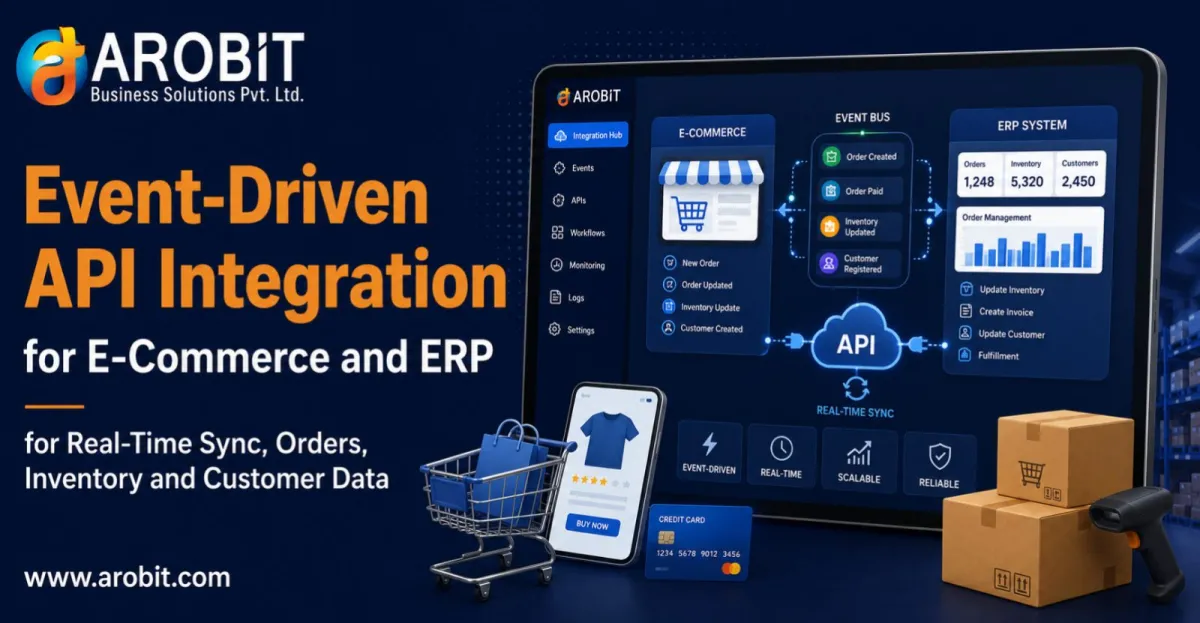
A customer completes an online purchase at 10:00:01 AM. The webstore confirms the payment and creates the order. However, the ERP checked for new orders at exactly 10:00:00 AM and will not check again for another minute.
For the next 59 seconds, the webstore knows the order exists, but the ERP does not.
That gap may appear small until order data triggers inventory allocation, warehouse picking, invoicing, or dispatch workflows. Multiply the same delay across thousands of orders, multiple sales channels, and peak shopping periods, and system synchronization becomes an operational concern.
The problem often lies in how the systems communicate.
Event-driven API integration replaces repeated scheduled checks with communication triggered by actual business events. When an order is created, a payment clears, or inventory changes, the relevant event can initiate data exchange between connected applications.
For e-commerce and ERP environments, this creates a more responsive integration model built around business activity rather than fixed polling schedules.
Why Polling Creates Delays in ERP E-Commerce Integration
Traditional API polling follows a pull-based model. The ERP, middleware, or background worker calls the e-commerce API at regular intervals to check whether data has changed.
A simplified request may look like this:
GET /api/orders?created_after=2026-07-10T10:00:00ZIf no new order exists, the response may be:
{
  "orders": []
}
One minute later, the integration sends another request.
Consider an online store processing 50 orders per day. An integration checking for new orders every minute can make 1,440 scheduled checks in 24 hours. Most of those requests may return no new order data.
Each request still requires the application to receive the call, validate it, check relevant records, prepare a response, and potentially create log entries.
Polling also creates an artificial synchronization window. In ERP e-commerce integration, an order created immediately after a polling cycle must wait for the next scheduled request.
Reducing the polling interval from 60 seconds to 10 seconds may lower the waiting time, but it also increases the number of API requests. The architecture forces technical teams to balance synchronization speed against repeated system activity.
How Event-Driven API Integration Changes the Communication Model
Event-driven API integration changes the relationship from pull-based checking to event-based notification.
Instead of the ERP repeatedly asking:
"Has a new order been created?"
The e-commerce application communicates:
"Order 9948 has just been created."
An event represents a meaningful action or state change within an application. Common commerce events include:
order.createdpayment.completedorder.cancelledinventory.updatedcustomer.registeredshipment.dispatched
When a customer completes checkout, the webstore can publish an order.created event.
A basic event payload may look like this:
{
  "event_id": "evt_78421",
  "event": "order.created",
  "timestamp": "2026-07-10T10:00:01Z",
  "data": {
    "order_id": 9948,
    "customer_id": 5021,
    "total_amount": 4000,
    "payment_status": "paid"
  }
}
The receiving integration identifies the event type and starts the relevant ERP workflow.
This is the central idea behind event-driven API integration: communication occurs because a business action happened, not because a timer instructed one system to check another.
From Online Checkout to Real-Time ERP Integration
Consider an apparel retailer that sells through an e-commerce website.
A customer orders two denim jackets. Once the payment is confirmed, several operational processes may need to begin:
- The ERP records the sales order.
- Available inventory is checked.
- Stock is allocated against the order.
- The warehouse receives a picking requirement.
- Invoice processing begins.
- Dispatch planning is updated.
With scheduled synchronization, these workflows cannot start until the ERP receives the order.
An event-based workflow can follow this sequence:
Customer Checkout → Order Created → Event Published → ERP Receives Event → Operational Workflow Starts
This supports real-time ERP integration by removing the fixed wait for the next polling cycle. Actual processing time still depends on network conditions, validation rules, queue backlogs, and ERP workload, but the communication process can begin when the source event occurs.
For businesses evaluating Custom erp software, this integration model should be considered during architecture planning. Order flow, inventory ownership, fulfilment rules, and connected applications all influence how events should move between systems.
Reducing Empty Requests and Repetitive System Activity
The impact of polling becomes more visible as the number of integrations grows.
An e-commerce business may connect its ERP with several systems:
- Online storefronts
- Marketplaces
- Warehouse applications
- Logistics platforms
- Payment services
- Customer management systems
If each integration repeatedly checks for updates, applications may process a large number of requests that do not correspond to new business activity.
With event-driven API integration, meaningful state changes initiate communication. An order event is published when an order is created. An inventory event is published when stock changes.
This does not mean an event-based architecture has zero infrastructure overhead. Message brokers, consumers, acknowledgements, monitoring, and retries all require resources.
The advantage is architectural relevance: processing is organised around actual events rather than repeated questions about whether an event has occurred.
Why Message Queues Matter During Order Spikes
Sending events directly from a webstore to an ERP endpoint can work at lower transaction volumes. However, direct communication introduces a different problem during sudden order spikes.
Imagine a flash sale generates 2,000 orders within a short period.
The e-commerce platform may accept those transactions successfully, but the ERP may not be designed to process 2,000 simultaneous order requests.
A message queue can act as a buffer between the systems.
The architecture may look like this:
E-Commerce Platform
        |
        | order.created
        v
   Message Queue
        |
        | Controlled Consumption
        v
ERP Integration Service
        |
        v
       ERP
When an order is created, the e-commerce application publishes the event to the queue and continues handling customer activity. An ERP integration consumer retrieves queued messages at a controlled processing rate.
RabbitMQ, Amazon SQS, and Redis Streams are examples of technologies that may support message-processing architectures, depending on the application's requirements.
This asynchronous pattern is an important part of event-driven API integration because it separates the speed of event production from the ERP's processing capacity.
If 2,000 events arrive quickly, the queue can hold pending messages while consumers process them according to available resources.
What Happens When the ERP Is Temporarily Unavailable?
System availability is another important consideration in ERP e-commerce integration.
Suppose the ERP is unavailable for 15 minutes during maintenance. In a tightly coupled architecture, the webstore may attempt to send an order directly to the ERP and receive an error.
The integration now needs a reliable method for handling the failed transaction.
A durable queue can retain pending events while the receiving consumer is unavailable. Once the ERP integration service resumes processing, it can continue retrieving messages.
However, simply adding a queue does not guarantee reliability.
A production integration should define:
- Retry limits
- Retry intervals or backoff rules
- Message acknowledgement behaviour
- Dead-letter queue handling
- Alerting for repeated failures
- Queue backlog monitoring
A reliable real-time ERP integration needs visibility into events that are delayed, rejected, or repeatedly failing. Otherwise, technical teams may only discover an integration problem when operations report missing orders.
Designing Idempotent ERP Endpoints
Retries create another architectural concern: duplicate events.
Suppose the e-commerce application publishes Order 9948. The ERP processes the order successfully, but the acknowledgement is lost because of a temporary network issue.
The integration retries the message.
The ERP now receives the same event twice.
Without duplicate protection, the second request could create another sales order, deduct inventory again, or generate a duplicate warehouse task.
This is why event-driven API integration should be designed for idempotency.
A simplified Node.js example may look like this:
app.post("/events/orders", async (req, res) => {
  const { event_id, data } = req.body;

  const processedEvent = await EventLog.findOne({
    event_id: event_id
  });

  if (processedEvent) {
    return res.status(200).json({
      message: "Event already processed"
    });
  }

  await createERPOrder(data);

  await EventLog.create({
    event_id: event_id
  });

  return res.status(200).json({
    message: "Order processed successfully"
  });
});
Before creating the ERP order, the endpoint checks whether the unique event_id has already been processed.
If the event exists in the processing log, the endpoint acknowledges the request without repeating the business action.
The example is simplified. In a production environment, transaction boundaries and concurrency controls also need careful design so that simultaneous duplicate requests cannot pass the initial check together.
An experienced ERP software development company should account for retries, duplicate events, transaction integrity, and failure recovery when planning enterprise integrations.
Thin Events vs Full-State Events
Another decision involves how much information an event should contain.
Thin Event
A thin event may only identify what happened and which business record changed.
{
  "event": "order.created",
  "order_id": 9948
}
The ERP integration service receives the event and calls the e-commerce API to retrieve the current order details.
Full-State Event
A full-state event carries more of the business data required for processing.
{
  "event": "order.created",
  "order_id": 9948,
  "customer_id": 5021,
  "items": [
    {
      "sku": "DENIM-JKT-01",
      "quantity": 2
    }
  ],
  "payment_status": "paid",
  "order_total": 4000
}
Neither design is automatically better.
Thin events reduce payload size and can allow the receiving system to retrieve current data. However, they create a dependency on the source API being available when the consumer processes the event.
Full-state events provide more information directly but require stronger schema management and careful handling of sensitive or unnecessary data.
Teams implementing event-driven API integration should evaluate event volume, payload size, data ownership, API availability, security requirements, and consistency expectations before selecting an approach.
Event Schema Versioning Cannot Be an Afterthought
Events often remain in an architecture longer than expected.
Suppose the original order.created payload contains:
{
  "order_id": 9948,
  "total": 4000
}
Six months later, the e-commerce team changes total to order_total.
A consumer still expecting total may fail.
Schema versioning gives producers and consumers a controlled method for handling event changes.
For example:
{
  "event": "order.created",
  "schema_version": "2.0",
  "order_id": 9948,
  "order_total": 4000
}
Technical teams should define how consumers respond to new fields, removed fields, and event versions they do not support.
This becomes especially important when one commerce event is consumed by the ERP, warehouse application, analytics platform, and notification service.
A Practical Checklist for Event-Driven ERP Integration
Adding webhooks or a queue does not automatically create a reliable event architecture.
Development and operations teams should define:
- Clear event names based on business actions
- Unique event IDs for duplicate detection
- Consistent timestamp formats
- Authentication and event-source verification
- Retry and backoff policies
- Dead-letter handling for failed events
- Event schema and versioning rules
- Processing logs for operational audits
- Queue backlog and consumer monitoring
- Data protection rules for event payloads
These considerations are particularly relevant when building Custom erp software around specific warehouse, inventory, production, or order management processes.
The integration model should follow the actual business workflow. A manufacturer managing production allocation may need different events from a retailer focused on multi-channel inventory synchronization.
When Does Event-Driven API Integration Make Business Sense?
Not every application needs an event-driven architecture.
A low-volume internal system that synchronizes non-critical data once per day may work adequately with scheduled API calls. Introducing message brokers, event consumers, monitoring, and dead-letter processing creates additional technical responsibilities.
Event-driven API integration is worth evaluating when:
- Online orders need to reach ERP workflows quickly.
- Inventory changes frequently across sales channels.
- Polling generates a high number of empty API requests.
- Order volumes increase sharply during sales or seasonal periods.
- Multiple systems respond to the same business action.
- ERP maintenance should not interrupt customer checkout.
- Synchronization delays affect warehouse or fulfilment operations.
The decision should start with the operational problem rather than an architecture trend.
A capable erp software development company should first examine transaction volumes, current synchronization delays, failure patterns, system dependencies, and processing requirements before recommending an event-based approach.
Conclusion: Build ERP Integration Around Business Events
Delayed orders, inventory mismatches, and ERP processing bottlenecks can originate in the communication layer connecting business systems.
Polling asks one application to repeatedly search for changes. Event-driven API integration allows a meaningful business action to initiate the communication process.
For e-commerce operations, an order creation event can start ERP processing without waiting for the next scheduled synchronization cycle. Message queues can buffer sudden transaction volumes, idempotent endpoints can protect against duplicate processing, and schema versioning can help connected systems handle event changes more predictably.
The objective is not to replace every scheduled API request with an event. It is to identify where order, inventory, payment, and fulfilment workflows benefit from faster and more controlled data exchange.
Arobit Business Solutions develops ERP and enterprise software around specific operational processes and integration requirements. If e-commerce orders, inventory records, or connected business systems are becoming difficult to synchronize, reviewing the current integration architecture can help identify where event-based communication is technically and operationally appropriate.
Frequently Asked Questions
1. What is event-driven API integration?
Event-driven API integration is an integration approach where applications communicate when a defined business event occurs. For example, an e-commerce platform can publish an order.created event after checkout instead of waiting for the ERP to request new order data.
2. How does event-driven integration differ from API polling?
API polling checks another system for updates at scheduled intervals. Event-driven communication begins when a specific action or state change occurs. This removes the fixed waiting period created by polling intervals and reduces repeated checks that return no new data.
3. Can event-driven APIs help synchronize e-commerce inventory with an ERP?
Yes. Events such as inventory.updated can inform connected systems when stock changes. The integration still needs clear inventory ownership, conflict-handling, and processing rules to prevent inconsistent stock records across channels.
4. Why are message queues used between e-commerce and ERP systems?
Message queues buffer events between applications. If order volumes suddenly increase or the ERP processes transactions more slowly than the webstore creates them, the queue can hold pending messages for controlled consumption and retry processing.
5. Is event-driven architecture suitable for every ERP project?
No. Scheduled synchronization may remain appropriate for low-volume or non-time-sensitive workflows. Event-based architecture is more relevant when synchronization speed, variable transaction volumes, multiple event consumers, or system availability directly affect business operations.



Comments
No comments yet. Be the first to share your thoughts!