




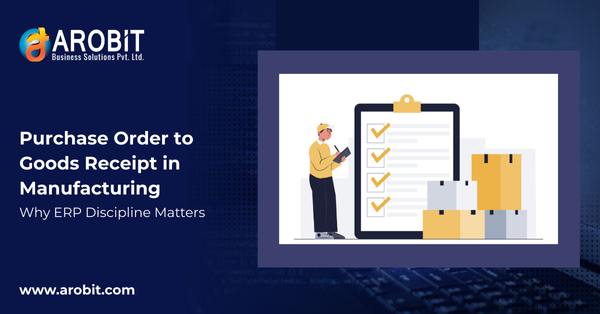
You're sitting with your accounts manager trying to reconcile purchase bills. Five suppliers. Ten invoices. Half of them have rate differences. Two have quantity mismatches. One bill has no matching GRN at all. This isn't fraud. This is what happens when purchase orders and goods receipts don't talk to each other.
This happens in factories every day. A verbal order. A missing PO. A GRN was logged without checking the original terms. And by the time accounts catches the mismatch, the material is already consumed in production.
How PO and GRN Work in Reality (Not on Paper)
In most manufacturing units, purchase orders exist, but they don't control anything. The process looks something like this:
The owner or purchase head calls a supplier. They agree on material, quantity, and rate. Someone writes it down—maybe in a register, maybe in Excel, sometimes just in a notebook. The supplier delivers. Stores accept the material, weigh it, and log an entry in the GRN register. Later, the bill comes, and accounts punches the entry.
Here's where it breaks:
- Verbal orders: Many factories still place orders over the phone. If the supplier delivers a week late or at a different rate, there's no written proof of what was agreed.
- Rate mismatches: The PO says ₹50 per kg. The bill says ₹58 per kg. Accounts discovers this only when entering the voucher. By then, the material is in production, and the supplier says, "This is the correct rate; you must have noted it wrong."
- Quantity disputes: The PO was for 1,000 kg. The truck delivered 850 kg. But no one checked it against the PO at the gate. The GRN just says "received 850 kg" with no mention that 150 kg is short. When production runs out of material mid-batch, everyone scrambles.
Without proper purchase order management and manufacturing discipline, you're not controlling procurement. You're reacting to problems after they've already cost you money.
ERP-Driven PO Lifecycle
A well-implemented ERP doesn't just record purchase orders. It enforces the process so nothing moves forward without the right checks. This is where manufacturing IT services become critical—not to complicate things, but to make sure every step follows the same rule every time.
Approved Purchase Orders
It starts with creating a proper PO in the system. The ERP captures:
- Supplier name and payment terms
- Material description and specifications
- Agreed rate per unit
- Total quantity ordered
- Expected delivery date
- Any advance payment or credit terms
Once the PO is created, it gets approved by the authorized person—owner, plant head, or purchase manager. The system logs who approved it and when. No verbal orders. No ambiguity.
The PO number is shared with the supplier. When the material arrives, the gate has a reference. Stores have a reference. Accounts has a reference. Everyone is looking at the same document.
GRN Validation Against PO
When the material reaches the factory, the stores team logs a Goods Receipt Note (GRN) in the ERP. But here's the key difference: the system won't let them create a random GRN. It forces them to link it to an open PO.
The ERP validates three things:
1. Quantity: Did the supplier deliver what was ordered? If the PO says 1,000 kg and only 850 kg arrived, the system flags the shortage. You can still accept it, but the shortage is recorded. Later, when you follow up with the supplier, you have proof.
2. Rate: Is the rate on the bill the same as the rate on the PO? If the PO says ₹50 per kg and the supplier's bill says ₹58, the system won't let accounts pass the bill without approval. No surprise costs during month-end.
3. Quality: Did the material pass inspection? Many ERPs allow quality checks to be logged before the GRN is finalized. If the lab rejects a batch due to moisture content or contamination, that lot doesn't enter inventory. You can't accidentally issue rejected material to production.
This is what GRN in ERP actually does. It's not just data entry. It's a validation layer that stops errors before they reach production or accounts.
Impact on Inventory, Production, and Accounts
When PO and GRN follow ERP discipline, three critical areas stay clean.
Accurate Stock
Inventory updates only after a valid GRN. There's no gap between physical stock and system stock. Production knows exactly what's available. The warehouse knows what batches are cleared for use. No one wastes time searching for material that "should be there" but isn't.
Clean Ledgers
Accounts get bills that are already matched to GRNs. Every entry has a reference—PO number, GRN number, supplier name, rate, and quantity. No duplicate bills. No ghost entries. No surprise expenses that no one can explain during audits.
When month-end comes, there's no reconciliation drama. The purchase register matches the GRN register. The GRN register matches inventory. Inventory matches what accounts have recorded. Everything ties back.
Better Supplier Management
When every PO and GRN is logged, you can track supplier performance. Who delivers on time? Who sends short quantities? Who keeps changing rates? This data helps you decide which suppliers to keep and which ones to replace.
Procurement automation manufacturing isn't about removing the purchase team. It's about giving them the tools to control the process instead of chasing issues after they happen.
What Factory Owners Should Ask Themselves
If your factory is still running on phone calls and manual registers, ask:
- How many times this year did a rate mismatch surprise me during closing?
- How many hours does my team spend reconciling POs, GRNs, and bills?
- Do I have a clear record of what was ordered versus what was delivered?
IT solutions for manufacturing solve this by enforcing discipline at every step—from PO creation to GRN validation to inventory update. It's not complicated. It's just structured.
A manufacturing ERP doesn't stop mistakes from happening. But it makes sure every mistake is visible immediately, not three weeks later when the damage is done.
This is where the goods receipt process stops being a formality and becomes a control point.
Arobit helps manufacturing units implement ERP systems that bring structure to procurement, inventory, and accounts—so mismatches are caught early, not after production losses.
Frequently Asked Questions
What is a Purchase Order (PO) in manufacturing?
A purchase order is a formal document sent to a supplier that specifies the material, quantity, rate, delivery date, and payment terms. It serves as a legal agreement and a reference for receiving material and processing payments.
What is GRN, and why is it important?
GRN stands for Goods Receipt Note. It's a document created when material is physically received at the factory. A proper GRN records what was delivered, matches it against the PO, and updates inventory. Without GRN discipline, inventory records become unreliable.
How does ERP prevent rate mismatches in procurement?
ERP stores the agreed rate in the PO. When the supplier's bill arrives, accounts can compare it against the PO rate in the system. If there's a mismatch, the ERP flags it before the payment is processed, preventing surprise costs.
Can a GRN be created without a PO in ERP?
Some ERPs allow it, but the best practice is to always link GRN to a PO. This ensures that only approved purchases enter the system and prevents unauthorized or duplicate material receipts.
What happens if the quantity received is less than the PO quantity?
The ERP allows partial GRN. It records the shortage and keeps the PO open for the remaining quantity. This gives visibility into pending deliveries and helps follow up with suppliers for the balance material.
How does GRN validation help production planning?
Production planning depends on knowing exactly what material is available. When GRN is validated and linked to quality checks, production gets accurate stock data. They don't plan for material that's rejected or not yet received.









Comments
No comments yet. Be the first to share your thoughts!